Ludwig Feuerbach in the context of "Marxist atheism"

Play Trivia Questions online!

or

Skip to study material about Ludwig Feuerbach in the context of "Marxist atheism"


⭐ Core Definition: Ludwig Feuerbach

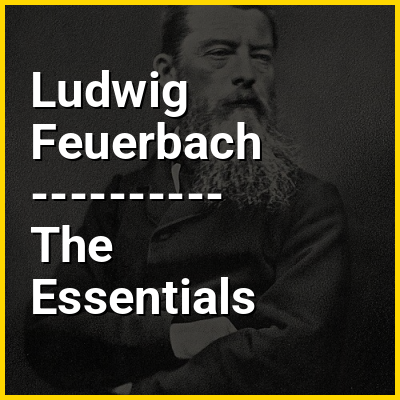
Ludwig Andreas Feuerbach (/ˈfɔɪərbɑːx/ FOIR-bahkh; German: [ˈluːtvɪç ˈfɔʏɐbax]; 28 July 1804 – 13 September 1872) was a German philosopher and anthropologist who was a leading figure among the Young Hegelians. He is best known for his 1841 book, The Essence of Christianity, which argued that God is a projection of the essential attributes of humanity. His critique of religion formed the basis for his advocacy of atheism, materialism, and sensualism. In his later work, Feuerbach developed a more complex theory of religion arising from the human confrontation with nature. His thought served as a critical bridge between the philosophy of Georg Wilhelm Friedrich Hegel and that of Karl Marx.

The son of a distinguished jurist, Feuerbach studied theology at Heidelberg before moving to Berlin to study directly under Hegel. His academic career was cut short in 1830 when his anonymously published first book, Thoughts on Death and Immortality, was condemned as scandalous for its attack on the concept of personal immortality. Barred from university posts, Feuerbach lived and worked in rural isolation for much of his life, in which he produced most of his significant writings supported by his wife's share in a porcelain factory.
↓ Menu

👉 Ludwig Feuerbach in the context of Marxist atheism

Marxist–Leninist atheism, also known as Marxist–Leninist scientific atheism, is the antireligious element of Marxism–Leninism. Based on a dialectical-materialist understanding of humanity's place in nature, Marxist–Leninist atheism proposes that religion is the opium of the people; thus, Marxism–Leninism advocates atheism, rather than religious belief.

To support those ideological premises, Marxist–Leninist atheism proposes an explanation for the origin of religion and explains methods for the scientific criticism of religion. The philosophic roots of Marxist–Leninist atheism appear in the works of Georg Wilhelm Friedrich Hegel (1770–1831), of Ludwig Feuerbach (1804–1872), of Karl Marx (1818–1883) and of Vladimir Lenin (1870–1924).

↓ Explore More Topics
In this Dossier

Ludwig Feuerbach in the context of The German Ideology

The German Ideology (German: Die deutsche Ideologie), also known as A Critique of the German Ideology, is a set of manuscripts written by Karl Marx and Friedrich Engels around April or early May 1846. Marx and Engels did not find a publisher, but the work was retrieved and first published in 1932 by the Soviet Union's Marx–Engels–Lenin Institute. The book uses satirical polemics to critique modern German philosophy, particularly that of young Hegelians such as Marx's former mentor Bruno Bauer, Ludwig Feuerbach, and Max Stirner's The Ego and Its Own. It criticizes "ideology" as a form of "historical idealism", as opposed to Marx's historical materialism (the "materialist conception of history"). The first part of Volume I also examines the division of labor and Marx's theory of human nature, on which he states that humans "distinguish themselves from animals as soon as they begin to produce their means of subsistence".

↑ Return to Menu

Ludwig Feuerbach in the context of Economic and Philosophic Manuscripts of 1844

The Economic and Philosophic Manuscripts of 1844 (German: Ökonomisch-philosophische Manuskripte aus dem Jahre 1844), also known as the Paris Manuscripts (Pariser Manuskripte) or as the 1844 Manuscripts, are a series of unfinished notes written between April and August 1844 by Karl Marx. They were compiled and published posthumously in 1932 by the Soviet Union's Marx–Engels–Lenin Institute. They were first published in their original German in Berlin, and there followed a republication in the Soviet Union in 1933, also in German.

The Manuscripts provide a critique of classical political economy grounded in the philosophies of Georg Wilhelm Friedrich Hegel and Ludwig Feuerbach. The work is best known for its articulation of Marx's argument that the conditions of modern industrial societies result in the estrangement (or alienation) of wage-workers from their own products, from their own work, and in turn from themselves and from each other. Marx argues that workers are forced by the capitalist productive process to work solely to satisfy their basic needs. As such, they merely exist as commodities in a constant state of drudgery, evaluated solely by their monetary value, with capital assuming the status of a good in and of itself.

↑ Return to Menu

Ludwig Feuerbach in the context of Marx's theory of human nature

In his works, Karl Marx does not refer to "human nature" as such, but to Gattungswesen, which is generally translated as "species-being" or "species-essence". According to a note from Marx in the Manuscripts of 1844, the term is derived from Ludwig Feuerbach's philosophy, in which it refers both to the nature of each human and of humanity as a whole.

In the sixth Thesis on Feuerbach (1845), Marx criticizes the traditional conception of human nature as a species which incarnates itself in each individual, instead arguing that human nature is formed by the totality of social relations. Marx describes Gattungswesen as neither permanent nor universal, as in classical idealist philosophy, but always determined in a specific social and historical formation, with some aspects being biological.

↑ Return to Menu

Ludwig Feuerbach in the context of The Essence of Christianity

The Essence of Christianity (German: Das Wesen des Christentums; historical orthography: Das Weſen des Chriſtenthums) is a book by Ludwig Feuerbach first published in 1841. It explains Feuerbach's philosophy and critique of religion.

↑ Return to Menu

Ludwig Feuerbach in the context of Karl Grün

Karl Theodor Ferdinand Grün (German: [kaʁl ˈɡʁyːn]; 30 September 1817 – 18 February 1887), also known by his alias Ernst von der Haide, was a German journalist, philosopher, political theorist and socialist politician. He played a prominent role in radical political movements leading up to the Revolution of 1848 and participated in the revolution. He was an associate of Heinrich Heine, Ludwig Feuerbach, Pierre-Joseph Proudhon, Karl Marx, Mikhail Bakunin and other radical political figures of the era.

Although less widely known today, Grün was an important figure in the German Vormärz, Young Hegelian philosophy and the democratic and socialist movements in nineteenth-century Germany. As a target of Marx's criticism, Grün played a role in the development of early Marxism. Through his philosophical influence on Proudhon, he had a certain influence on the development of French socialist theory.

↑ Return to Menu