In physics, the Lorentz transformations are a six-parameter family of linear transformations from a coordinate frame in spacetime to another frame that moves at a constant velocity relative to the former. The respective inverse transformation is then parameterized by the negative of this velocity. The transformations are named after the Dutch physicist Hendrik Lorentz.
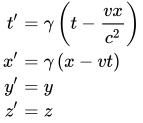
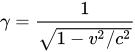
The most common form of the transformation, parametrized by the real constant representing a velocity confined to the x-direction, is expressed aswhere (t, x, y, z) and (t′, x′, y′, z′) are the coordinates of an event in two frames with the spatial origins coinciding at t = t′ = 0, where the primed frame is seen from the unprimed frame as moving with speed v along the x-axis, where c is the speed of light, and is the Lorentz factor. When speed v is much smaller than c, the Lorentz factor is negligibly different from 1, but as v approaches c, grows without bound. The value of v must be smaller than c for the transformation to make sense.