Lombard Kingdom in the context of Langobardia Minor


Lombard Kingdom in the context of Langobardia Minor

⭐ Core Definition: Lombard Kingdom

The Kingdom of the Lombards, also known as the Lombard Kingdom and later as the Kingdom of all Italy (Latin: Regnum totius Italiae), was an early medieval state established by the Lombards, a Germanic people, on the Italian Peninsula in the latter part of the 6th century. The king was traditionally elected by the very highest-ranking aristocrats, the dukes, as several attempts to establish a hereditary dynasty failed. The kingdom was subdivided into a varying number of duchies, ruled by semi-autonomous dukes, which were in turn subdivided into gastaldates at the municipal level. The capital of the kingdom and the center of its political life was Pavia in the modern northern Italian region of Lombardy.

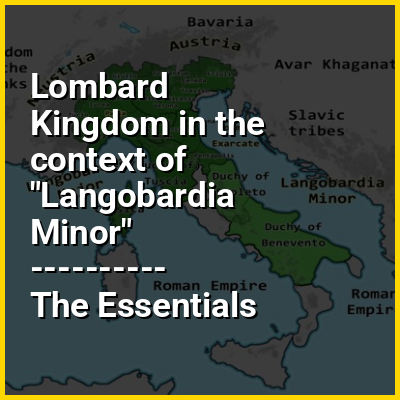
The Lombard invasion of Italy was opposed by the Byzantine Empire, which had control of the peninsula at the time of the invasion. For most of the kingdom's history, the Byzantine-ruled Exarchate of Ravenna and Duchy of Rome separated the northern Lombard duchies, collectively known as Langobardia Maior, from the two large southern duchies of Spoleto and Benevento, which constituted Langobardia Minor. Because of this division, the southern duchies were considerably more autonomous than the smaller northern duchies.
↓ Menu
HINT:

In this Dossier

Lombard Kingdom in the context of Neustria (Lombard)

Neustria was, according to the early medieval geographical classification, the western portion of Langobardia Major, the north-central part of the Lombard Kingdom, extended from the Adda (river) to the Western Alps and opposite to Austria. The partition had not only been territorial, but also implied significant cultural and political differences.

View the full Wikipedia page for Neustria (Lombard)
↑ Return to Menu

Lombard Kingdom in the context of Austria (Lombard)

Austria was, according to the early medieval geographical classification, the eastern portion of Langobardia Major, the north-central part of the Lombard Kingdom, extended from the Adda to Friuli and opposite to Neustria. The partition had not only been territorial, but also implied significant cultural and political differences.

View the full Wikipedia page for Austria (Lombard)
↑ Return to Menu

Lombard Kingdom in the context of Pepin of Italy

Pepin or Pippin (born Carloman), (777 – 8 July 810) was King of Italy from 781 until his death in 810. He was the third son of Charlemagne (and his second with Queen Hildegard). Upon his baptism in 781, Carloman was renamed Pepin, where he was also crowned as king of the Lombard Kingdom his father had conquered. Pepin ruled the kingdom from a young age under Charlemagne, but predeceased his father. His son Bernard was named king of Italy after him, and his descendants were the longest-surviving direct male line of the Carolingian dynasty.

View the full Wikipedia page for Pepin of Italy
↑ Return to Menu

Lombard Kingdom in the context of Longobards in Italy. Places of the power (568-774 A.D.)

Longobards in Italy: Places of Power (568–774 A.D.) (Italian: Longobardi in Italia: i luoghi del potere) is seven groups of historic buildings that reflect the achievements of the Germanic tribe of the Lombards (also referred to as Longobards), who settled in Italy during the sixth century and established a Lombard Kingdom which ended in 774 A.D.

The groups comprise monasteries, church buildings, and fortresses and became UNESCO World Heritage Sites in June 2011 as they testify "to the Lombards' major role in the spiritual and cultural development of Medieval European Christianity".

View the full Wikipedia page for Longobards in Italy. Places of the power (568-774 A.D.)
↑ Return to Menu

Lombard Kingdom in the context of 700s (decade)

The 700s decade ran from January 1, 700, to December 31, 709.

  • The Wariʼ people invade and occupy the Cuzco Valley (modern Peru) in the southern highlands (approximate date).
  • The Moche culture in the northern part of modern day Peru collapses, largely due to environmental problems and/or political and social unrest (approximate date).
  • July 18 – Emperor Monmu dies after a 10-year reign. He is succeeded by his aunt Genmei, who becomes the 43rd empress of Japan. She is the sister of former empress Jitō, and the niece and wife of late emperor Tenmu.
View the full Wikipedia page for 700s (decade)
↑ Return to Menu