Local administration in the context of "List of municipalities in Almería"

Play Trivia Questions online!

or

Skip to study material about Local administration in the context of "List of municipalities in Almería"

Ad spacer

>>>PUT SHARE BUTTONS HERE<<<

👉 Local administration in the context of List of municipalities in Almería

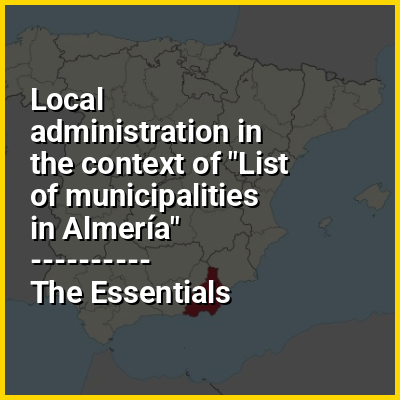
Almería is a province in the autonomous community of Andalusia, Spain. The province is divided into 103 municipalities. As of the 2024 Spanish census, Almería is the 21st most populous of Spain's 50 provinces, with 760,964 inhabitants, and the 27th largest by land area, spanning 8,773.05 square kilometres (3,387.29 sq mi). Municipalities are the most basic local political division in Spain and can only belong to one province. They enjoy a large degree of autonomy in their local administration, being in charge of tasks such as urban planning, water supply, lighting, roads, local police, and firefighting.

The organisation of municipalities in Spain is outlined by the local government law Ley 7/1985, de 2 de abril, Reguladora de las Bases del Régimen Local (transl. Law 7/1985, of 2 April, Regulating the Bases of the Local Administration), which was passed by the Cortes Generales—Spain's national parliament—on 2 April 1985 and finalised by royal decree on 18 April 1986. Municipalities in Almería are also governed by the Statute of Autonomy of Andalusia, which includes provisions concerning their relations with Andalusia's autonomous government. All citizens of Spain are required to register in the municipality in which they reside. Each municipality is a corporation with independent legal personhood: its governing body is called the ayuntamiento (municipal council or corporation), a term often also used to refer to the municipal offices (city and town halls). The ayuntamiento is composed of the mayor (Spanish: alcalde), the deputy mayors (tenientes de alcalde) and the councillors (concejales), who form the plenary (pleno), the deliberative body. Municipalities are categorised by population for determining the number of councillors: three when the population is up to 100 inhabitants, five for 101–250, seven for 251–1,000, nine for 1,001–2,000, eleven for 2,001–5,000, thirteen for 5,001–10,000, seventeen for 10,001–20,000, twenty-one for 20,001–50,000, and twenty-five for 50,001–100,000. One councillor is added for every additional 100,000 inhabitants, with a further one included if the total would otherwise be even, to avoid tied votes.

↓ Explore More Topics
In this Dossier

Local administration in the context of List of municipalities in Granada

Granada is a province in the autonomous community of Andalusia, Spain. The province is divided into 174 municipalities. As of the 2024 Spanish census, Granada is the 17th most populous of Spain's 50 provinces, with 939,741 inhabitants, and the 15th largest by land area, spanning 12,645.41 square kilometres (4,882.42 sq mi). Municipalities are the most basic local political division in Spain and can only belong to one province. They enjoy a large degree of autonomy in their local administration, being in charge of tasks such as urban planning, water supply, lighting, roads, local police, and firefighting.

The organisation of municipalities in Spain is outlined by the local government law Ley 7/1985, de 2 de abril, Reguladora de las Bases del Régimen Local (transl. Law 7/1985, of 2 April, Regulating the Bases of the Local Administration), which was passed by the Cortes Generales—Spain’s national parliament—on 2 April 1985 and finalised by royal decree on 18 April 1986. Municipalities in Granada are also governed by the Statute of Autonomy of Andalusia, which includes provisions concerning their relations with Andalusia's autonomous government. All citizens of Spain are required to register in the municipality in which they reside. Each municipality is a corporation with independent legal personhood: its governing body is called the ayuntamiento (municipal council or corporation), a term often also used to refer to the municipal offices (city and town halls). The ayuntamiento is composed of the mayor (Spanish: alcalde), the deputy mayors (tenientes de alcalde) and the councillors (concejales), who form the plenary (pleno), the deliberative body. Municipalities are categorised by population for determining the number of councillors: three when the population is up to 100 inhabitants, five for 101–250, seven for 251–1,000, nine for 1,001–2,000, eleven for 2,001–5,000, thirteen for 5,001–10,000, seventeen for 10,001–20,000, twenty-one for 20,001–50,000, and twenty-five for 50,001–100,000. One councillor is added for every additional 100,000 inhabitants, with a further one included if the total would otherwise be even, to avoid tied votes.

↑ Return to Menu

Local administration in the context of List of municipalities in Huelva

Huelva is a province in the autonomous community of Andalusia, Spain. The province is divided into 79 municipalities. As of the 2024 Spanish census, Huelva is the 29th most populous of Spain's 50 provinces, with 535,734 inhabitants, and the 25th largest by land area, spanning 10,127.43 square kilometres (3,910.22 sq mi). Municipalities are the most basic local political division in Spain and can only belong to one province. They enjoy a large degree of autonomy in their local administration, being in charge of tasks such as urban planning, water supply, lighting, roads, local police, and firefighting.

The organisation of municipalities in Spain is outlined by the local government law Ley 7/1985, de 2 de abril, Reguladora de las Bases del Régimen Local (transl. Law 7/1985, of 2 April, Regulating the Bases of the Local Administration), which was passed by the Cortes Generales—Spain’s national parliament—on 2 April 1985 and finalised by royal decree on 18 April 1986. Municipalities in Huelva are also governed by the Statute of Autonomy of Andalusia, which includes provisions concerning their relations with Andalusia's autonomous government. All citizens of Spain are required to register in the municipality in which they reside. Each municipality is a corporation with independent legal personhood: its governing body is called the ayuntamiento (municipal council or corporation), a term often also used to refer to the municipal offices (city and town halls). The ayuntamiento is composed of the mayor (Spanish: alcalde), the deputy mayors (tenientes de alcalde) and the councillors (concejales), who form the plenary (pleno), the deliberative body. Municipalities are categorised by population for determining the number of councillors: three when the population is up to 100 inhabitants, five for 101–250, seven for 251–1,000, nine for 1,001–2,000, eleven for 2,001–5,000, thirteen for 5,001–10,000, seventeen for 10,001–20,000, twenty-one for 20,001–50,000, and twenty-five for 50,001–100,000. One councillor is added for every additional 100,000 inhabitants, with a further one included if the total would otherwise be even, to avoid tied votes.

↑ Return to Menu

Local administration in the context of List of municipalities in Jaén

Jaén is a province in the autonomous community of Andalusia, Spain. The province is divided into 97 municipalities. As of the 2024 Spanish census, Jaén is the 27th most populous of Spain's 50 provinces, with 619,055 inhabitants, and the 14th largest by land area, spanning 13,486.05 square kilometres (5,206.99 sq mi). Municipalities are the most basic local political division in Spain and can only belong to one province. They enjoy a large degree of autonomy in their local administration, being in charge of tasks such as urban planning, water supply, lighting, roads, local police, and firefighting.

The organisation of municipalities in Spain is outlined by the local government law Ley 7/1985, de 2 de abril, Reguladora de las Bases del Régimen Local (transl. Law 7/1985, of 2 April, Regulating the Bases of the Local Administration), which was passed by the Cortes Generales—Spain’s national parliament—on 2 April 1985 and finalised by royal decree on 18 April 1986. Municipalities in Jaén are also governed by the Statute of Autonomy of Andalusia, which includes provisions concerning their relations with Andalusia's autonomous government. All citizens of Spain are required to register in the municipality in which they reside. Each municipality is a corporation with independent legal personhood: its governing body is called the ayuntamiento (municipal council or corporation), a term often also used to refer to the municipal offices (city and town halls). The ayuntamiento is composed of the mayor (Spanish: alcalde), the deputy mayors (tenientes de alcalde) and the councillors (concejales), who form the plenary (pleno), the deliberative body. Municipalities are categorised by population for determining the number of councillors: three when the population is up to 100 inhabitants, five for 101–250, seven for 251–1,000, nine for 1,001–2,000, eleven for 2,001–5,000, thirteen for 5,001–10,000, seventeen for 10,001–20,000, twenty-one for 20,001–50,000, and twenty-five for 50,001–100,000. One councillor is added for every additional 100,000 inhabitants, with a further one included if the total would otherwise be even, to avoid tied votes.

↑ Return to Menu