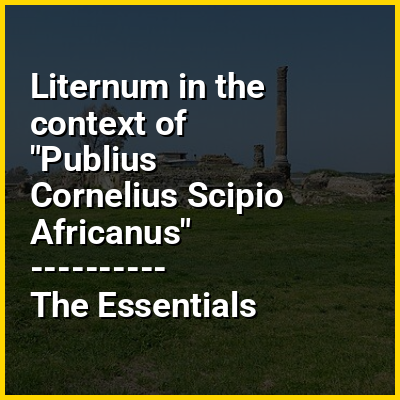
Liternum was an ancient town of Campania, southern central Italy, near "Patria Lake", on the low sandy coast between Cumae and the mouth of the Volturnus. It was probably once dependent on Cumae. In 194 BC it became a Roman colony. Although Livy records that the town was unsuccessful, excavation reveals a Roman town existed there until the 4th century AD.
HINT:
In this Dossier
Liternum in the context of Scipio Africanus
Publius Cornelius Scipio Africanus (/ˈskɪp.i.oʊ/, /ˈsɪp-/, Latin: [ˈskiːpioː]; 236/235–c. 183 BC) was a Roman general and statesman who was one of the main architects of Rome's victory against Carthage in the Second Punic War. Often regarded as one of the greatest military commanders and strategists of all time, his greatest military achievement was the defeat of Hannibal at the Battle of Zama in 202 BC. This victory in Africa earned him the honorific epithet Africanus, literally meaning 'the African', but meant to be understood as a conqueror of Africa.
Scipio's conquest of Carthaginian Iberia culminated in the Battle of Ilipa in 206 BC against Hannibal's brother Mago Barca. Although considered a hero by the Roman people, primarily for his victories against Carthage, Scipio had many opponents, especially Cato the Elder, who hated him deeply. In 187 BC, he was tried in a show trial alongside his brother for bribes they supposedly received from the Seleucid king Antiochus III during the Roman–Seleucid War. Disillusioned by the ingratitude of his peers, Scipio left Rome and retired from public life at his villa in Liternum.
View the full Wikipedia page for Scipio Africanus