This is a list of cities and towns in Cambodia.

This is a list of cities and towns in Cambodia.
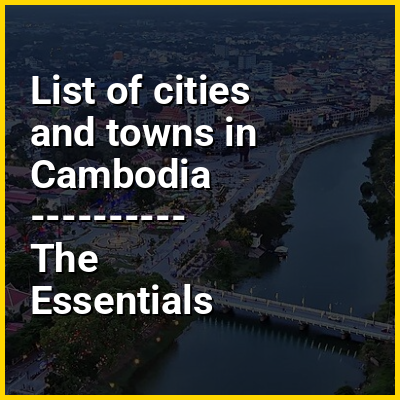
Battambang (Khmer: បាត់ដំបង, UNGEGN: Bătdâmbâng [ɓatɗɑmɓɑːŋ]) is the capital of Battambang province and the third largest city in Cambodia. The city is situated on the Sangkae River, which winds its way through the province.
Battambang was founded in the 11th century by the Khmer Empire. It later became a major commercial hub and the capital of the Siamese province of Inner Cambodia. It was reintegrated into Cambodia during French colonisation. During the 20th century, Battambang was Cambodia's second largest city, but it was overtaken by the growth of Siem Reap. It was impacted by conflict and genocide in the 20th century, with the city forcibly evacuated during the Democratic Kampuchea period. It was also the site of fighting during the Khmer Rouge insurgency until the 1990s.
Cambodia, officially the Kingdom of Cambodia, is a country in Mainland Southeast Asia. It is bordered by Thailand to the northwest, Laos to the north, and Vietnam to the east, and has a coastline along the Gulf of Thailand in the southwest. It spans an area of 181,035 square kilometres (69,898 square miles), dominated by a low-lying plain and the confluence of the Mekong river and Tonlé Sap, Southeast Asia's largest lake. It is dominated by a tropical climate. Cambodia has a population of about 17 million people, the majority of which are ethnically Khmer. Its capital and most populous city is Phnom Penh, followed by Siem Reap and Battambang.
In 802 AD, Jayavarman II declared himself king, uniting the warring Khmer princes of Chenla under the name "Kambuja". This marked the beginning of the Khmer Empire. The Indianised kingdom facilitated the spread of first Hinduism and then Buddhism to Southeast Asia and undertook religious infrastructural projects throughout the region, the most famous of which is Angkor Wat. In the 15th century, it began a decline in power until, in 1863, Cambodia became a French protectorate. Following Japanese occupation during World War II, Cambodia declared independence from France in 1953. The Vietnam War embroiled the country in civil war during the 1960s, culminating in a 1970 coup which installed the US-aligned Khmer Republic and the takeover of the communist Khmer Rouge in 1975. The Khmer Rouge ruled the country and carried out the Cambodian genocide from 1975 until 1979, until they were ousted during the Cambodian–Vietnamese War. Peace was restored by the 1991 Paris Peace Accords and subsequent United Nations peacekeeping mission, establishing a new constitution, holding the 1993 general election, and ending long-term insurgencies. The 1997 coup d'état consolidated power under Prime Minister Hun Sen and the Cambodian People's Party (CPP).
Phnom Penh is the capital and most populous city of Cambodia. It has been the national capital since 1865 and has grown to become the nation's primate city and its political, economic, industrial, and cultural centre. The city's name derives from Wat Phnom, a Buddhist temple, and Lady Penh, the city's founder. It sits at the confluence of the Tonlé Sap and Mekong rivers, and is the start of the Bassac River. It is also the seat of Cambodia's monarchy, based at the Royal Palace.
Founded in 1372, Phnom Penh succeeded Angkor Thom as the national capital in 1434 following the fall of Angkor, and remained so until 1497. It regained its capital status during the French colonial era. It underwent a period of investment and modernization during Cambodia's independence period, earning the nickname the "Pearl of Asia" for its colonial French, New Khmer and Art Deco architecture. The city's population swelled in the 1960s and 1970s as refugees fled from civil war and American bombing during the Vietnam War. Phnom Penh's entire population was forcibly evacuated in 1975 by the Khmer Rouge, and faced persecution, forced labour and genocide. Phnom Penh remained largely uninhabited during the Democratic Kampuchea era until Vietnam-backed forces took the city in 1979. The city was reconstructed and infrastructure improved in the modern era with the support of international investment and aid. By 2019, it was home to more than 2 million people, approximately 14% of the Cambodian population.
Siem Reap (Khmer: សៀមរាប, Siĕm Réab [siəm riəp]) is the second-largest city of Cambodia, as well as the capital and largest city of Siem Reap Province in northwestern Cambodia.
Siem Reap possesses French-colonial and Chinese-style architecture in the Old French Quarter and around the Old Market. The city is a major hub for tourism in Cambodia due to its close proximity to the ancient temples of Angkor constructed during the Khmer Empire. In and around the city there are museums, traditional Apsara dance performances, a Cambodian cultural village, souvenir and handicraft shops, silk farms, rice paddies in the countryside, fishing villages and a bird sanctuary near Tonlé Sap, and a cosmopolitan drinking and dining scene.