List of Roman watermills in the context of "Hierapolis sawmill"

Play Trivia Questions online!

or

Skip to study material about List of Roman watermills in the context of "Hierapolis sawmill"

Ad spacer

⭐ Core Definition: List of Roman watermills

This list of ancient watermills presents an overview of water-powered grain-mills and industrial mills in classical antiquity, including the Hellenistic period through the Roman period up until circa 500 AD.

The water wheel and watermill are the earliest instances of machines harnessing natural forces to replace human muscular labour (apart from the sail). As such, it holds a special place in the history of technology and also in economic studies where it is associated with growth.
↓ Menu

>>>PUT SHARE BUTTONS HERE<<<

👉 List of Roman watermills in the context of Hierapolis sawmill

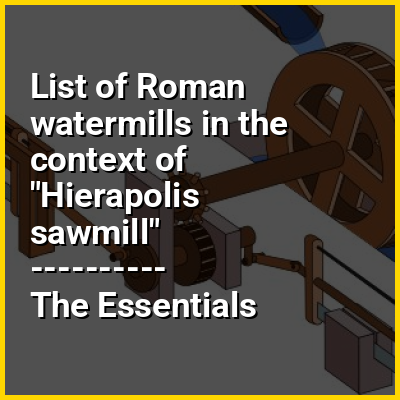
The Hierapolis sawmill was a water-powered stone sawmill in the Ancient Greek city of Hierapolis in Roman Asia (modern-day Turkey). Dating to the second half of the 3rd century AD, the sawmill is considered the earliest known machine to combine a crank with a connecting rod to form a crank-slider mechanism.

The watermill is evidenced by a raised relief on the sarcophagus of a certain Marcus Aurelius Ammianos, a local miller. On the pediment a waterwheel fed by a mill race is shown powering via a gear train two frame saws cutting rectangular blocks by the way of connecting rods and, through mechanical necessity, cranks (see diagram). The accompanying inscription is in Greek and attributes the mechanism to Ammianos' "skills with wheels".

↓ Explore More Topics
In this Dossier

List of Roman watermills in the context of Barbegal

The Barbegal aqueduct and mills was a Roman watermill complex in the commune of Fontvieille, Bouches-du-Rhône, near the town of Arles, in southern France. The complex has been referred to as "the greatest known concentration of mechanical power in the ancient world" and the 16 overshot wheels are considered to be the largest ancient mill complex.

Another similar mill complex existed on the Janiculum in Rome, and there are suggestions that further such complexes existed at other major Roman sites, such as Amida (Mesopotamia).

↑ Return to Menu