Linear polarization in the context of "Plane of polarization"

Play Trivia Questions online!

or

Skip to study material about Linear polarization in the context of "Plane of polarization"

Ad spacer

⭐ Core Definition: Linear polarization

In electrodynamics, linear polarization or plane polarization of electromagnetic radiation is a confinement of the electric field vector or magnetic field vector to a given plane along the direction of propagation. The term linear polarization (French: polarisation rectiligne) was coined by Augustin-Jean Fresnel in 1822. See polarization and plane of polarization for more information.

The orientation of a linearly polarized electromagnetic wave is defined by the direction of the electric field vector. For example, if the electric field vector is vertical (alternately up and down as the wave travels) the radiation is said to be vertically polarized.
↓ Menu

>>>PUT SHARE BUTTONS HERE<<<

👉 Linear polarization in the context of Plane of polarization

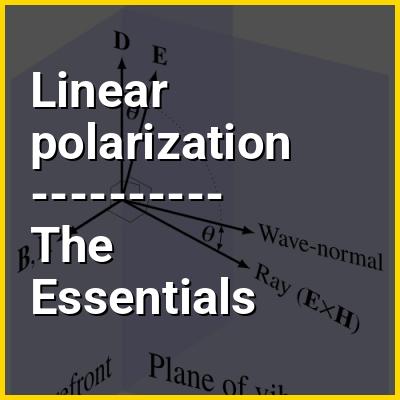
For light and other electromagnetic radiation, the plane of polarization is the plane spanned by the direction of propagation and either the electric vector or the magnetic vector, depending on the convention. It can be defined for polarized light, remains fixed in space for linearly-polarized light, and undergoes axial rotation for circularly-polarized light.

Unfortunately the two conventions are contradictory. As originally defined by Étienne-Louis Malus in 1811, the plane of polarization coincided (although this was not known at the time) with the plane containing the direction of propagation and the magnetic vector. In modern literature, the term plane of polarization, if it is used at all, is likely to mean the plane containing the direction of propagation and the electric vector, because the electric field has the greater propensity to interact with matter.

↓ Explore More Topics
In this Dossier

Linear polarization in the context of Electromagnetic radiation

In physics, electromagnetic radiation (EMR) or electromagnetic wave (EMW) is a self-propagating wave of the electromagnetic field that carries momentum and radiant energy through space. It encompasses a broad spectrum, classified by frequency (inversely proportional to wavelength), ranging from radio waves, microwaves, infrared, visible light, ultraviolet, X-rays, to gamma rays. All forms of EMR travel at the speed of light in a vacuum and exhibit wave–particle duality, behaving both as waves and as discrete particles called photons.

Electromagnetic radiation is produced by accelerating charged particles such as from the Sun and other celestial bodies or artificially generated for various applications. Its interaction with matter depends on wavelength, influencing its uses in communication, medicine, industry, and scientific research. Radio waves enable broadcasting and wireless communication, infrared is used in thermal imaging, visible light is essential for vision, and higher-energy radiation, such as X-rays and gamma rays, is applied in medical imaging, cancer treatment, and industrial inspection. Exposure to high-energy radiation can pose health risks, making shielding and regulation necessary in certain applications.

↑ Return to Menu

Linear polarization in the context of Polarization (waves)

Polarization, or polarisation, is a property of transverse waves which specifies the geometrical orientation of the oscillations. In a transverse wave, the direction of the oscillation is perpendicular to the direction of motion of the wave. One example of a polarized transverse wave is vibrations traveling along a taut string, for example, in a musical instrument like a guitar string. Depending on how the string is plucked, the vibrations can be in a vertical direction, horizontal direction, or at any angle perpendicular to the string. In contrast, in longitudinal waves, such as sound waves in a liquid or gas, the displacement of the particles in the oscillation is always in the direction of propagation, so these waves do not exhibit polarization. Transverse waves that exhibit polarization include electromagnetic waves such as light and radio waves, gravitational waves, and transverse sound waves (shear waves) in solids.

An electromagnetic wave such as light consists of a coupled oscillating electric field and magnetic field that are always perpendicular to each other. Different states of polarization correspond to different relationships between the directions of the fields and the direction of propagation. In linear polarization, the electric and magnetic fields each oscillate in a single direction, perpendicular to one another. In circular or elliptical polarization, the fields rotate around the beam's direction of travel at a constant rate. The rotation can be either in the right-hand or in the left-hand direction.

↑ Return to Menu

Linear polarization in the context of Elliptical polarization

In electrodynamics, elliptical polarization is the polarization of electromagnetic radiation such that the tip of the electric field vector describes an ellipse in any fixed plane intersecting, and normal to, the direction of propagation. An elliptically polarized wave may be resolved into two linearly polarized waves in phase quadrature, with their polarization planes at right angles to each other. Since the electric field can rotate clockwise or counterclockwise as it propagates, elliptically polarized waves exhibit chirality.

Circular polarization and linear polarization can be considered to be special cases of elliptical polarization. This terminology was introduced by Augustin-Jean Fresnel in 1822, before the electromagnetic nature of light waves was known.

↑ Return to Menu