Li Dazhao in the context of "Bolshevism"

Play Trivia Questions online!

or

Skip to study material about Li Dazhao in the context of "Bolshevism"

Ad spacer

⭐ Core Definition: Li Dazhao

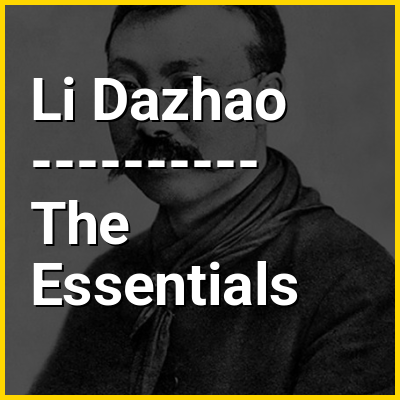
Li Dazhao (simplified Chinese: 李大钊; traditional Chinese: 李大釗; pinyin: Lǐ Dàzhāo; Wade–Giles: Li Ta-chao; 29 October 1889 – 28 April 1927) was a Chinese intellectual, revolutionary, and political activist who co-founded the Chinese Communist Party (CCP) with Chen Duxiu in 1921. He was one of the first Chinese intellectuals to publicly support Bolshevism and the October Revolution, and his writings and mentorship inspired a generation of young radicals, including Mao Zedong.

Born to a peasant family in Hebei province, Li was educated in modern schools in China and later at Waseda University in Japan. He rose to prominence during the New Culture Movement as the chief librarian and a professor of history at Peking University. In this role, he influenced many student activists and transformed his office into a hub for Marxist discussion. After the May Fourth Movement of 1919, he helped organize some of China's first communist study groups.
↓ Menu

>>>PUT SHARE BUTTONS HERE<<<
In this Dossier

Li Dazhao in the context of Communist Party of China

The Communist Party of China (CPC), commonly known as the Chinese Communist Party (CCP), is the founding and ruling party of the People's Republic of China (PRC). Founded in 1921, the CCP won the Chinese Civil War against the Kuomintang and proclaimed the establishment of the PRC under the chairmanship of Mao Zedong in October 1949. The CCP has since governed China and has had sole control over the country's armed forces and law enforcement. As of 2024, the CCP has more than 100 million members, making it the second largest political party by membership in the world.

In 1921, Chen Duxiu and Li Dazhao founded the CCP with the help of the Far Eastern Bureau of the Russian Communist Party (Bolsheviks) and Far Eastern Bureau of the Communist International. Although the CCP aligned with the Kuomintang (KMT) during its initial years, the rise of the KMT's right-wing under the leadership of Chiang Kai-shek and subsequent massacres of tens of thousands of CCP members resulted in a split and a prolonged civil war between the CCP and KMT. During the next ten years of guerrilla warfare, Mao Zedong rose to become the most influential figure in the CCP and the party established a strong base among the rural peasantry with its land reform policies. Support for the CCP continued to grow throughout the Second Sino-Japanese War. After the Japanese surrender in 1945, the CCP emerged triumphant in the communist revolution against the Nationalist government. The CCP established the People's Republic of China on 1 October 1949 and the remnants of the Nationalist government retreated to Taiwan shortly after.

↑ Return to Menu

Li Dazhao in the context of Chen Duxiu

Chen Duxiu (simplified Chinese: 陈独秀; traditional Chinese: 陳獨秀; pinyin: Chén Dúxiù; Wade–Giles: Chʻên Tu-hsiu; 9 October 1879 – 27 May 1942) was a Chinese revolutionary, writer, educator, and political philosopher who co-founded the Chinese Communist Party (CCP) with Li Dazhao in 1921, serving as its first General Secretary from 1921 to 1927. Chen was a leading figure in the New Culture Movement and May Fourth Movement of 1919, which significantly influenced China's intellectual and political landscape in the early 20th century.

Born in Anhui, Chen was raised in a traditional gentry family but became involved in revolutionary activities from a young age. He studied in Japan, where he was exposed to Western ideas and became involved with Chinese student activist groups. Returning to China, he played a key role in local revolutionary movements in Anhui, notably through journalism and education, advocating for a vernacular literary revolution and the preservation of China's "national essence". During the New Culture Movement (c. 1915–1922), Chen rose to national prominence as the editor of the influential magazine New Youth (Xin Qingnian) and as Dean of Arts and Letters at Peking University. He championed science, democracy, and vernacular literature, while launching trenchant critiques of traditional Confucianism and Chinese society. His writings and leadership were instrumental in shaping the May Fourth generation of intellectuals and activists.

↑ Return to Menu

Li Dazhao in the context of Hu Shih

Hu Shih (Chinese: 胡適; 17 December 1891 – 24 February 1962) was a Chinese academic, writer, and politician. Hu contributed to Chinese liberalism and language reform, and was a leading advocate for the use of written vernacular Chinese. He participated in the May Fourth Movement and China's New Culture Movement. He was a president of Peking University and Academia Sinica.

Hu was the editor of the Free China Journal, which was shut down for criticizing Chiang Kai-shek. In 1919, he also criticized Li Dazhao. Hu advocated that the world adopt Western-style democracy. Moreover, Hu criticized Sun Yat-sen's claim that people are incapable of self-rule. Hu criticized the Nationalist government for betraying the ideal of Constitutionalism in The Outline of National Reconstruction.

↑ Return to Menu

Li Dazhao in the context of New Culture Movement

The New Culture Movement was a progressive sociopolitical movement in China during the 1910s and 1920s. Participants criticized many aspects of traditional Chinese society, in favor of new formulations of Chinese culture informed by modern ideals of mass political participation. Arising out of disillusionment with traditional Chinese culture following the failure of the Republic of China to address China's problems, it featured scholars such as Chen Duxiu, Cai Yuanpei, Chen Hengzhe, Li Dazhao, Lu Xun, Zhou Zuoren, He Dong, Qian Xuantong, Liu Bannong, Bing Xin and Hu Shih, many of whom were classically educated, who led a revolt against Confucianism. The movement was launched by the writers of New Youth magazine, where these intellectuals promoted a new society based on unconstrained individuals rather than the traditional Confucian system. In 1917, Hu Shih put forward his famous "eight principles", which advocated for abandoning ancient traditional writing methods for ones that more accurately represented vernacular speech.

The New Culture Movement was the progenitor of the May Fourth Movement. On 4 May 1919, students in Beijing aligned with the movement protested the transfer of German rights over Jiaozhou Bay to Imperial Japan rather than China at the Paris Peace Conference (the meeting setting the terms of peace at the conclusion of World War I), transforming what had been a cultural movement into a political one.

↑ Return to Menu

Li Dazhao in the context of 3rd National Congress of the Chinese Communist Party

The 3rd National Congress of the Chinese Communist Party was held in Guangzhou at 31 Xuguyuan Road between 12 June and 20 June 1923. It succeeded the 2nd National Congress of the Chinese Communist Party and preceded the 4th National Congress of the Chinese Communist Party. The congress was attended by 40 representatives across China and Moscow representing 420 party members of the Chinese Communist Party (CCP).

The congress was hosted by Chen Duxiu, with participation from Li Dazhao, Zhang Guotao, Tan Pingshan, Cai Hesen, Chen Tanqiu, Luo Zhanglong, and Henk Sneevliet (representing the Comintern). Sneevilet briefed congress regarding the inquiries by the Comintern related to the cooperation between the CCP and Kuomintang. The congress held elections to appoint members in the 3rd Central Executive Committee of the Chinese Communist Party and drafted resolutions of the 3rd Congress.

↑ Return to Menu

Li Dazhao in the context of Communist Youth League of China

The Communist Youth League of China (CYLC; also known as the Young Communist League of China or simply the Communist Youth League or CYL) is a people's organization of the People's Republic of China for youth between the ages of 14 and 28, run by the Chinese Communist Party (CCP).

The predecessor of the CYLC, the Shanghai Socialist Youth League, was founded in August 1920 by Chen Duxiu and Li Dazhao. Its national organization, the Socialist Youth League of China, was founded in 1922 and initially accepted the command and assistance of the Communist International. In January 1925, it was renamed to the Chinese Communist Youth League. During the Second Sino-Japanese War, it assisted the Second United Front. In November 1936, the Communist Youth League was reorganized into the Youth National Salvation Association. After the CCP won the Chinese Civil War, the CCP Central Committee announced the re-establishment of the Chinese New Democracy Youth League which changed its name to the Communist Youth League of China in 1957.

↑ Return to Menu