Lerdo Law in the context of "La Reforma"

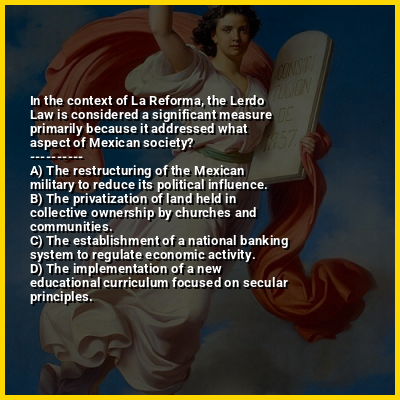
⭐ In the context of La Reforma, the Lerdo Law is considered a significant measure primarily because it addressed what aspect of Mexican society?

Ad spacer

⭐ Core Definition: Lerdo Law

The Lerdo Law (Spanish: Ley Lerdo) was the common name for the Confiscation of Law and Urban Ruins of the Civil and Religious Corporations of Mexico, part of La Reforma. It targeted not only property owned by the Catholic Church, but also properties held in common by indigenous communities and transferred them to private hands. Liberals considered such corporate ownership as a major impediment to modernization and development in Mexico. Drafted by Miguel Lerdo de Tejada, it was signed on 25 June 1856 by President Ignacio Comonfort, but its language was ambiguous, needing subsequent clarifications.

Its objectives were to create a market in rural real estate and incentivize development; create rural middle class, improve public finances of the state, and revive the economy by eliminating restrictions on freedom of movement. Properties were to be sold to private individuals, which was expected to stimulate the real estate market and to generate government revenue by a sales tax. Much property held by the Catholic Church was urban and exempt from confiscation. The impact was felt most by indigenous communities, now forced to break up holdings held in common that had allowed communities to retain control of their land. The rural poor lacked the funds to buy property and pay the transfer fees. Most purchasers were large landowners or foreign investors, which further concentrated land ownership. Religious groups and their civil corporations were prohibited from purchasing land sold under law unless for strictly-religious purposes. Implementation of the law was disrupted by the Reform War (1858–60) and the French Intervention (1862–67), but resumed with the defeat of the French invaders and their Conservative allies in 1867. Implementation resumed after that, but not until the regime of Porfirio Díaz was the impact felt significantly.
↓ Menu

>>>PUT SHARE BUTTONS HERE<<<

👉 Lerdo Law in the context of La Reforma

In the history of Mexico, La Reforma (from Spanish: "The Reform"), or reform laws, refers to a pivotal set of laws, including a new constitution, that were enacted in the Second Federal Republic of Mexico during the 1850s after the Plan of Ayutla overthrew the dictatorship of Santa Anna. They were intended as modernizing measures: social, political, and economic, aimed at undermining the traditional power of the Catholic Church and the army. The reforms sought separation of church and state, equality before the law, and economic development. These anticlerical laws were enacted in the Second Mexican Republic between 1855 and 1863, during the governments of Juan Álvarez, Ignacio Comonfort and Benito Juárez. The laws also limited the ability of Catholic Church and Indigenous communities from collectively holding land. The liberal government sought the revenues from the disentailment of church property, which could fund the civil war against Mexican conservatives and to broaden the base of property ownership in Mexico and encouraging private enterprise. Several of them were raised to constitutional status by the constituent Congress that drafted the liberal Constitution of 1857. Although the laws had a major impact on the Catholic Church in Mexico, liberal proponents were not opposed to the church as a spiritual institution, but rather sought a secular state and a society not dominated by religion.

The Juárez Law reduced the power that military and ecclesiastical courts held. The Lerdo Law forced land held in collective ownership to be sold to individual owners. It aimed at creating a dynamic real estate market, creating a class of yeoman farmers owning their own land, and raising revenue for the state. The measure was intended to strip the Church of most of its property, as well as to break Indigenous communities' collective ownership of land.

↓ Explore More Topics
In this Dossier

Lerdo Law in the context of Reform War

The Reform War (17 December 1857 – 11 January 1861) or War of Reform (Spanish: Guerra de Reforma), also known as the Three Years' War (Spanish: Guerra de los Tres Años), and the Mexican Civil War, was a complex civil conflict in Mexico fought between Mexican liberals and conservatives with regional variations over the promulgation of Constitution of 1857. It has been called the "worst civil war to hit Mexico between the War of Independence of 1810–21 and the Revolution of 1910–20". Following the liberals' overthrow of the dictatorship of conservative Antonio López de Santa Anna, liberals passed a series of laws codifying their political program. These laws were incorporated into the new constitution. It aimed to limit the political power of the executive branch, as well as the political, economic, and cultural power of the Catholic Church. Specific measures were the expropriation of Church property; separation of church and state; reduction of the power of the Mexican Army by elimination of their special privileges; strengthening the secular state through public education; and measures to develop the nation economically.

The constitution had been promulgated on 5 February 1857 was to come into force on 16 September 1857. There was intense opposition from Conservatives and the Catholic Church over its anti-clerical provisions, but there were also moderate liberals, including President Ignacio Comonfort, who considered the constitution too radical and likely to trigger a civil war. The Lerdo Law forced the sale of most of the Church's rural properties. The measure was not exclusively aimed at the Catholic Church, but also Mexico's indigenous peoples, which were forced to sell sizeable portions of their communal lands. Controversy was further inflamed when the Catholic Church decreed the excommunication of civil servants who took a government-mandated oath upholding the new constitution, which left Catholic civil servants with the choice of losing their jobs or being excommunicated.

↑ Return to Menu

Lerdo Law in the context of Miguel Lerdo de Tejada

Miguel Lerdo de Tejada (July 6, 1812 – March 22, 1861) was a Mexican statesman, a leader of the Revolution of Ayutla, and author of the Lerdo Law, extinguishing the right of corporations, including the Roman Catholic Church and indigenous communities, from holding land.

Born in the port of Veracruz, Veracruz, both he and his younger brother, Sebastián Lerdo de Tejada, became leaders of Mexico's Liberal Party. As the president of the ayuntamiento (city council) of Mexico City in 1852, Miguel Lerdo de Tejada proposed initiatives on public education, transportation, public health, and budgetary reforms. Lerdo served Antonio López de Santa Anna in his final term as president (1853–55) and then as the Treasury Secretary under liberal president Ignacio Comonfort following the successful implementation of the Plan de Ayutla. In 1856, Miguel Lerdo de Tejada initiated the Ley de Desamortización de Fincas Rústicas y Urbanas (Disentailment of Rural and Urban Properties Law), commonly known as the Ley Lerdo, which called for the forced sale of most properties held by the Roman Catholic Church in Mexico, common lands of indigenous communities, and by municipal and state governments. The Church could retain only the buildings it used for its operations (churches, monasteries, seminary buildings); governments could keep only government offices, jails, and school buildings. Other property, which had been used to generate income for the Church and for local governments, was to be sold with the proceeds going into the national treasury. Because of the disruptions of the War of Reform (1858 - 1861) and the French Intervention (1862 - 1867) that wracked Mexico, few properties were actually sold as a direct result of the Ley Lerdo. Most of the "disruptions" attributed to that law actually occurred later, under legislation passed during the regime of Porfirio Díaz (1876 - 1911), but took their legal foundation in the Ley Lerdo.

↑ Return to Menu