Lecce in the context of "Grecìa Salentina"

Play Trivia Questions online!

or

Skip to study material about Lecce in the context of "Grecìa Salentina"

Ad spacer

⭐ Core Definition: Lecce

Lecce (/ˈlɛ/ LETCH-ay, Italian: [ˈlettʃe] ) is a city in southern Italy and capital of the province of Lecce. It is on the Salentine Peninsula, at the heel of the Italian Peninsula. The city is more than two thousand years old.

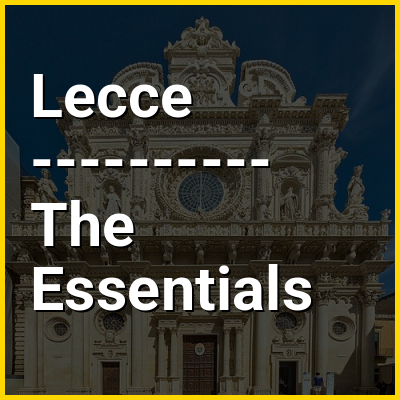
Because of its rich Baroque architecture, Lecce is nicknamed "The Florence of the South". "Lecce stone"—a particular kind of limestone—is one of main exports of the city. It is very soft and workable, thus suitable for sculptures. As well as being an industrial centre specializing in ceramics, Lecce also is an important agricultural centre, chiefly for its olive oil and wine production.
↓ Menu

>>>PUT SHARE BUTTONS HERE<<<

👉 Lecce in the context of Grecìa Salentina

Grecìa Salentina (Griko for "Salentine Greece") is an area in the peninsula of Salento in southern Italy, near the town of Lecce which is inhabited by the Griko people, an ethnic Greek minority in southern Italy who speak Griko, a variant of Greek.

↓ Explore More Topics
In this Dossier

Lecce in the context of House of Kastrioti

The Kastrioti were an Albanian noble family, active in the 14th and 15th centuries as the rulers of the Principality of Kastrioti. At the beginning of the 15th century, the family controlled a territory in the Mat and Dibra regions. The most notable member was Gjergj Kastrioti, better known as Skanderbeg, regarded today as an Albanian hero for leading the resistance against Mehmed the Conqueror's efforts to expand the Ottoman Empire into Albania. After Skanderbeg's death and the fall of the Principality in 1468, the Kastrioti family gave their allegiance to the Kingdom of Naples and were given control over the Duchy of San Pietro in Galatina and the County of Soleto, now in the Province of Lecce, Italy. Ferrante (died 1561), son of Gjon Kastrioti II, Duke of Galatina and Count of Soleto, is the direct ancestor of all male members of the Kastrioti family today. Today, the family consists of two Italian branches, one in Lecce and the other in Naples. The descendants of the House of Kastrioti in Italy use the family name "Castriota Scanderbeg".

↑ Return to Menu

Lecce in the context of Province of Lecce

The province of Lecce (Italian: provincia di Lecce; Salentino: provincia te Lècce) is a province in the Apulia region of Italy. Its capital is the city of Lecce. The province is called the "Heel of Italy". Located on the Salento peninsula, it is the second most-populous province in Apulia and the 21st most-populous province in Italy.

The province occupies an area of 2,799.07 square kilometres (1,080.73 sq mi) and has a total population of 802,807 (2016). There are 97 comuni (sg.: comune) in the province. It is surrounded by the provinces Taranto and Brindisi in the northwest, the Ionian Sea in the west, and the Adriatic Sea in the east. This location has established it as a popular tourist destination. It has been ruled by the Romans, Byzantine Greeks, Carolingians, Lombards, and Normans. The important towns are Lecce, Gallipoli, Nardò, Maglie, and Otranto. Its important agricultural products are wheat and corn. Lecce stone extracted from the province has been used to decorate several historical monuments and is widely used for interior decoration.

↑ Return to Menu

Lecce in the context of Ennius

Quintus Ennius (Latin pronunciation: [ˈkᶣiːnt̪ʊs̺ ˈɛnːiʊs̺]; c. 239 – c. 169 BCE) was a writer and poet who lived during the Roman Republic. He is often considered the father of Roman poetry. He was born in the small town of Rudiae, located near modern Lecce (ancient Calabria, today Salento), a town founded by the Messapians, and could speak Greek as well as Latin and Oscan (his native language). Although only fragments of his works survive, his influence in Latin literature was significant, particularly in his use of Greek literary models.

↑ Return to Menu

Lecce in the context of Galatina

Galatina (Griko: Ας Πέτρο, romanizedAs Pètro; Salentino: San Pietru; both lit.'Saint Peter'), known before the unification of Italy as San Pietro in Galatina, is a town and comune (municipality) in the Province of Lecce in Apulia, southern Italy. It is situated about 21 kilometres (13 mi) south of the city of Lecce.

↑ Return to Menu

Lecce in the context of Soleto

Soleto (Griko: Sulìtu; Salentino: Sulìtu; Latin: Soletum) is a small Griko-speaking city located in the province of Lecce in Apulia, Italy. The town has a total population of 5,542 and is one of the nine towns of Grecìa Salentina where the Greek dialect Griko is spoken.

↑ Return to Menu

Lecce in the context of Rudiae

Rudiae (Rusce ['Ruʃe] in the local dialect; Ῥοδίαι in ancient Greek) was a former human settlement in late 9th or early 8th centuries BCE. It is presently an archaeological park beside the San Pietro in Lama that runs south-west from the city of Lecce. The place was identified as the former home of the poet Ennius by the Renaissance Humanist, Antonio de Ferraris.

↑ Return to Menu

Lecce in the context of Tancred of Lecce

Tancred (Italian: Tancredi; 1138 – 20 February 1194) was King of Sicily from 1189 to 1194. He was born in Lecce, an illegitimate son of Roger III, Duke of Apulia (the eldest son of King Roger II) by his mistress Emma, a daughter of Achard II, Count of Lecce. He inherited the title "Count of Lecce" from his grandfather and is consequently often referred to as Tancred of Lecce. Due to his short stature and unhandsome visage, he was mocked by his critics as "The Monkey King".

↑ Return to Menu