Laplacian in the context of Newtonian potential


Laplacian in the context of Newtonian potential

Laplacian Study page number 1 of 1

Play TriviaQuestions Online!

or

Skip to study material about Laplacian in the context of "Newtonian potential"


HINT:

👉 Laplacian in the context of Newtonian potential

In mathematics, the Newtonian potential, or Newton potential, is an operator in vector calculus that acts as the inverse to the negative Laplacian on functions that are smooth and decay rapidly enough at infinity. As such, it is a fundamental object of study in potential theory. In its general nature, it is a singular integral operator, defined by convolution with a function having a mathematical singularity at the origin, the Newtonian kernel which is the fundamental solution of the Laplace equation. It is named for Isaac Newton, who first discovered it and proved that it was a harmonic function in the special case of three variables, where it served as the fundamental gravitational potential in Newton's law of universal gravitation. In modern potential theory, the Newtonian potential is instead thought of as an electrostatic potential.

The Newtonian potential of a compactly supported integrable function is defined as the convolution

↓ Explore More Topics
In this Dossier

Laplacian in the context of Cahn–Hilliard equation

The Cahn–Hilliard equation (after John W. Cahn and John E. Hilliard) is an equation of mathematical physics which describes the process of phase separation, spinodal decomposition, by which the two components of a binary fluid spontaneously separate and form domains pure in each component. If is the concentration of the fluid, with indicating domains, then the equation is written as

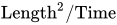
where is a diffusion coefficient with units of and gives the length of the transition regions between the domains. Here is the partial time derivative and is the Laplacian in dimensions. Additionally, the quantity is identified as a chemical potential.

View the full Wikipedia page for Cahn–Hilliard equation
↑ Return to Menu