Lapis lazuli in the context of Bhirrana


Lapis lazuli in the context of Bhirrana

⭐ Core Definition: Lapis lazuli

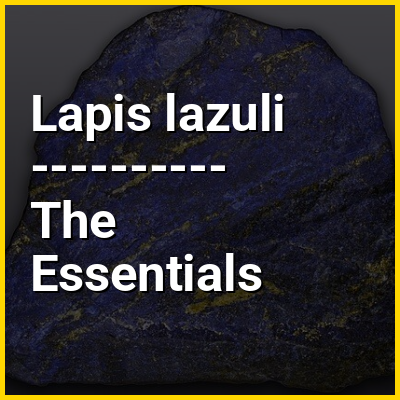
Lapis lazuli (UK: /ˌlæpɪs ˈlæz(j)ʊli, ˈlæʒʊ-, -ˌli/; US: /ˈlæz(j)əli, ˈlæʒə-, -ˌliˌ læˈzli/) is a deep-blue metamorphic rock used as a semi-precious stone that has been prized since antiquity for its intense color. Its name originates from the Persian word for the gem, lāžward, and serves as the root for the word for "blue" in several languages, including Spanish and Portuguese azul and English azure. Lapis lazuli is a rock composed primarily of the minerals lazurite, pyrite, diopside, and calcite. As early as the 7th millennium BC, lapis lazuli was mined in the Sar-i Sang mines, in Shortugai, and in other mines in Badakhshan province in modern northeast Afghanistan. Lapis lazuli artifacts, dated to 7570 BC, have been found at Bhirrana, which is the oldest site of Indus Valley Civilisation. Lapis was highly valued by the Indus Valley Civilisation (3300–1900 BC). Lapis beads have been found at Neolithic burials in Mehrgarh, the Caucasus, and as far away as Mauritania. It was used in the funeral mask of Tutankhamun (1341–1323 BC).

By the end of the Middle Ages, Europe began importing lapis lazuli to grind it into powder and make ultramarine pigment. Ultramarine was used by some of the most important artists of the Renaissance and Baroque, including Masaccio, Perugino, Titian and Vermeer; it was often reserved for the clothing of the central figures of their paintings, especially the Virgin Mary. Ultramarine has also been found in dental tartar of medieval nuns and scribes, perhaps as a result of licking their painting brushes while producing medieval texts and manuscripts.
↓ Menu
HINT:

In this Dossier

Lapis lazuli in the context of Pigment

A pigment is a chemical compound that gives a substance or organism color, or is used by humans to add or alter color or change visual appearance. Pigments are completely or nearly insoluble and chemically unreactive in water or another medium; in contrast, dyes are colored substances which are soluble or go into solution at some stage in their use. Dyes are often organic compounds whereas pigments are often inorganic. Pigments of prehistoric and historic value include ochre, charcoal, and lapis lazuli. Biological pigments are compounds produced by living organisms that provide coloration.

View the full Wikipedia page for Pigment
↑ Return to Menu

Lapis lazuli in the context of Osiris myth

The Osiris myth is the most elaborate and influential story in ancient Egyptian mythology. It concerns the murder of the god Osiris, a primeval king of Egypt, and its consequences. Osiris's murderer, his brother Set, usurps his throne. Meanwhile, Osiris's wife Isis restores her husband's body, allowing him to posthumously conceive their son, Horus. The remainder of the story focuses on Horus, the product of the union of Isis and Osiris, who is at first a vulnerable child protected by his mother and then becomes Set's rival for the throne. Their often violent conflict ends with Horus's triumph, which restores maat (cosmic and social order) to Egypt after Set's unrighteous reign and completes the process of Osiris's resurrection.

The myth, with its complex symbolism, is integral to ancient Egyptian conceptions of kingship and succession, conflict between order and disorder, and especially death and the afterlife. It also expresses the essential character of each of the four deities at its center, and many elements of their worship in ancient Egyptian religion were derived from the myth.

View the full Wikipedia page for Osiris myth
↑ Return to Menu

Lapis lazuli in the context of Gold background

Gold ground (both a noun and adjective) or gold-ground (adjective) is a term in art history for a style of images with all or most of the background in a solid gold colour. Historically, real gold leaf has normally been used, giving a luxurious appearance. The style has been used in several periods and places, but is especially associated with Byzantine and medieval art in mosaic, illuminated manuscripts and panel paintings, where it was for many centuries the dominant style for some types of images, such as icons. For three-dimensional objects, the term is gilded or gold-plated.

Gold in mosaic began in Roman mosaics around the 1st century AD, and originally was used for details and had no particular religious connotation, but in Early Christian art it came to be regarded as very suitable for representing Christian religious figures, highlighting them against a plain but glistering background that might be read as representing heaven, or a less specific spiritual plane. Full-length figures often stand on more naturalistically coloured ground, with the sky in gold, but some are shown fully surrounded by gold. The style could not be used in fresco, but was adapted very successfully for miniatures in manuscripts and the increasingly important portable icons on wood. In all of these the style required a good deal of extra skilled work, but because of the extreme thinness of the gold leaf used, the cost of the gold bullion used was relatively low; lapis lazuli blue seems to have been at least as expensive to use.

View the full Wikipedia page for Gold background
↑ Return to Menu

Lapis lazuli in the context of Gemstones

A gemstone (also called a fine gem, jewel, precious stone, semiprecious stone, or simply gem) is a piece of mineral crystal which, when cut or polished, is used to make jewelry or other adornments. Certain rocks (such as lapis lazuli, opal, and obsidian) and occasionally organic materials that are not minerals (such as amber, jet, and pearl) may also be used for jewelry and are therefore often considered to be gemstones as well. Most gemstones are hard, but some softer minerals such as brazilianite may be used in jewelry because of their color or luster or other physical properties that have aesthetic value. However, generally speaking, soft minerals are not typically used as gemstones by virtue of their brittleness and lack of durability.

Found all over the world, the industry of coloured gemstones (i.e. anything other than diamonds) is currently estimated at US$1.55 billion as of 2023 and is projected to steadily increase to a value of $4.46 billion by 2033.

View the full Wikipedia page for Gemstones
↑ Return to Menu

Lapis lazuli in the context of Bhaisajyaguru

Bhaiṣajyaguru (Sanskrit: भैषज्यगुरु, Chinese: 藥師佛, Japanese: 薬師仏, Korean: 약사불, Vietnamese: Dược Sư Phật, Standard Tibetan: སངས་རྒྱས་སྨན་བླ), or Bhaishajyaguru, formally Bhaiṣajya-guru-vaiḍūrya-prabha-rāja ("Medicine Master and King of Lapis Lazuli Light"; Chinese: 藥師琉璃光(王)如來, Japanese: 薬師瑠璃光如来, Korean: 약사유리광여래, Vietnamese: Dược Sư Lưu Ly Quang Vương Như Lai), is the Buddha of healing and medicine in Mahāyāna Buddhism. Commonly referred to as the "Medicine Buddha", he is described as a doctor who cures suffering (Pali/Sanskrit: dukkha/duḥkha) using the medicine of his teachings.

The image of Bhaiṣajyaguru is usually expressed with a canonical Buddha-like form holding a gallipot and, in some versions, possessing blue or deep green skin. Though also considered to be a guardian of the East, in most cases, Akshobhya is given that role. As an exceptional case, the honzon of Mount Kōya's Kongōbu Temple was changed from Akshobhya to Bhaiṣajyaguru.

View the full Wikipedia page for Bhaisajyaguru
↑ Return to Menu

Lapis lazuli in the context of Steppe Route

The Steppe Route was an ancient overland route through the Eurasian Steppe that was an active precursor of the Silk Road. Silk and horses were traded as key commodities; secondary trade included furs, weapons, musical instruments, precious stones (turquoise, lapis lazuli, agate, nephrite) and jewels. This route extended for approximately 10,000 km (6,200 mi). Trans-Eurasian trade through the Steppe Route preceded the conventional date for the origins of the Silk Road by at least two millennia.

View the full Wikipedia page for Steppe Route
↑ Return to Menu

Lapis lazuli in the context of Sapphire

Sapphire is a precious gemstone, a variety of the mineral corundum, consisting of aluminium oxide (α-Al2O3) with trace amounts of elements such as iron, titanium, cobalt, lead, chromium, vanadium, magnesium, boron, and silicon. The name sapphire is derived from the Latin word sapphirus, itself from the Greek word sappheiros (σάπφειρος), which referred to lapis lazuli. It is typically blue, but natural "fancy" sapphires also occur in yellow, purple, orange, and green colors; "parti sapphires" show two or more colors. Red corundum stones also occur, but are called rubies rather than sapphires. Pink-colored corundum may be classified either as ruby or sapphire depending on the locale. Commonly, natural sapphires are cut and polished into gemstones and worn in jewelry. They also may be created synthetically in laboratories for industrial or decorative purposes in large crystal boules. Because of the remarkable hardness of sapphires – 9 on the Mohs scale (the third-hardest mineral, after diamond at 10 and moissanite at 9.5) – sapphires are also used in some non-ornamental applications, such as infrared optical components, high-durability windows, wristwatch crystals and movement bearings, and very thin electronic wafers, which are used as the insulating substrates of special-purpose solid-state electronics such as integrated circuits and GaN-based blue LEDs. It occurs in association with ruby, zircon, biotite, muscovite, calcite, dravite and quartz.

View the full Wikipedia page for Sapphire
↑ Return to Menu