Lahore Fort in the context of "Early Muslim period in Lahore"

Play Trivia Questions online!

or

Skip to study material about Lahore Fort in the context of "Early Muslim period in Lahore"

Ad spacer

⭐ Core Definition: Lahore Fort

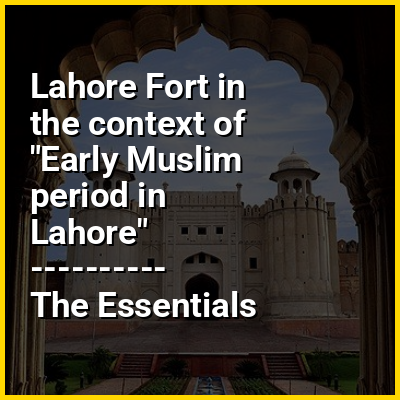
The Lahore Fort (Punjabi: شاہی قلعہ, romanized: Śā'ī Qilā; Urdu: شاہی قلعہ, romanizedŚāhī Qil'ā; lit.'Royal Fort') is a citadel in the walled interior of Lahore in Punjab, Pakistan. The fortress is located at the northern end of the Walled City and is spread over an area greater than 20 hectares (49 acres). It contains 21 notable monuments, some of which date to the era of Emperor Akbar. The Lahore Fort is notable for having been almost entirely rebuilt in the 17th century, when the Mughal Empire was at the height of its splendor and opulence.

Though the site of the present fort has been inhabited for millennia, the first record of a fortified structure at the site was that of an 11th-century mudbrick fort. The foundations of the modern fort was laid in 1566 ,during the reign of Emperor Akbar, in a syncretic architectural style that featured both Islamic and Hindu motifs. Additions from the Shah Jahan period are characterized by marble with inlaid Persian floral designs, while the fort's grand Alamgiri Gate was constructed by the last of the great Mughal emperors, Aurangzeb, and faces the Badshahi Mosque.
↓ Menu

>>>PUT SHARE BUTTONS HERE<<<

👉 Lahore Fort in the context of Early Muslim period in Lahore

The early Muslim period refers to the start of Muslim rule in the history of Lahore. In 664/682, the city was besieged by Muslim forces led by Muhallab ibn Abi Sufra.

Few references to Lahore remain from before its capture by Sultan Mahmud of Ghazni in the eleventh century. The sultan took Lahore after a long siege and battle in which the city was torched and depopulated. In 1021, Sultan Mahmud appointed Malik Ayaz to the throne and made Lahore the capital of the Ghaznavid Empire. As the first Muslim governor of Lahore, Ayaz rebuilt and repopulated the city. He added many important features, such as city gates and a masonry fort, built in 1037–1040 on the ruins of the previous one, which had been demolished in the fighting (as recorded by Munshi Sujan Rae Bhandari, author of the Khulasat-ut-Tawarikh in 1695–96). The present Lahore Fort stands on the same location. Under Ayaz's rule, the city became a cultural and academic center, renowned for poetry. The tomb of Malik Ayaz can still be seen in the Rang Mahal commercial area of town. In 1034, the city was captured by Nialtigin, the rebellious governor of Multan. However, his forces were expelled by Malik Ayaz in 1036.

↓ Explore More Topics
In this Dossier

Lahore Fort in the context of Badshahi Mosque

The Badshahi Mosque (Punjabi: شاہی مسیت, romanized: śāhī masīt; Urdu: بادشاہی مسجد, romanizedbādśāhī masjid) is a Mughal-era imperial mosque located in Lahore, Punjab, Pakistan. It was constructed between 1671 and 1673 during the rule of the Mughal emperor Aurangzeb, opposite to the Lahore Fort in the northern outskirts of the historic Walled City. It is widely considered to be one of the most iconic landmarks of Pakistan.

The mosque is an important example of the Mughal architecture, with an exterior that is decorated with carved red sandstone with marble inlay. It was the largest mosque built during the Mughal era, and is currently the second largest mosque in Pakistan.

↑ Return to Menu

Lahore Fort in the context of Origins of Lahore

A Hindu legend based on oral traditions holds that Lahore, known in ancient times as Nokhar (City of Lava in Sanskrit),was founded by Prince Lava,the son of the goddess Sita and Rama; Kasur was founded by his twin brother Prince Kusha.To this day, Lahore Fort has a vacant Lava temple dedicated to Lava (also pronounced Loh, hence Loh-awar or "The Fort of Loh"). It is one of various etymological theory of Lahore's origin.

The oldest authentic document about Lahore was written anonymously in 982. It is called Hudud-i-Alam (The Regions of the World). In 1927 it was translated into English by Vladimir Fedorovich Minorsky and published in Lahore. In this document, Lahore is referred to as a small shehr (city) with "impressive temples, large markets and huge orchards." It refers to "two major markets around which dwellings exist," and it also mentions "the mud walls that enclose these two dwellings to make it one." The original document is currently held in the British Museum. Lahore was called by different names throughout history. To date there is no conclusive evidence as to when it was founded. Some historians trace the history of the city as far back as 4000 years ago. However, historically, it has been proved that Lahore is at least 2,000 years old. Lying on the main trade and invasion routes to South Asia, Lahore has been ruled and plundered by a number of dynasties and hordes.

↑ Return to Menu

Lahore Fort in the context of Walled City of Lahore

The Walled City of Lahore, also known as the Old City or Inner Lahore, refers to the historic core of Lahore, the capital and largest city of Punjab, Pakistan. The early settlements were established between the 1st and 7th centuries, with Lahore attaining the status of a proper city in 1040 which was fortified throughout the medieval era. It has been the primary cultural centre of the Punjab since the late-medieval era.

The Walled City rose in prominence after being selected as the Mughal capital, which resulted in the construction of the Lahore Fort – now a UNESCO World Heritage Site, as well as the city's new reinforced walls. The Walled City was bestowed with numerous monuments during the Mughal era, with some of Lahore's most iconic structures being located in the Walled City, such as the lavishly decorated Wazir Khan Mosque, the massive Badshahi Mosque, and the Shahi Hammam. Under Sikh rule, the city was again selected as the capital, and the Walled City again rose in prominence with numerous religious buildings built in the Walled City at the time, including the Samadhi of Ranjit Singh, and the Gurdwara Janam Asthan Guru Ram Das.

↑ Return to Menu

Lahore Fort in the context of Tourism in Pakistan

Tourism in Pakistan is a growing industry. In 2010, Lonely Planet termed Pakistan "tourism's 'next big thing'". The country is geographically and ethnically diverse, and has a number of historical and cultural heritage sites. Condé Nast Traveller ranked Pakistan The Best Holiday Destination for 2020 and also declared it the third-highest potential adventure destination in the world for 2020. As security in the country improves, tourism increases; in two years, it has increased by more than 300%.

In 2018, the British Backpacker Society ranked Pakistan the world's top adventure travel destination, describing the country as "one of the friendliest countries on earth, with mountain scenery that is beyond anyone's wildest imagination". Forbes ranked Pakistan as one of the ‘coolest places’ to visit in 2019. The World Economic Forum's Travel and Tourism Competitiveness Report placed Pakistan in the top 25 percent of global destinations for its World Heritage Sites, which range from the mangroves in the Indus delta to the Indus Valley civilization sites including Mohenjo-daro and Harappa.

↑ Return to Menu

Lahore Fort in the context of Sikh period in Lahore

The Sikh period in Lahore initiated from the conquest and rule of the Sikh Misls and extended till the Sikh Empire of Ranjit Singh (also known as Punjab, the Sikh Raj, Sarkar Khālsā Rāj, and Sarkar Khalsaji) which ended in 1849. The Sikhs began gaining power following the decline of the Mughal Empire in Punjab and consisted of a collection of autonomous Punjabi Misls, which were governed by Misldars, mainly in the Punjab region.

↑ Return to Menu

Lahore Fort in the context of Lava temple

Lava Temple (Urdu: لو مندر) is a Hindu place of worship dedicated to the Hindu deity Lava, the son of Rama. It is in Lahore Fort, Lahore, Pakistan, and dates to the Sikh period. According to a Hindu legend, Lahore is named after him.

↑ Return to Menu

Lahore Fort in the context of Samadhi of Ranjit Singh

The Samadhi of Ranjit Singh is a 19th-century building in Lahore, Punjab, Pakistan, that houses the funerary urns of the former Sikh Maharaja Ranjit Singh. It is located within the Walled City, adjacent to the Lahore Fort, Badshahi Mosque, and the Gurdwara Dera Sahib. Its construction was started by his son and successor, Maharaja Kharak Singh, after the Maharaja's death in 1839, and completed nine years later. It overlooks the Hazuri Bagh, built by Ranjit Singh, to its south.
Cite error: There are <ref group=lower-alpha> tags or {{efn}} templates on this page, but the references will not show without a {{reflist|group=lower-alpha}} template or {{notelist}} template (see the help page).

↑ Return to Menu