Krishnamacharya in the context of "Natarajasana"

Play Trivia Questions online!

or

Skip to study material about Krishnamacharya in the context of "Natarajasana"

Ad spacer

⭐ Core Definition: Krishnamacharya

Tirumala Krishnamacharya (18 November 1888 – 28 February 1989) was an Indian yoga teacher, ayurvedic healer and scholar. He is seen as one of the most important gurus of modern yoga, and is often called "Father of Modern Yoga" for his wide influence on the development of postural yoga. Like earlier pioneers influenced by physical culture such as Yogendra and Kuvalayananda, he contributed to the revival of hatha yoga.

Krishnamacharya held degrees in all the six Vedic darśanas, or Indian philosophies. While under the patronage of the King of Mysore, Krishna Raja Wadiyar IV, Krishnamacharya traveled around India giving lectures and demonstrations to promote yoga, including such feats as apparently stopping his heartbeat. He is widely considered as the architect of vinyāsa, in the sense of combining breathing with movement; the style of yoga he created has come to be called Viniyoga or Vinyasa Krama Yoga. Underlying all of Krishnamacharya's teachings was the principle "Teach what is appropriate for an individual." While he is revered in other parts of the world as a yogi, in India Krishnamacharya is mainly known as a healer who drew from both ayurvedic and yogic traditions to restore health and well-being to those he treated. He wrote four books on yoga—Yoga Makaranda (1934), Yogaasanagalu (c. 1941), Yoga Rahasya, and Yogavalli (Chapter 1 – 1988)—as well as several essays and poetic compositions.
↓ Menu

>>>PUT SHARE BUTTONS HERE<<<

👉 Krishnamacharya in the context of Natarajasana

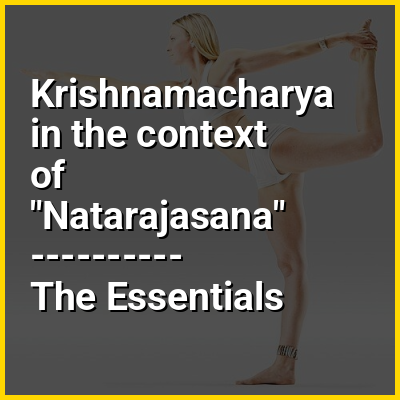
Natarajasana (Sanskrit: नटराजासन, romanizedNaṭarājāsana), Lord of the Dance Pose or Dancer Pose is a standing, balancing, back-bending asana in modern yoga as exercise. It is derived from a pose in the classical Indian dance form Bharatnatyam, which is depicted in temple statues in the Nataraja Temple, Chidambaram. Nataraja, the "Dancing King", is in turn an aspect of the Hindu God Shiva, depicted in bronze statues from the Chola dynasty. The asana was most likely introduced into modern yoga by Krishnamacharya in the early 20th century, and taken up by his pupils, such as B. K. S. Iyengar, who made the pose his signature. Natarajasana is among the yoga poses often used in advertising, denoting desirable qualities such as flexibility and grace.

↓ Explore More Topics
In this Dossier

Krishnamacharya in the context of Asana

An āsana (Sanskrit: आसन) is a body posture, originally and still a general term for a sitting meditation pose, and later extended in hatha yoga and modern yoga as exercise, to any type of position, adding reclining, standing, inverted, twisting, and balancing poses. The Yoga Sutras of Patanjali define "asana" as "[a position that] is steady and comfortable". Patanjali mentions the ability to sit for extended periods as one of the eight limbs of his system. Asanas are also called yoga poses or yoga postures in English.

The 10th or 11th century Goraksha Sataka and the 15th century Hatha Yoga Pradipika identify 84 asanas; the 17th century Hatha Ratnavali provides a different list of 84 asanas, describing some of them. In the 20th century, Indian nationalism favoured physical culture in response to colonialism. In that environment, pioneers such as Yogendra, Kuvalayananda, and Krishnamacharya taught a new system of asanas (incorporating systems of exercise as well as traditional hatha yoga). Among Krishnamacharya's pupils were influential Indian yoga teachers including Pattabhi Jois, founder of Ashtanga (vinyasa) yoga, and B.K.S. Iyengar, founder of Iyengar yoga. Together they described hundreds more asanas, revived the popularity of yoga, and brought it to the Western world. Many more asanas have been devised since Iyengar's 1966 Light on Yoga which described some 200 asanas. Hundreds more were illustrated by Dharma Mittra.

↑ Return to Menu

Krishnamacharya in the context of Yoga Sutras of Patanjali

The Yoga Sutras of Patañjali (IAST: Patañjali yoga-sūtra) is a compilation "from a variety of sources" of Sanskrit sutras (aphorisms) on the practice of yoga – 195 sutras (according to Vyāsa and Krishnamacharya) and 196 sutras (according to others, including BKS Iyengar). The Yoga Sutras were compiled in India in the early centuries CE by the sage Patanjali, who collected and organized knowledge about yoga from Samkhya, Buddhism, and older Yoga traditions, and possibly another compiler who may have added the fourth chapter. He may also be the author of the Yogabhashya, a commentary on the Yoga Sutras, traditionally attributed to the legendary Vedic sage Vyasa, but possibly forming a joint work of Patanjali called the Pātañjalayogaśāstra.

The Yoga Sutras draw from three distinct traditions from the 2nd century BCE to the 1st century CE, namely Samkhya, Buddhism traditions, and "various older ascetic and religious strands of speculation." The Yoga Sutras are built on Samkhya notions of purusha and prakriti, and are often seen as complementary to it. It is closely related to Buddhism, incorporating some of its terminology. While there is "an apparent lack of unity and coherence," there is a "straightforward unity to the text," which focuses on "one-pointed awareness" (ekagrata) and "content-free awareness" (nirvikalpa samadhi); the means to acquire these, namely kriya yoga ("action yoga") and ashtanga yoga (eight-limb yoga); the results acquired from the attainment of these levels of awareness; and the final goal of yoga, namely kaivalya and liberation.

↑ Return to Menu

Krishnamacharya in the context of Yoga as exercise

Yoga as exercise is a physical activity consisting mainly of postures, often connected by flowing sequences, sometimes accompanied by breathing exercises, and frequently ending with relaxation lying down or meditation. Yoga in this form has become familiar across the world, especially in the US and Europe. It is derived from medieval Haṭha yoga, which made use of similar postures, but it is generally simply called "yoga". Academic research has given yoga as exercise a variety of names, including modern postural yoga and transnational anglophone yoga.

Postures were not central in any of the older traditions of yoga; posture practice was revived in the 1920s by yoga gurus including Yogendra and Kuvalayananda, who emphasised its health benefits. The flowing sequences of Surya Namaskar (Salute to the Sun) were pioneered by the Rajah of Aundh, Bhawanrao Shrinivasrao Pant Pratinidhi, in the 1920s. It and many standing poses used in gymnastics were incorporated into yoga by the yoga teacher Krishnamacharya in Mysore from the 1930s to the 1950s. Several of his students went on to found influential schools of yoga: Pattabhi Jois created Ashtanga Vinyasa Yoga, which in turn led to Power Yoga; B. K. S. Iyengar created Iyengar Yoga, and defined a modern set of yoga postures in his 1966 book Light on Yoga; and Indra Devi taught yoga as exercise to many celebrities in Hollywood. Other major schools founded in the 20th century include Bikram Yoga and Sivananda Yoga. Yoga as exercise spread across America and Europe, and then the rest of the world.

↑ Return to Menu

Krishnamacharya in the context of Standing asanas

The standing asanas are the yoga poses or asanas with one or both feet on the ground, and the body more or less upright. They are among the most distinctive features of modern yoga as exercise. Until the 20th century there were very few of these, the best example being Vrikshasana, Tree Pose. From the time of Krishnamacharya in Mysore, many standing poses have been created. Two major sources of these asanas have been identified: the exercise sequence Surya Namaskar (the salute to the sun); and the gymnastics widely practised in India at the time, based on the prevailing physical culture.

The origin of standing asanas has been controversial since Mark Singleton argued in 2010 that some forms of modern yoga represent a radical reworking of hatha yoga, in particular by adding standing asanas and transitions (vinyasas) between them, and by suppressing most non-postural aspects of yoga, rather than a smooth continuation of ancient traditions. These changes enabled yoga to be practised as a flowing sequence of movements rather than as static poses, and in turn this allowed sessions to focus on aerobic exercise.

↑ Return to Menu

Krishnamacharya in the context of Pattabhi Jois

K. Pattabhi Jois (26 July 1915 – 18 May 2009) was an Indian yoga guru who developed and popularized the flowing style of yoga as exercise known as Ashtanga (vinyasa) yoga. In 1948, Jois established the Ashtanga Yoga Research Institute in Mysore, India. Pattabhi Jois is one of a short list of Indians instrumental in establishing modern yoga as exercise in the 20th century, along with B. K. S. Iyengar, another pupil of Krishnamacharya in Mysore. Jois sexually abused some of his yoga students by touching inappropriately during adjustments. Sharath Jois has publicly apologised for his grandfather's "improper adjustments".

↑ Return to Menu