King of Bavaria in the context of "Maximilian II of Bavaria"

Play Trivia Questions online!

or

Skip to study material about King of Bavaria in the context of "Maximilian II of Bavaria"


⭐ Core Definition: King of Bavaria

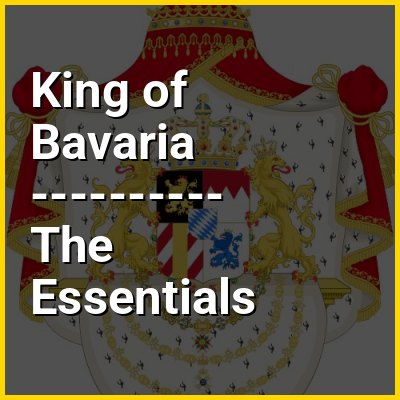
The King of Bavaria (German: König von Bayern) was a title held by the hereditary Wittelsbach rulers of Bavaria in the state known as the Kingdom of Bavaria from 1805 until 1918, when the kingdom was abolished. It was the second time Bavaria was a kingdom, almost a thousand years after the short-lived Carolingian kingdom of Bavaria.

↓ Menu

👉 King of Bavaria in the context of Maximilian II of Bavaria

Maximilian II (28 November 1811 – 10 March 1864) reigned as King of Bavaria between 1848 and 1864.

Ascending the throne during the German Revolution of 1848, King Maximilian restored stability in his kingdom. The rest of his reign was characterized by attempts to maintain Bavarian independence during the wars of German Unification and to transform his capital city of Munich into a cultural and educational city. He was very popular and took a greater interest in the business of government than in personal extravagance.

↓ Explore More Topics
In this Dossier

King of Bavaria in the context of Electorate of Bavaria

The Electorate of Bavaria (German: Kurfürstentum Bayern) was a quasi-independent hereditary electorate of the Holy Roman Empire from 1623 to 1806, when it was succeeded by the Kingdom of Bavaria.

The Wittelsbach dynasty which ruled the Duchy of Bavaria was the younger branch of the family which also ruled the Electoral Palatinate. The head of the elder branch was one of the seven prince-electors of the Holy Roman Empire according to the Golden Bull of 1356, but Bavaria was excluded from the electoral dignity. In 1621, Frederick V, Elector Palatine was put under the imperial ban for his role in the Bohemian Revolt against Ferdinand II, Holy Roman Emperor, and the electoral dignity and territory of the Upper Palatinate was conferred upon his loyal cousin, Duke Maximilian I of Bavaria. Although the Peace of Westphalia would create a new electoral title for Frederick V's son, with the exception of a brief period during the War of the Spanish Succession, Maximilian's descendants would continue to hold the original electoral dignity until the extinction of his line in 1777. At that point the two lines were joined in personal union until the end of the Holy Roman Empire. In 1805, after the Peace of Pressburg, the then-elector, Maximilian Joseph, raised himself to the dignity of King of Bavaria, and the Holy Roman Empire was abolished the following year.

↑ Return to Menu

King of Bavaria in the context of Kingdom of Bavaria

The Kingdom of Bavaria (German: Königreich Bayern [ˈkøːnɪkʁaɪç ˈbaɪɐn]; Bavarian: Kinereich Bayern [ˈkɪnəraɪ̯x ˈb̥ajɛɐ̯n]; spelled Baiern until 1825) was a German state that succeeded the former Electorate of Bavaria in 1806 and continued to exist until 1918. With the unification of Germany into the German Empire in 1871, the kingdom became a federated state of the new empire and was second in size, power, and wealth only to the leading state, the Kingdom of Prussia.

The polity's foundation dates back to the ascension of Elector Maximilian IV Joseph of the House of Wittelsbach as King of Bavaria in 1806. The crown continued to be held by the Wittelsbachs until the kingdom came to an end in 1918. Most of the border of modern Germany's Free State of Bavaria was established after 1814 with the Treaty of Paris, in which the Kingdom of Bavaria ceded Tyrol and Vorarlberg to the Austrian Empire while receiving Aschaffenburg and Würzburg.

↑ Return to Menu

King of Bavaria in the context of Ludwig I of Bavaria

Ludwig I or Louis I (German: Ludwig I.; 25 August 1786 – 29 February 1868) was King of Bavaria from 1825 until the 1848 revolutions in the German states. When he was crown prince, he was involved in the Napoleonic Wars. As king, he encouraged Bavaria's industrialization, initiating the Ludwig Canal between the rivers Main and the Danube. In 1835, the first German railway was constructed in his domain, between Fürth and Nuremberg, with his Bavaria joining the Zollverein economic union in 1834. After the July Revolution of 1830 in France, Ludwig's previous liberal policy became increasingly repressive; in 1844, Ludwig was confronted during the Beer riots in Bavaria. During the revolutions of 1848 he faced increasing protests and demonstrations by students and the middle classes. On 20 March 1848, he abdicated in favour of his eldest son, Maximilian.

Ludwig lived another 20 years after his abdication and remained influential. An admirer of ancient Greece and the Italian Renaissance, he patronized the arts and commissioned several neoclassical buildings, especially in Munich. He was an avid collector of arts, amassing paintings from the Early German and Early Dutch periods as well as Graeco-Roman sculptures.

↑ Return to Menu

King of Bavaria in the context of Maximilian I Joseph of Bavaria

Maximilian I Joseph (German: Maximilian I. Josef; 27 May 1756 – 13 October 1825) was Duke of Zweibrücken from 1795 to 1799, prince-elector of Bavaria (as Maximilian IV Joseph) from 1799 to 1806, then King of Bavaria (as Maximilian I Joseph) from 1806 to 1825. He was a member of the House of Palatinate-Birkenfeld-Zweibrücken, a branch of the House of Wittelsbach.

↑ Return to Menu

King of Bavaria in the context of Carloman of Bavaria

Carloman (German: Karlmann, Latin: Carlomannus; c. 830 – 22 March 880) was a Frankish king of the Carolingian dynasty. He was the eldest son of Louis the German, king of East Francia, and Hemma, daughter of a Bavarian count. His father appointed him governor of Carantania in 856, and commander of southeastern frontier marches in 864. Upon his father's death in 876 he became king of Bavaria. He was appointed by King Louis II of Italy as his successor, but the Kingdom of Italy was taken by his uncle Charles the Bald in 875. Carloman only conquered it in 877. In 879 he was incapacitated, perhaps by a stroke, and abdicated his domains in favour of his younger brothers: Bavaria to Louis the Younger and Italy to Charles the Fat.

↑ Return to Menu

King of Bavaria in the context of Ludwig II of Bavaria

Ludwig II (Ludwig Otto Friedrich Wilhelm; German: [ˈluːtvɪç ˈɔto ˈfʁiː.dʁɪç ˈvɪlˌhɛlm]; 25 August 1845 – 13 June 1886), also called the Swan King or the Fairy Tale King (der Märchenkönig), was King of Bavaria from 1864 until his death in 1886. He also held the titles of Count Palatine of the Rhine, Duke of Bavaria, Duke of Franconia and Duke in Swabia. Outside Germany, he is at times called "the Mad King" or Mad King Ludwig.

Ludwig ascended to the throne in 1864 at the age of 18. He increasingly withdrew from day-to-day affairs of state in favour of extravagant artistic and architectural projects. He commissioned the construction of lavish palaces: Neuschwanstein Castle, Linderhof Palace, and Herrenchiemsee. He was also a devoted patron of the composer Richard Wagner. Ludwig spent all his own private royal revenues (although not state funds as is commonly thought) on these projects, borrowed extensively, and defied all attempts by his ministers to restrain him. This extravagance was used against him to declare him insane, a determination that is now questioned.

↑ Return to Menu

King of Bavaria in the context of King Ludwig III

Ludwig III (Ludwig Luitpold Josef Maria Aloys Alfred; 7 January 1845 – 18 October 1921) was the last King of Bavaria, reigning from 1913 to 1918. Initially, he served in the Bavarian military as a lieutenant and went on to hold the rank of Oberleutnant during the Austro-Prussian War. He entered politics at the age of 18, as a member of the Bavarian parliament, and was a keen participant, supporting electoral reforms. Later in life, he served as regent and de facto head of state from 1912 to 1913, ruling for his cousin, Otto. After the Bavarian parliament passed a law allowing him to do so, Ludwig deposed Otto and assumed the throne for himself. He led Bavaria during World War I. His short reign was seen as championing conservative causes and he was influenced by the Catholic encyclical Rerum novarum.

After the German Revolution of 1918–1919, the German Empire was dissolved and the Weimar Republic was created. As a result of this revolution, the Bavarian throne was abolished along with the other monarchies of the German states, ending the House of Wittelsbach's 738-year reign over Bavaria. Fearing that he might be a victim of an assassination, Ludwig fled to Hungary, Liechtenstein and then Switzerland. He returned to Bavaria in 1920 and lived at Wildenwart Castle. Ludwig would die shortly after, when he was staying at Nádasdy Mansion in Sárvár.

↑ Return to Menu