King Wen of Zhou in the context of "King Wu of Zhou"

Play Trivia Questions online!

or

Skip to study material about King Wen of Zhou in the context of "King Wu of Zhou"


⭐ Core Definition: King Wen of Zhou

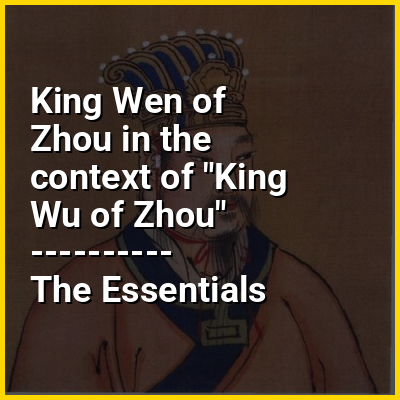
King Wen of Zhou (Chinese: , Zhōu Wén Wáng; 1152–1050 BC) was the posthumous title given to Ji Chang (Xiahou) (), the patriarch of the Zhou state during the final years of Shang dynasty in ancient China. Ji Chang himself died before the end of the Zhou–Shang war. His second son Ji Fa completed the conquest of Shang following the Battle of Muye and posthumously honored him as the founder of the Zhou dynasty. Many of the hymns of the Classic of Poetry are paeans of praise to King Wen. Some consider him the first epic hero of Chinese history.

↓ Menu

👉 King Wen of Zhou in the context of King Wu of Zhou

King Wu of Zhou (died c. 1043 BC), personal name Ji Fa, was the founding king of the Chinese Zhou dynasty. The chronology of his reign is disputed but is generally thought to have begun around 1046 BC and ended with his death three years later.

King Wu was the second son of the Zhou elder Ji Chang (posthumously titled King Wen) and Tai Si. In most accounts, his older brother Bo Yikao was said to have predeceased his father, typically at the hands of King Zhou of Shang, the last king of the Shang dynasty. In the Book of Rites, however, it is assumed that his inheritance represented an older tradition among the Zhou of passing over the eldest son. (Fa's grandfather Jili had likewise inherited Zhou despite having two older brothers.)

↓ Explore More Topics
In this Dossier

King Wen of Zhou in the context of King Wen sequence

The King Wen sequence (Chinese: 文王卦序) is an arrangement of the sixty-four divination figures in the I Ching (often translated as the Book of Changes). They are called hexagrams in English because each figure is composed of six 爻 yáo—broken or unbroken lines, that represent yin or yang respectively.

The King Wen sequence is also known as the "received" or "classical" sequence because it is the oldest surviving arrangement of the hexagrams. Its true age and authorship are unknown. Traditionally, it is said that King Wen of Zhou arranged the hexagrams in this sequence while imprisoned by King Zhou of Shang in the 12th century BC. A different arrangement, the "binary sequence" named in honor of the mythic culture hero Fu Xi, originated in the Song dynasty. It is believed to be the work of scholar Shao Yong (1011–1077 AD). As mirrored by the 先天 Earlier Heaven and 後天 Later Heaven arrangements of the eight trigrams, or bagua, it was customary to attribute authorship to these legendary figures. Of the two hexagram arrangements, the King Wen sequence is, however, of much greater antiquity than the Fu Xi sequence.

↑ Return to Menu

King Wen of Zhou in the context of State of Qi

Qi, or Ch'i in Wade–Giles romanization, was a regional state of the Zhou dynasty in ancient China, whose rulers held titles of Hou (), then Gong (), before declaring themselves independent Kings (王). Its capital was Linzi, located in present-day Shandong. Qi was founded shortly after the Zhou conquest of Shang, c. 1046 BCE. Its first monarch was Jiang Ziya (Lord Tai; r.1046–1015 BCE), minister of King Wen and a legendary figure in Chinese culture. His family ruled Qi for several centuries before it was replaced by the Tian family in 386 BCE. Qi was the final surviving state to be annexed by Qin during its unification of China.

↑ Return to Menu

King Wen of Zhou in the context of Well-field system

The well-field system or well-and-field system (Chinese: 井田制度; pinyin: jǐngtián zhìdù) was a Chinese land redistribution method existing between the eleventh or tenth century BCE (Western Zhou dynasty) to around the Warring States period. Though Mencius describes examples from the Xia and Shang dynasties, these could be mythological or imagined, and credited King Wen of Zhou as one of the persons enacting the system. The name comes from Chinese character (jǐng), which means 'well' and looks like the # symbol; this character represents the theoretical appearance of land division: a square area of land was divided into nine identically sized sections; the eight outer sections (私田; sītián) were privately cultivated by farmers, or nong in Chinese, one of the occupations of the four occupations system; and the center section (公田; gōngtián) was communally cultivated on behalf of the government, or in some cases, the landowning aristocrat or duke.

While all fields were government- or aristocrat-owned, the private fields were managed exclusively by farmers and the produce was entirely the farmers'. It was only produce from the communal fields, worked on by all eight families, that went to the government for famine distribution or the aristocrats and which, in turn, could go to the king as tribute.

↑ Return to Menu

King Wen of Zhou in the context of Cao (state)

The State of Cao (simplified Chinese: 曹国; traditional Chinese: 曹國; pinyin: Cáoguó) was a vassal state in China during the Zhou dynasty (1046–221 BC). The state was founded sometime in the 11th century BC by Shu Zhenduo of Cao (zh) (d. 1053 BC), a son of King Wen of Zhou and younger brother of King Wu of Zhou. With its capital at Taoqiu (陶丘), the State of Cao covered roughly the area of modern-day Dingtao County, Shandong Province. It was located on the flat country of the North China Plain about 50 miles east of the point where the current course of the Yellow River changes from east to north-east. To the northwest was Wey, to the northeast Lu and to the southeast Song.

↑ Return to Menu