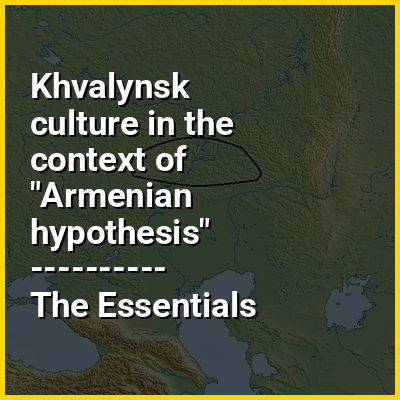
Khvalynsk culture in the context of "Armenian hypothesis"

Play Trivia Questions online!

or

Skip to study material about Khvalynsk culture in the context of "Armenian hypothesis"

Ad spacer

⭐ Core Definition: Khvalynsk culture

52°44′29″N 49°33′05″E / 52.741254°N 49.551376°E / 52.741254; 49.551376

The Khvalynsk culture is a Middle Copper Age Eneolithic culture (c. 4900 – 3500 BCE) of the middle Volga region. It takes its name from Khvalynsk in Saratov Oblast. It was preceded by the Early Eneolithic Samara culture.

↓ Menu

>>>PUT SHARE BUTTONS HERE<<<

👉 Khvalynsk culture in the context of Armenian hypothesis

The Armenian hypothesis, also known as the Near Eastern model, is a theory of the Proto-Indo-European homeland, initially proposed by linguists Tamaz V. Gamkrelidze and Vyacheslav Ivanov in the early 1980s, which suggests that the Proto-Indo-European language was spoken during the 5th–4th millennia BC in "eastern Anatolia, the southern Caucasus, and northern Mesopotamia".

Recent ancient DNA research has led to renewed suggestions of a Caucasian homeland for a "pre-proto-Indo-European". Particularly, an admixture between the Khvalynsk and Caucasian Copper Age burials gave rise to the ancestry that later became known as a typical marker (WSH – Western Steppe Herders) of the Yamnaya pastoralists. It also lends support to the Indo-Hittite hypothesis, according to which both proto-Anatolian and proto-Indo-European split off from a common mother language "no later than the 4th millennium BCE".These suggestions have been disputed in other recent research, which still locates the origin of the ancestor of proto-Indo-European in the Eastern European/Eurasian steppe or from a hybridization of both steppe and Northwest-Caucasian languages. The origin of the Anatolian languages according to the Near Eastern model has also been challenged because "[a]mong comparative linguists, a Balkan route for the introduction of Anatolian IE is generally considered more likely than a passage through the Caucasus, due to, for example, greater Anatolian IE presence and language diversity in the west."

↓ Explore More Topics
In this Dossier

Khvalynsk culture in the context of Western Steppe Herders

In archaeogenetics, the term Western Steppe Herders (WSH), or Western Steppe Pastoralists, is the name given to a distinct ancestral component first identified in individuals from the Chalcolithic steppe around the start of the 5th millennium BC, subsequently detected in several genetically similar or directly related ancient populations including the Khvalynsk, Repin, Sredny Stog, and Yamnaya cultures, and found in substantial levels in contemporary populations of Europe, Central Asia, South Asia and West Asia. This ancestry is often referred to as Yamnaya ancestry, Yamnaya-related ancestry, Steppe ancestry or Steppe-related ancestry.

Western Steppe Herders are considered to be descended from a merger between Eastern Hunter-Gatherers (EHGs) and Caucasus Hunter-Gatherers (CHGs). The WSH component is modeled as an admixture of EHG and CHG ancestral components in roughly equal proportions, with the majority of the Y-DNA haplogroup contribution from EHG males. The Y-DNA haplogroups of Western Steppe Herder males are not uniform, with the Yamnaya culture individuals mainly belonging to R1b-Z2103 with a minority of I2a2, the earlier Khvalynsk culture also with mainly R1b but also some R1a, Q1a, J, and I2a2, and the later, high WSH ancestry Corded Ware culture individuals mainly belonging to haplogroup R1b in the earliest samples, with R1a-M417 becoming predominant over time.
↑ Return to Menu