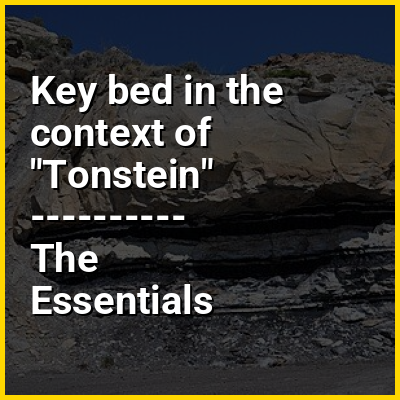
Marker horizons (also referred to as chronohorizons, key beds or marker beds) are stratigraphic units of the same age and of such distinctive composition and appearance, that, despite their presence in separate geographic locations, there is no doubt about their being of equivalent age (isochronous) and of common origin. Such clear markers facilitate the correlation of strata, and used in conjunction with fossil floral and faunal assemblages and paleomagnetism, permit the mapping of land masses and bodies of water throughout the history of the earth. They usually consist of a relatively thin layer of sedimentary rock that is readily recognized on the basis of either its distinct physical characteristics or fossil content and can be mapped over a very large geographic area. As a result, a key bed is useful for correlating sequences of sedimentary rocks over a large area. Typically, key beds were created as the result of either instantaneous events or (geologically speaking) very short episodes of the widespread deposition of a specific types of sediment. As the result, key beds often can be used for both mapping and correlating sedimentary rocks and dating them. Volcanic ash beds (tonsteins and bentonite beds) and impact spherule beds, and specific megaturbidites are types of key beds created by instantaneous events. The widespread accumulation of distinctive sediments over a geologically short period of time have created key beds in the form of peat beds, coal beds, shell beds, marine bands, black shales in cyclothems, and oil shales. A well-known example of a key bed is the global layer of iridium-rich impact ejecta that marks the Cretaceous–Paleogene boundary (K–T boundary).
Palynology, the study of fossil pollens and spores, routinely works out the stratigraphy of rocks by comparing pollen and spore assemblages with those of well-known layers—a tool frequently used by petroleum exploration companies in the search for new fields. The fossilised teeth or elements of conodonts are an equally useful tool.