Keita dynasty in the context of "Mali Empire"

Play Trivia Questions online!

or

Skip to study material about Keita dynasty in the context of "Mali Empire"

Ad spacer

⭐ Core Definition: Keita dynasty

The Keita dynasty ruled pre-imperial and imperial Mali from the 11th century into the early 17th century. It was a Muslim dynasty, and its rulers claimed descent from Bilal ibn Rabah. The early history is entirely unknown, outside of legends and myths. The first Keita mansa was Sundiata Keita. This is when Mari Jata is crowned and Keita becomes a clan name. A couple of generations after him, his great-nephew, Mansa Musa Keita I of Mali, made a celebrated pilgrimage to Mecca.

The dynasty remained a major power in West Africa from the early 13th century until the breakup of the Mali Empire around 1610. Rivals from within the clan founded smaller kingdoms within contemporary Mali and Guinea. Of the members of these modern "daughter dynasties", the late politician Modibo Keita and the musician Salif Keita are arguably the most famous.
↓ Menu

>>>PUT SHARE BUTTONS HERE<<<

👉 Keita dynasty in the context of Mali Empire

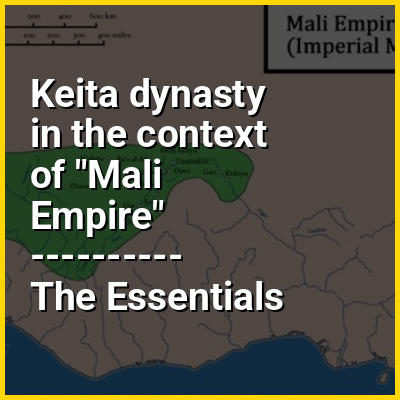
The Mali Empire (Manding: Mandé or Manden Duguba; Arabic: مالي, romanizedMālī) was an empire in West Africa from c. 1226 to 1610. The empire was founded by Sundiata Keita (c. 1214 – c. 1255) and became renowned for the wealth of its rulers, especially Mansa Musa (Musa Keita). At its peak, Mali was the largest empire in West Africa, widely influencing the culture of the region through the spread of its language, laws, and customs.

The empire began as a small Mandinka kingdom at the upper reaches of the Niger River, centered around the Manding region. It began to develop during the 11th and 12th centuries as the Ghana Empire, or Wagadu, declined and trade epicentres shifted southward. The history of the Mali Empire before the 13th century is unclear, as there are conflicting and imprecise accounts by both Arab chroniclers and oral traditionalists. The first ruler for which there is accurate written information is Sundiata Keita, a warrior-prince of the Keita dynasty who was called upon to free the local people from the rule of the king of the Sosso Empire, Soumaoro Kanté. The conquest of Sosso in c. 1235 marked the emergence of Mali as a major power, with the Kouroukan Fouga as its constitution.

↓ Explore More Topics
In this Dossier

Keita dynasty in the context of Mansa Musa

Mansa Musa (reigned c. 1312 – c. 1337) was the ninth Mansa of the Mali Empire, which reached its territorial peak during his reign. Musa's reign is often regarded as the zenith of Mali's power and prestige, although he features less in Mandinka oral traditions than his predecessors.

Musa was exceptionally wealthy, to an extent that contemporaries described him as inconceivably rich; Time magazine reported: "There's really no way to put an accurate number on his wealth." It is known from local manuscripts and travellers' accounts that Mansa Musa's wealth came principally from the Mali Empire's control and taxing of the trade in salt from northern regions and especially from gold panned and mined in Bambuk and Bure to the south. Over a very long period Mali had amassed a large reserve of gold. Mali is also believed to have been involved in the trade in many goods such as ivory, slaves, spices, silks, and ceramics. However, presently little is known about the extent or mechanics of these trades. At the time of Musa's ascension to the throne, Mali consisted largely of the territory of the former Ghana Empire, which had become a vassal of Mali. The Mali Empire comprised land that is now part of Guinea, Senegal, Mauritania, the Gambia, and the modern state of Mali.

↑ Return to Menu