K'iche' people in the context of Rigoberta Menchú


K'iche' people in the context of Rigoberta Menchú

⭐ Core Definition: K'iche' people

Kʼicheʼ (pronounced [kʼiˈtʃeʔ]; previous Spanish spelling: Quiché) are Indigenous peoples of the Americas and are one of the Maya peoples. The eponymous Kʼicheʼ language is a Mesoamerican language in the Mayan language family. The highland Kʼicheʼ states in the pre-Columbian era are associated with the ancient Maya civilization, and reached the peak of their power and influence during the Mayan Postclassic period (c. 950–1539 AD).

The meaning of the word Kʼicheʼ in the Kʼicheʼ language is "many trees". The Nahuatl translation, Cuauhtēmallān "Place of the Many Trees (People)", is the origin of the word Guatemala. Quiché Department is also named after them. Rigoberta Menchú Tum, an activist for Indigenous rights who won the Nobel Peace Prize in 1992, is perhaps the best-known Kʼicheʼ person.
↓ Menu
HINT:

👉 K'iche' people in the context of Rigoberta Menchú

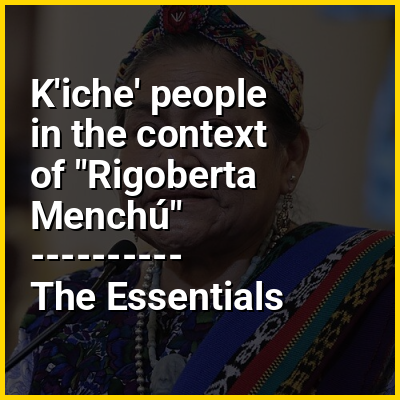
Rigoberta Menchú Tum (Spanish: [riɣoˈβeɾta menˈtʃu]; born 9 January 1959) is a K'iche' Guatemalan human rights activist, feminist, and Nobel Peace Prize laureate. Menchú has dedicated her life to publicizing the rights of Guatemala's Indigenous peoples during and after the Guatemalan Civil War (1960–1996), and to promoting Indigenous rights internationally.

She received the Nobel Peace Prize in 1992, was named a UNESCO Goodwill Ambassador in 1996, and received the Prince of Asturias Award in 1998. She is the subject of the testimonial biography I, Rigoberta Menchú (1983) and author of the autobiographical work, Crossing Borders (1998). Menchú founded the country's first indigenous political party, Winaq, and ran as its candidate for president of Guatemala in the 2007 and 2011 presidential elections.

↓ Explore More Topics
In this Dossier

K'iche' people in the context of Huehuetenango Department

Huehuetenango (Spanish pronunciation: [w̝e.we.t̪eˈnãŋ.ɡo]) is one of the 22 departments of Guatemala. It is located in the western highlands and shares the borders with the Mexican state of Chiapas in the north and west; with El Quiché in the east, and Totonicapán, Quetzaltenango and San Marcos in the south. The capital is the city of Huehuetenango.

Huehuetenango's ethnic composition is one of the most diverse in Guatemala. While the Mam are predominant in the department, other Maya groups are the Q'anjob'al, Chuj, Jakaltek, Tektik, Awakatek, Chalchitek, Akatek and K'iche'. Each of these nine Maya ethnic groups speaks its own language.

View the full Wikipedia page for Huehuetenango Department
↑ Return to Menu

K'iche' people in the context of Uspantán

Uspantán is a municipality in the Guatemalan department of El Quiché. It is one of the largest municipalities of El Quiché and stretches from the mountainous highlands in the South to the tropical lowlands in the North. The municipal seat is in Villa de San Miguel Uspantán with a population of 2,800. The birthplace of Nobel Peace Prize winner Rigoberta Menchú, a community named Laj Chimel, is located Uspantán not far from the municipal seat. Completion of paving on the road in from Chichicastenango has brought a small tourist boom to the town.

The municipality includes the pre-Columbian Maya archaeological site of Chitinamit, believed to be Jakawitz, the first capital of the K'iche' Maya.

View the full Wikipedia page for Uspantán
↑ Return to Menu

K'iche' people in the context of Adrián Recinos

Adrián Recinos (July 5, 1886 – March 8, 1962) was a Guatemalan historian, essayist, Mayanist scholar and translator, and diplomat. Recinos was a student of national history, especially the Maya civilization and the ancient history of the K'iche' and Kaqchikel people.

He published the first Spanish edition of Popol Vuh, based on his translation of the manuscript found in the Newberry Library, Chicago. He also published his translations of other ancient Mayan manuscripts, including the Anales de los Cakchiqueles.

View the full Wikipedia page for Adrián Recinos
↑ Return to Menu