Kōraku-en in the context of "Okayama"

Play Trivia Questions online!

or

Skip to study material about Kōraku-en in the context of "Okayama"

Ad spacer

⭐ Core Definition: Kōraku-en

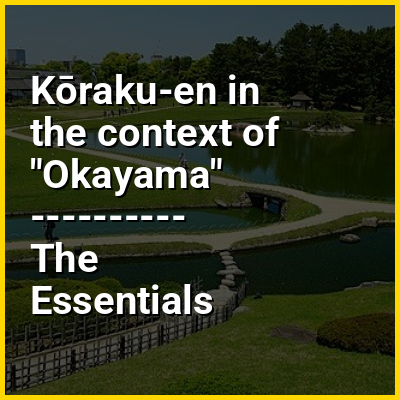
Kōraku-en (後楽園, Kōrakuen) is a Japanese garden located in Okayama, Okayama Prefecture. It is one of the Three Great Gardens of Japan, along with Kenroku-en and Kairaku-en. Korakuen was built in 1700 by Ikeda Tsunamasa, lord of Okayama. The garden reached its modern form in 1863.

Zhu Zhiyu, one of the greatest scholars of Confucianism in the Ming dynasty and Edo Japan, helped to redesign the garden.

↓ Menu

>>>PUT SHARE BUTTONS HERE<<<

👉 Kōraku-en in the context of Okayama

Okayama (岡山市, Okayama-shi; Japanese: [okaꜜjama]) is the capital city of Okayama Prefecture in the Chūgoku region of Japan. The Okayama metropolitan area, centered around the city, has the largest urban employment zone in the Chugoku region of western Japan. The city was founded on June 1, 1889. As of February 2023, the city has an estimated population of 700,940 and a population density of 890 people per km. The total area is 789.95 square kilometres (305.00 square miles).

The city is the site of Kōraku-en, known as one of the top three traditional gardens in Japan, and Okayama Castle, which is ranked among the best 100 Japanese castles. The city is famous as the setting of the Japanese fable Momotarō. Okayama joined the UNESCO Global Network of Learning Cities in 2016.

↓ Explore More Topics
In this Dossier

Kōraku-en in the context of Three Great Gardens of Japan

The Three Great Gardens of Japan (日本三名園, Nihon Sanmeien), also known as "the three most famous gardens in Japan" are considered to include Kenroku-en in Kanazawa, Kōraku-en in Okayama and Kairaku-en in Mito.

The conception of gardens in a group of three is found elsewhere, for example, in the three gardens of Emperor Go-Mizunoo, who abdicated in 1629. At Shugakuin Imperial Villa, Go-Mizunoo maintained landscaped areas at separate elevations on the northeastern outskirts of Kyoto.

↑ Return to Menu

Kōraku-en in the context of Monuments of Japan

Monuments (記念物, kinenbutsu) is a collective term used by the Japanese government's Law for the Protection of Cultural Properties to denote Cultural Properties of Japan as historic locations such as shell mounds, ancient tombs, sites of palaces, sites of forts or castles, monumental dwelling houses and other sites of high historical or scientific value; gardens, bridges, gorges, mountains, and other places of great scenic beauty; and natural features such as animals, plants, and geological or mineral formations of high scientific value.

↑ Return to Menu

Kōraku-en in the context of Japanese garden

Japanese gardens (日本庭園, nihon teien) are traditional gardens whose designs are accompanied by Japanese aesthetics and philosophical ideas, avoid artificial ornamentation, and highlight the natural landscape. Plants and worn, aged materials are generally used by Japanese garden designers to suggest a natural landscape, and to express the fragility of existence as well as time's unstoppable advance. Ancient Japanese art inspired past garden designers. Water is an important feature of many gardens, as are rocks and often gravel. Despite there being many attractive Japanese flowering plants, herbaceous flowers generally play much less of a role in Japanese gardens than in the West, though seasonally flowering shrubs and trees are important, all the more dramatic because of the contrast with the usual predominant green. Evergreen plants are "the bones of the garden" in Japan. Though a natural-seeming appearance is the aim, Japanese gardeners often shape their plants, including trees, with great rigour.

Japanese literature on gardening goes back almost a thousand years, and several different styles of garden have developed, some with religious or philosophical implications. A characteristic of Japanese gardens is that they are designed to be seen from specific points. Some of the most significant different traditional styles of Japanese garden are the chisen-shoyū-teien ("lake-spring-boat excursion garden"), which was imported from China during the Heian period (794–1185). These were designed to be seen from small boats on the central lake. No original examples of these survive, but they were replaced by the "paradise garden" associated with Pure Land Buddhism, with a Buddha shrine on an island in the lake. Later large gardens are often in the kaiyū-shiki-teien, or promenade garden style, designed to be seen from a path circulating around the garden, with fixed stopping points for viewing. Specialized styles, often small sections in a larger garden, include the moss garden, the dry garden with gravel and rocks, associated with Zen Buddhism, the roji or teahouse garden, designed to be seen only from a short pathway, and the tsubo-niwa, a very small urban garden.
↑ Return to Menu

Kōraku-en in the context of Kenroku-en

Kenroku-en (Japanese: 兼六園; Garden of Six Attributes), located in Kanazawa, Ishikawa, Japan, is a strolling style garden constructed during the Edo period by the Maeda clan. Along with Kairaku-en and Kōraku-en, Kenroku-en is considered one of the Three Great Gardens of Japan and is noted for its beauty across all seasons, particularly in winter. Spread over nearly 25 acres, features of the landscape include meandering paths, a large pond, several tea houses, and one of Japan's oldest fountains. First opening to the public in 1871, the garden was later designated a National Site of Scenic Beauty in 1922, and subsequently received status as a National Site of Special Scenic Beauty in 1985. The grounds are open through paid admission year-round during daylight hours.

↑ Return to Menu