James Ussher in the context of "Ussher chronology"

Play Trivia Questions online!

or

Skip to study material about James Ussher in the context of "Ussher chronology"


⭐ Core Definition: James Ussher

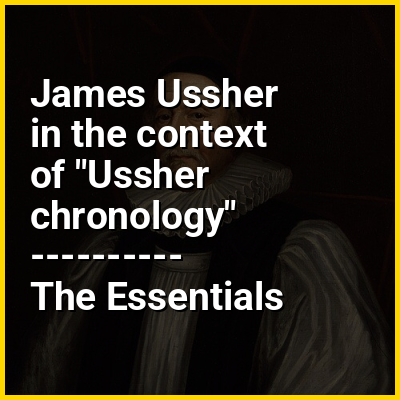
James Ussher (or Usher; 4 January 1581 – 21 March 1656) was the Church of Ireland Archbishop of Armagh and Primate of All Ireland between 1625 and 1656. He was a prolific Irish scholar and church leader, who today is most famous for his identification of the genuine letters of the church father, Ignatius of Antioch, and for his chronology that sought to establish the time and date of the creation as "the entrance of the night preceding the 23rd day of October ... the year before Christ 4004"; that is, around 6 pm on 22 October 4004 BC, per the proleptic Julian calendar.

↓ Menu

👉 James Ussher in the context of Ussher chronology

The Ussher chronology is a 17th-century chronology of the history of the world formulated from a literal reading of the Old Testament by James Ussher, the Archbishop of Armagh and Primate of All Ireland. The chronology is sometimes associated with young Earth creationism, which holds that the universe was created only a few millennia ago by God as described in the first two chapters of the biblical book of Genesis. Ussher's work fell into disrepute in the 19th century.

Published in 1650, the full title of Ussher's work in Latin is Annales Veteris Testamenti, a prima mundi origine deducti, una cum rerum Asiaticarum et Aegyptiacarum chronico, a temporis historici principio usque ad Maccabaicorum initia producto (Annals of the Old Testament, deduced from the first origins of the world, the chronicle of Asiatic and Egyptian matters together produced from the beginning of historical time up to the beginnings of Maccabees). Ussher's work was his contribution to the long-running theological debate on the age of the Earth. This was a major concern of many Christian scholars over the centuries.

↓ Explore More Topics
In this Dossier

James Ussher in the context of Cotton library

The Cotton or Cottonian library is a collection of manuscripts that came into the hands of the antiquarian and bibliophile Sir Robert Bruce Cotton MP (1571–1631). The collection of books and materials Sir Robert held was one of the three "foundation collections" of the British Museum in 1753. It is now one of the major collections of the Department of Manuscripts of the British Library. Cotton was of a Shropshire family who originated near Wem and were based in Alkington and employed by the Geneva Bible publisher, statesman and polymath Sir Rowland Hill in the mid 16th century.

After the Dissolution of the Monasteries, many priceless and ancient manuscripts that had belonged to the monastic libraries began to be disseminated among various owners, many of whom were unaware of the cultural value of the manuscripts. Cotton's skill lay in finding, purchasing and preserving these ancient documents. The leading scholars of the era, including Francis Bacon, Walter Raleigh, and James Ussher, came to use Sir Robert's library. Richard James acted as his librarian. The library is of special importance for having preserved the only copy of several works, including Beowulf, The Battle of Maldon, and Sir Gawain and the Green Knight.

↑ Return to Menu