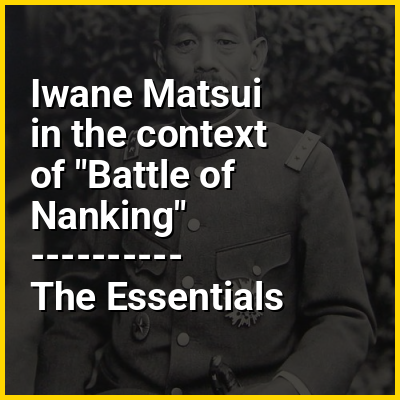
The Battle of Nanking (or Nanjing) was fought in early December 1937 during the Second Sino-Japanese War between the Chinese National Revolutionary Army and the Imperial Japanese Army for control of Nanjing (Chinese: 南京; pinyin: Nánjīng), the capital of the Republic of China.
Following the outbreak of war between Japan and China in July 1937, the Japanese and Chinese forces engaged in the vicious three-month Battle of Shanghai, where both sides suffered heavy casualties. The Japanese eventually won the battle, forcing the Chinese army into a withdrawal. Capitalizing on their victory, the Japanese officially authorized a campaign to capture Nanjing. The task of occupying Nanjing was given to General Iwane Matsui, the commander of Japan's Central China Area Army, who believed that the capture of Nanjing would force China to surrender and thus end the war. Chinese leader Chiang Kai-shek ultimately decided to defend the city and appointed Tang Shengzhi to command the Nanjing Garrison Force, a hastily assembled army of local conscripts and the remnants of the Chinese units who had fought in Shanghai.