Istoriya Slavyanobolgarskaya in the context of "Paisius of Hilendar"

Play Trivia Questions online!

or

Skip to study material about Istoriya Slavyanobolgarskaya in the context of "Paisius of Hilendar"


⭐ Core Definition: Istoriya Slavyanobolgarskaya

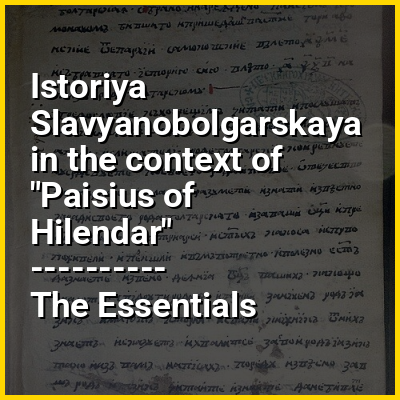
Istoriya Slavyanobolgarskaya (Original Cyrillic: Истори́ѧ славѣноболгарскаѧ corrected from Їстори́ѧ славѣноболгарскаѧ; Bulgarian: История славянобългарска, romanizedIstoriya slavyanobalgarska, lit.'Slav-Bulgarian History') is a book by Bulgarian scholar and clergyman Saint Paisius of Hilendar. Written in 1762, it is considered Saint Paisius of Hilendar's greatest work and one of the most influential pieces of the Bulgarian revival.

Although he was based in the Serbian monastery Hilandar, which was inhabited then mostly by Bulgarian monks, Paisius travelled extensively throughout the country and abroad and collected a vast amount of references to compile and write his concise but historically influential version of Bulgarian history. At that time the influx of Serbian monks decreased at the expense of Bulgarians, particularly from Macedonia. From the 17th to the 19th century, Hilandar was predominantly Bulgarian-populated.
↓ Menu

👉 Istoriya Slavyanobolgarskaya in the context of Paisius of Hilendar

Saint Paisius of Hilendar or Paìsiy Hilendàrski (Bulgarian: Свети Паисий Хилендарски) (1722–1773) was a Bulgarian Orthodox clergyman and a key Bulgarian National Revival figure. He is most famous for being the author of Istoriya Slavyanobolgarskaya (1762), the first significant modern Bulgarian history that became famous and has been copied and distributed everywhere in the Bulgarian lands. The book is, overall, the third modern work of Bulgarian history, after the works titled "History of Bulgaria" by Petar Bogdan Bakshev in 1667 and by Blasius Kleiner in 1761. He is considered the forefather of the Bulgarian National Revival.

Paisius was born in the Samokov eparchy of the time. There is a scientific dispute about the exact place of his birth, although the prevailing consensus points to the town of Bansko. He established himself in the Hilandar monastery in 1745, where he was later a hieromonk and deputy-abbot. Collecting materials for two years through hard work and even visiting the Habsburg monarchy, he finished his Istoriya Slavyanobolgarskaya in 1762 in the Zograf Monastery. The book was the first attempt to write a complete history of Bulgaria and attempted to awaken and strengthen Bulgarian national consciousnesses.

↓ Explore More Topics
In this Dossier

Istoriya Slavyanobolgarskaya in the context of Bulgarian National Revival

The Bulgarian Revival (Bulgarian: Българско възраждане, Balgarsko vazrazhdane or simply: Възраждане, Vazrazhdane, and Turkish: Bulgar ulus canlanması), sometimes called the Bulgarian National Revival, was a period of socio-economic development and national integration among Bulgarian people under Ottoman rule. It is commonly accepted to have started with the historical book, Istoriya Slavyanobolgarskaya, written in 1762 by Paisius, a Bulgarian monk of the Hilandar monastery at Mount Athos, leading to the National awakening of Bulgaria and the modern Bulgarian nationalism, and lasting until the Liberation of Bulgaria in 1878 as a result of the Russo-Turkish War of 1877–1878.

↑ Return to Menu