Ionic order in the context of Erechtheum


Ionic order in the context of Erechtheum

⭐ Core Definition: Ionic order

The Ionic order is one of the three canonic orders of classical architecture, the other two being the Doric and the Corinthian. There are two lesser orders: the Tuscan (a plainer Doric), and the rich variant of Corinthian called the composite order. Of the three classical canonic orders, the Corinthian order has the narrowest columns, followed by the Ionic order, with the Doric order having the widest columns.

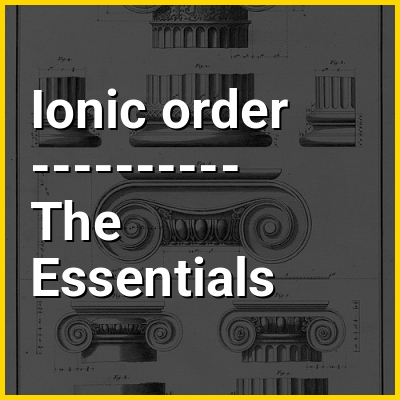
The Ionic capital is characterized by the use of volutes. Ionic columns normally stand on a base which separates the shaft of the column from the stylobate or platform while the cap is usually enriched with egg-and-dart.

↓ Menu
HINT:

In this Dossier

Ionic order in the context of Ancient Greek temple

Greek temples (Ancient Greek: ναός, romanizednāós, lit.'dwelling', semantically distinct from Latin templum, "temple") were structures built to house deity statues within Greek sanctuaries in ancient Greek religion. The temple interiors did not serve as meeting places, since the sacrifices and rituals dedicated to the deity took place outside them, within the wider precinct of the sanctuary, which might be large. Temples were frequently used to store votive offerings. They are the most important and most widespread surviving building type in Greek architecture. In the Hellenistic kingdoms of Southwest Asia and of North Africa, buildings erected to fulfill the functions of a temple often continued to follow the local traditions. Even where a Greek influence is visible, such structures are not normally considered as Greek temples. This applies, for example, to the Graeco-Parthian and Bactrian temples, or to the Ptolemaic examples, which follow Egyptian tradition. Most Greek temples were oriented astronomically.

Between the 9th century BC and the 6th century BC, the ancient Greek temples developed from the small mud brick structures into double-porched monumental "peripteral" buildings with colonnade on all sides, often reaching more than 20 metres in height (not including the roof). Stylistically, they were governed by the regionally specific architectural orders. Whereas the distinction was originally between the Doric and Ionic orders, a third alternative arose in late 3rd century with the Corinthian order. A multitude of different ground plans were developed, each of which could be combined with the superstructure in the different orders. Temples would be destroyed due to warfare in the Greek World or from lack of repairs. Some of these temples such as the temple of Poseidon Soter (The Savior) would be rebuilt outside of Athens after the defeat of the Persian Empire in 449. From the 3rd century onward, the construction of large temples became less common; after a short 2nd century BC flourish, it ceased nearly entirely in the 1st century BC. Thereafter, only smaller structures were started, while older temples continued to be renovated or brought to completion if in an unfinished state.

View the full Wikipedia page for Ancient Greek temple
↑ Return to Menu

Ionic order in the context of Erechtheion

The Erechtheion (/ɪˈrɛkθiən/, latinized as Erechtheum /ɪˈrɛkθiəm, ˌɛrɪkˈθəm/; Ancient Greek: Ἐρέχθειον, Greek: Ερέχθειο) or Temple of Athena Polias is an ancient Greek Ionic temple, on the north side of the Acropolis, Athens, that was primarily dedicated to the goddess Athena.

The iconic Ionic building, which housed the statue of Athena Polias, has in modern scholarship been called the Erechtheion (the sanctuary of Erechtheus or Poseidon), in the belief that it encompassed two buildings mentioned by the Greek-Roman geographer Pausanias: the Temple of Athena Polias; and the Erechtheion.

View the full Wikipedia page for Erechtheion
↑ Return to Menu

Ionic order in the context of Temple of Athena Nike

The Temple of Athena Nike (Greek: Ναός Αθηνάς Νίκης, Naós Athinás Níkis) is a temple on the Acropolis of Athens, dedicated to the goddesses Athena and Nike. Built around 420 BC, the temple is the earliest fully Ionic temple on the Acropolis. It has a prominent position on a steep bastion at the south west corner of the Acropolis to the right of the entrance, the Propylaea. In contrast to the Acropolis proper, a walled sanctuary entered through the Propylaea, the Victory Sanctuary was open, entered from the Propylaea's southwest wing and from a narrow stair on the north. The sheer walls of its bastion were protected on the north, west, and south by the Nike Parapet, named for its frieze of Nikai celebrating victory and sacrificing to their patroness, Athena and Nike.

Nike was the goddess of victory in Greek mythology, and Athena was worshipped in this form, representative of being victorious in war. The citizens worshipped the goddesses in hopes of a successful outcome in the long Peloponnesian War fought against the Spartans and allies.

View the full Wikipedia page for Temple of Athena Nike
↑ Return to Menu

Ionic order in the context of Classical architecture

Classical architecture typically refers to architecture consciously derived from the principles of Greek and Roman architecture of classical antiquity, or more specifically, from De architectura (c. 10 AD) by the Roman architect Vitruvius. Variations of classical architecture have arguably existed since the Carolingian Renaissance, and became especially prominent during the Italian Renaissance and the later period known as neoclassical architecture or Classical revival. While classical styles of architecture can vary, they generally share a common "vocabulary" of decorative and structural elements. Across much of the Western world, classical architectural styles have dominated the history of architecture from the Renaissance until World War II. Classical architecture continues to influence contemporary architects.

The term classical architecture can also refer to any architectural tradition that has evolved to a highly refined form, such as classical Chinese or Mayan architecture. It may also describe architecture that adheres to classical aesthetic philosophy. The term might be used differently from "traditional" or "vernacular architecture", it can share underlying axioms with it.

View the full Wikipedia page for Classical architecture
↑ Return to Menu

Ionic order in the context of Doric order

The Doric order is one of the three orders of ancient Greek and later Roman architecture; the other two canonical orders were the Ionic and the Corinthian. The Doric is most easily recognized by the simple circular capitals at the top of the columns. Originating in the western Doric region of Greece, it is the earliest and, in its essence, the simplest of the orders, though still with complex details in the entablature above.

The Greek Doric column was fluted, and had no base, dropping straight into the stylobate or platform on which the temple or other building stood. The capital was a simple circular form, with some mouldings, under a square cushion that is very wide in early versions, but later more restrained. Above a plain architrave, the complexity comes in the frieze, where the two features originally unique to the Doric, the triglyph and gutta, are skeuomorphic memories of the beams and retaining pegs of the wooden constructions that preceded stone Doric temples. In stone they are purely ornamental.

View the full Wikipedia page for Doric order
↑ Return to Menu

Ionic order in the context of Classical orders

An order in architecture is a certain assemblage of parts subject to uniform established proportions, regulated by the office that each part has to perform.Coming down to the present from Ancient Greek and Ancient Roman civilization, the architectural orders are the styles of classical architecture, each distinguished by its proportions and characteristic profiles and details, and most readily recognizable by the type of column employed. The three orders of architecture—the Doric, Ionic, and Corinthian—originated in Greece. To these the Romans added, in practice if not in name, the Tuscan, which they made simpler than Doric, and the Composite, which was more ornamental than the Corinthian. The architectural order of a classical building is akin to the mode or key of classical music; the grammar or rhetoric of a written composition. It is established by certain modules like the intervals of music, and it raises certain expectations in an audience attuned to its language.

Whereas the orders were essentially structural in Ancient Greek architecture, which made little use of the arch until its late period, in Roman architecture where the arch was often dominant, the orders became increasingly decorative elements except in porticos and similar uses. Columns shrank into half-columns emerging from walls or turned into pilasters. This treatment continued after the conscious and "correct" use of the orders, initially following exclusively Roman models, returned in the Italian Renaissance. Greek Revival architecture, inspired by increasing knowledge of Greek originals, returned to more authentic models, including ones from relatively early periods.

View the full Wikipedia page for Classical orders
↑ Return to Menu

Ionic order in the context of Corinthian order

The Corinthian order (Greek: Κορινθιακὸς ῥυθμός, Korinthiakós rythmós; Latin: Ordo Corinthius) is the last developed and most ornate of the three principal classical orders of Ancient Greek architecture and Roman architecture. The other two are the Doric order, which was the earliest, followed by the Ionic order. In Ancient Greek architecture, the Corinthian order follows the Ionic in almost all respects, other than the capitals of the columns, though this changed in Roman architecture.

A Corinthian capital may be seen as an enriched development of the Ionic capital, though one may have to look closely at a Corinthian capital to see the Ionic volutes ("helices"), at the corners, perhaps reduced in size and importance, scrolling out above the two ranks of stylized acanthus leaves and stalks ("cauliculi" or caulicoles), eight in all, and to notice that smaller volutes scroll inwards to meet each other on each side. The leaves may be quite stiff, schematic and dry, or they may be extravagantly drilled and undercut, naturalistic and spiky. The flat abacus at the top of the capital has a concave curve on each face, and usually a single flower ("rosette") projecting from the leaves below overlaps it on each face.

View the full Wikipedia page for Corinthian order
↑ Return to Menu

Ionic order in the context of Greek Revival

Greek Revival architecture is a style that began in the middle of the 18th century but which particularly flourished in the late 18th and early 19th centuries, predominantly in northern Europe, the United States, and Canada, and Greece following that nation's independence in 1821. It revived many aspects of the forms and styles of ancient Greek architecture, including the Greek temple. A product of Hellenism, Greek Revival architecture is looked upon as the last phase in the development of Neoclassical architecture, which was drawn from Roman architecture. The term was first used by Charles Robert Cockerell in a lecture he gave as an architecture professor at the Royal Academy of Arts in London in 1842.

With newfound access to Greece and Turkey, or initially to the books produced by the few who had visited the sites, archaeologist–architects of the period studied the Doric and Ionic orders. Despite its universality rooted in ancient Greece, the Greek Revival idiom was considered an expression of local nationalism and civic virtue in each country that adopted it, and freedom from the lax detail and frivolity that then characterized the architecture of France and Italy, two countries where the style never really took architecturally. Greek Revival architecture was embraced in Great Britain, Germany, and the United States, where the idiom was regarded as being free from ecclesiastical and aristocratic associations and was appealed to each country's emerging embrace of classical liberalism.

View the full Wikipedia page for Greek Revival
↑ Return to Menu

Ionic order in the context of Frieze

In classical architecture, the frieze /frz/ is the wide central section of an entablature and may be plain in the Ionic or Corinthian orders, or decorated with bas-reliefs. Paterae are also usually used to decorate friezes. Even when neither columns nor pilasters are expressed, on an astylar wall it lies upon the architrave ("main beam") and is capped by the moldings of the cornice. A frieze can be found on many Greek and Roman buildings, the Parthenon Frieze being the most famous, and perhaps the most elaborate.

In interiors, the frieze of a room is the section of wall above the picture rail and under the crown moldings or cornice. By extension, a frieze is a long stretch of painted, sculpted or even calligraphic decoration in such a position, normally above eye-level. Frieze decorations may depict scenes in a sequence of discrete panels. The material of which the frieze is made may be plasterwork, carved wood or other decorative medium.

View the full Wikipedia page for Frieze
↑ Return to Menu