Internment camp in the context of "Death march"

Play Trivia Questions online!

or

Skip to study material about Internment camp in the context of "Death march"

Ad spacer

⭐ Core Definition: Internment camp

Internment is the imprisonment of people, commonly in large groups, without charges or intent to file charges. The term is especially used for the confinement "of enemy citizens in wartime or of terrorism suspects". Thus, while it can simply mean imprisonment, it tends to refer to preventive confinement rather than confinement after having been convicted of some crime. Use of these terms is subject to debate and political sensitivities. The word internment is also occasionally used to describe a neutral country's practice of detaining belligerent armed forces and equipment on its territory during times of war, under the Hague Convention of 1907.

Interned persons may be held in prisons or in facilities known as internment camps or concentration camps. The term concentration camp originates from the Spanish–Cuban Ten Years' War when Spanish forces detained Cuban civilians in camps in order to more easily combat guerrilla forces. Over the following decades the British during the Second Boer War and the Americans during the Philippine–American War also used concentration camps.
↓ Menu

>>>PUT SHARE BUTTONS HERE<<<

👉 Internment camp in the context of Death march

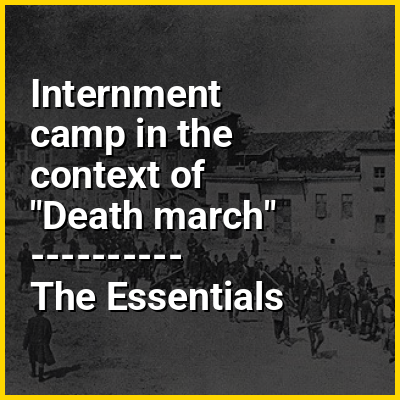
A death march is a forced march of prisoners of war, other captives, or deportees in which individuals are left to die along the way. It is distinct from simple prisoner transport via foot march. Article 19 of the Geneva Convention requires that prisoners must be moved away from a danger zone such as an advancing front line, to a place that may be considered more secure. It is not required to evacuate prisoners who are too unwell or injured to move. In times of war, such evacuations can be difficult to carry out.

Death marches usually feature harsh physical labor and abuse, neglect of prisoner injury and illness, deliberate starvation and dehydration, humiliation, torture, and execution of those unable to keep up the marching pace. The march may end at a prisoner-of-war camp or internment camp, or it may continue until all those who are forced to march are dead.

↓ Explore More Topics
In this Dossier

Internment camp in the context of Empire of the Sun (film)

Empire of the Sun is a 1987 American epic coming-of-age war drama film directed by Steven Spielberg and written by Tom Stoppard, based on J. G. Ballard's semi-autobiographical 1984 novel of the same name. The film tells the story of Jamie "Jim" Graham (Christian Bale), a young boy who goes from living with his wealthy British family in Shanghai to becoming a prisoner of war in an internment camp operated by the Japanese during World War II. The film also stars John Malkovich, Miranda Richardson, Nigel Havers, Joe Pantoliano, Masatō Ibu, Leslie Phillips, Ben Stiller, and Robert Stephens.

Harold Becker and David Lean were originally to direct before Spielberg came on board, initially as a producer for Lean. Spielberg was attracted to directing the film because of a personal connection to Lean's films and World War II topics. He considers it to be his most profound work on "the loss of innocence". The film received positive reviews, with praise towards Bale's performance, the cinematography, the visuals, Williams's score and Spielberg's direction. However, the film was not initially a commercial success, earning only $22 million at the US box office, although it eventually more than recouped its budget through revenues in foreign markets, home video, and television.

↑ Return to Menu

Internment camp in the context of Prisoner-of-war camp

A prisoner-of-war camp (often abbreviated as POW camp) is a site for the containment of enemy fighters captured as prisoners of war by a belligerent power in time of war.

There are significant differences among POW camps, internment camps, and military prisons. Purpose-built prisoner-of-war camps appeared at Norman Cross in England in 1797 during the French Revolutionary Wars and HM Prison Dartmoor, constructed during the Napoleonic Wars, and they have been in use in all the main conflicts of the last 200 years. The main camps are used for marines, sailors, soldiers, and more recently, airmen of an enemy power who have been captured by a belligerent power during or immediately after an armed conflict. Civilians, such as merchant mariners and war correspondents, have also been imprisoned in some conflicts. Per the 1929 Geneva Convention on Prisoners of War, later superseded by the Third Geneva Convention, such camps have been required to be open to inspection by representatives of a neutral power, but this hasn't always been consistently applied.

↑ Return to Menu