International Military Tribunal for the Far East in the context of "Nanjing Massacre"

Play Trivia Questions online!

or

Skip to study material about International Military Tribunal for the Far East in the context of "Nanjing Massacre"

Ad spacer

⭐ Core Definition: International Military Tribunal for the Far East

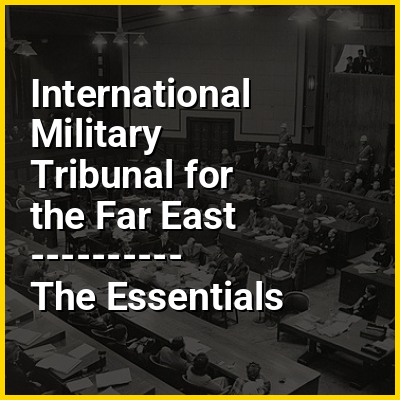
The International Military Tribunal for the Far East (IMTFE), also known as the Tokyo Trial and the Tokyo War Crimes Tribunal, was a military trial convened on April 29, 1946 to try leaders of the Empire of Japan for their crimes against peace, conventional war crimes, and crimes against humanity, leading up to and during World War II. The IMTFE was modeled after the International Military Tribunal (IMT) at Nuremberg, Germany, which prosecuted the leaders of Nazi Germany for their war crimes, crimes against peace, and crimes against humanity.

Following Japan's defeat and occupation by the Allies, the Supreme Commander for the Allied Powers, United States General Douglas MacArthur, issued a special proclamation establishing the IMTFE. A charter was drafted to establish the court's composition, jurisdiction, and procedures; the crimes were defined based on the Nuremberg Charter. The Tokyo War Crimes Tribunal was composed of judges, prosecutors, and staff from eleven countries that had fought against Japan: Australia, Canada, China, France, India, the Netherlands, New Zealand, the Philippines, the Soviet Union, the United Kingdom, and the United States; the defense consisted of Japanese and American lawyers. The Tokyo Trial exercised broader temporal jurisdiction than its counterpart in Nuremberg, beginning from the 1931 Japanese invasion of Manchuria. Twenty-eight high-ranking Japanese military and political leaders were tried by the court, including current and former prime ministers, cabinet members, and military commanders. They were charged with fifty-five separate counts, including the waging wars of aggression, murder, and various war crimes and crimes against humanity (such as torture and forced labor) against prisoners-of-war, civilian internees, and the inhabitants of occupied territories; ultimately, 45 of the counts, including all the murder charges, were ruled either redundant or not authorized under the IMTFE Charter. The Tokyo Trial lasted more than twice as long as the better-known Nuremberg trials, and its impact was similarly influential in the development of international law; similar international war crimes tribunals would not be established until the 1990s.
↓ Menu

>>>PUT SHARE BUTTONS HERE<<<

👉 International Military Tribunal for the Far East in the context of Nanjing Massacre

The Nanjing Massacre or the Rape of Nanjing (formerly romanized as Nanking) was the mass rape and murder of Chinese civilians, noncombatants, and prisoners of war by the Imperial Japanese Army in Nanjing, the capital of the Republic of China. It took place immediately after the Battle of Nanking and retreat of the National Revolutionary Army during the Second Sino-Japanese War.

Many scholars support the validity of the International Military Tribunal for the Far East (IMTFE), which estimated that more than 200,000 people were killed, while newer estimates adhere to a death toll between 100,000 and 200,000. Other estimates of the death toll vary from a low of 40,000 (confined just to the city itself) to a high of over 340,000 (encompassing the entire Shanghai-Nanjing region), and estimates of rapes range from 4,000 to over 80,000 (with estimates around 20,000 being most common).

↓ Explore More Topics
In this Dossier

International Military Tribunal for the Far East in the context of Yasukuni Shrine

Yasukuni Shrine (Japanese: 靖国神社 or 靖國神社, Hepburn: Yasukuni Jinja; lit.'Peaceful Country Shrine') is a Shinto shrine located in Chiyoda, Tokyo. It was founded by Emperor Meiji in June 1869 and commemorates those who died in service of Japan, from the Boshin War of 1868–1869, to the two Sino-Japanese Wars, 1894–1895 and 1937–1945 respectively, and the First Indochina War of 1946–1954. The shrine's purpose has been expanded over the years to include those who died in the wars involving Japan spanning from the entire Meiji and Taishō periods, and the earlier part of the Shōwa period.

The shrine lists the names, origins, birthdates and places of death of 2,466,532 people. Among those are 1,066 convicted war criminals from the Pacific War, twelve of whom were charged with Class A crimes (the planning, preparation, initiation, or waging of the war). Eleven were convicted on those charges, with the twelfth found not guilty on all such charges, though he was found guilty of Class B war crimes. The names of two more men charged with Class A war crimes are on the list, but both died before they could be sentenced (one died during trial and one before trial), so they were never convicted.

↑ Return to Menu

International Military Tribunal for the Far East in the context of Treaty of San Francisco

The Treaty of San Francisco (サンフランシスコ講和条約, San-Furanshisuko kōwa-Jōyaku), also called the Treaty of Peace with Japan (日本国との平和条約, Nihon-koku to no Heiwa-Jōyaku), re-established peaceful relations between Japan and the Allied Powers on behalf of the United Nations by ending the legal state of war, military occupation and providing for redress for hostile actions up to and including World War II. It was signed by 49 nations on 8 September 1951, in San Francisco, United States, at the War Memorial Opera House. Italy and China were not invited, the latter due to disagreements on whether the Republic of China or the People's Republic of China represented the Chinese people. Korea was also not invited due to a similar disagreement on whether South Korea or North Korea represented the Korean people.

The treaty came into force on April 28, 1952. It ended Japan's role as an imperial power, allocated compensation to Allied nations and former prisoners of war who had suffered Japanese war crimes during World War II, ended the Allied post-war occupation of Japan, and returned full sovereignty to it. This treaty relied heavily on the Charter of the United Nations and the Universal Declaration of Human Rights to enunciate the Allies' goals. In Article 11, Japan accepted the judgments of the International Military Tribunal for the Far East and of other Allied War Crimes Courts imposed on Japan both within and outside Japan.

↑ Return to Menu

International Military Tribunal for the Far East in the context of Japanese Peace Treaty

The Treaty of San Francisco, also called the Treaty of Peace with Japan, re-established peaceful relations between Japan and the Allied powers on behalf of the United Nations by ending the legal state of war, military occupation and providing for redress for hostile actions up to and including World War II. It was signed by 49 nations on September 8, 1951, in San Francisco, United States, at the War Memorial Opera House. Italy and China were not invited, the latter due to disagreements on whether the Republic of China or the People's Republic of China represented the Chinese people. Korea was also not invited due to a similar disagreement on whether South Korea or North Korea represented the Korean people.

The treaty came into force on April 28, 1952. It ended Japan's role as an imperial power, allocated compensation to Allied nations and former prisoners of war who had suffered Japanese war crimes during World War II, ended the Allied post-war occupation of Japan, and returned full sovereignty to it. This treaty relied heavily on the Charter of the United Nations and the Universal Declaration of Human Rights to enunciate the Allies' goals. In Article 11, Japan accepted the judgments of the International Military Tribunal for the Far East and of other Allied War Crimes Courts imposed on Japan both within and outside Japan.

↑ Return to Menu