Internally displaced person in the context of "Refugees of Iraq"

Play Trivia Questions online!

or

Skip to study material about Internally displaced person in the context of "Refugees of Iraq"

Ad spacer

⭐ Core Definition: Internally displaced person

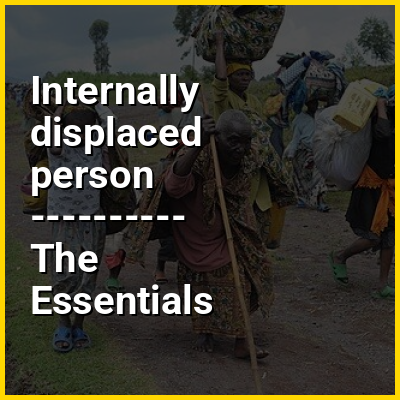
An internally displaced person (IDP) is someone who is forced to leave their home but who remains within their country's borders. They are often referred to as refugees, although they do not fall within the legal definitions of a refugee.

In 2022, it was estimated there were 70.5 million IDPs worldwide. The first year for which global statistics on IDPs are available was in 1989. As of 3 May 2022, the countries with the largest IDP populations were Ukraine (8 million), Syria (7.6 million), Sudan (7.3 million), Ethiopia (5.5 million), the Democratic Republic of the Congo (5.2 million), Colombia (4.9 million), Yemen (4.3 million), Afghanistan (3.8 million), Iraq (3.6 million), South Sudan (1.9 million), Pakistan (1.4 million), Nigeria (1.2 million) and Somalia (1.1 million). More than 85% of Palestinians in Gaza (1.9 million) were internally displaced as of January 2024.
↓ Menu

>>>PUT SHARE BUTTONS HERE<<<
In this Dossier

Internally displaced person in the context of Emergency sanitation

Emergency sanitation is the management and technical processes required to provide sanitation in emergency situations. Emergency sanitation is required during humanitarian relief operations for refugees, people affected by natural disasters and internally displaced persons. There are three phases of emergency response: Immediate, short term and long term. In the immediate phase, the focus is on managing open defecation, and toilet technologies might include very basic latrines, pit latrines, bucket toilets, container-based toilets, chemical toilets. The short term phase might also involve technologies such as urine-diverting dry toilets, septic tanks, decentralized wastewater systems. Providing handwashing facilities and management of fecal sludge are also part of emergency sanitation.

The immediate sanitation phase focuses on the provision of proper waste management resources. The main course of action during this stage is reducing open defecation. It is implemented as a course of initial action in emergency situations and it lasts from one to three months. Toilets provided might include very basic Latrines, pit latrines, Bucket toilets, container-based toilets or Chemical toilets.

↑ Return to Menu

Internally displaced person in the context of Homelessness

Homelessness, also known as houselessness or being unhoused or unsheltered, is the condition of lacking stable, safe, and functional housing. It includes living on the streets, moving between temporary accommodation with family or friends, living in boarding houses with no security of tenure, and people who leave their homes because of civil conflict and are refugees within their country.

The legal status of homeless people varies from place to place. Homeless enumeration studies conducted by the government of the United States also include people who sleep in a public or private place that is not designed for use as a regular sleeping accommodation for human beings. Homelessness and poverty are interrelated. There is no standardized method for counting homeless individuals and identifying their needs; consequently, most cities only have estimated figures for their homeless populations.

↑ Return to Menu

Internally displaced person in the context of United Nations High Commissioner for Refugees

The Office of the United Nations High Commissioner for Refugees (UNHCR) is a United Nations agency mandated to aid and protect refugees, forcibly displaced communities, and stateless people, and to assist in their voluntary repatriation, local integration or resettlement to a third country. It is headquartered in Geneva, Switzerland, and has 20,305 staff working in 136 countries as of December 2023.

↑ Return to Menu

Internally displaced person in the context of International Organization for Migration

The International Organization for Migration (IOM) is a United Nations related organization working in the field of migration. The organization implements operational assistance programmes for migrants, including internally displaced persons, refugees, and migrant workers.

The International Organization for Migration is a UN agency based in Geneva. Its director general is Amy E. Pope.

↑ Return to Menu

Internally displaced person in the context of Latakia

Latakia (/lætəˈkə/; Arabic: اللَّاذِقِيَّة, romanizedal-Lādhiqiyya; Syrian pronunciation: [el.laːdˈʔɪjje]), officially Lattakia, is the principal port city of Syria and capital city of the Latakia Governorate located on the Mediterranean coast. Historically, it has also been known as Laodicea in Syria or Laodicea ad Mare. In addition to serving as a port, the city is a significant manufacturing center for surrounding agricultural towns and villages. According to a 2023 estimate, the population of the city is 709,000, its population greatly increased as a result of the Syrian Revolution, which led to an influx of internally displaced persons from rebel held areas. It is the 5th-largest city in Syria after Aleppo, Damascus, Homs and Hama. Cape Apostolos Andreas, the north-eastern tip of Cyprus, is about 109 kilometres (68 mi) away.

Although the site of the city has been inhabited since the 2nd millennium BC, the city was founded as a Greek city in the 4th century BC under the rule of the Greek Seleucid Empire. Latakia was subsequently ruled by the Romans and Byzantines, followed by the Rashiduns, Umayyads and Abbasids during the 7th–10th centuries AD. Byzantine ruling groups frequently attacked the city, periodically recapturing it before losing it again to Arab powers, particularly the Fatimids. Afterward, Latakia was ruled successively by the Seljuk Turks, Crusaders, Ayyubids, Mamluks, and the Ottomans. Following World War I, Latakia was assigned to the French mandate of Syria, in which it served as the capital of the autonomous territory of the Alawites. This autonomous territory became the Alawite State in 1922, proclaiming its independence a number of times until reintegrating into Syria in 1944.

↑ Return to Menu

Internally displaced person in the context of BP-5 Compact Food

BP-5 Compact Food (also known as a BP-5 biscuit) is a high-calorie, vitamin fortified, compact, compressed and dry emergency food (food ration bar), often used by relief agencies for the emergency feeding of refugees and internally displaced persons.

↑ Return to Menu

Internally displaced person in the context of Forced displacement

Forced displacement (also forced migration or forced relocation) is an involuntary or coerced movement of a person or people away from their home or home region. The UNHCR defines "forced displacement" as follows: displaced "as a result of persecution, conflict, generalized violence or human rights violations".

A forcibly displaced person may also be referred to as a "forced migrant", a "displaced person" (DP), or, if displaced within the home country, an "internally displaced person" (IDP). While some displaced persons may be considered refugees, the latter term specifically refers to such displaced persons who are receiving legally defined protection and are recognized as such by their country of residence and/or international organizations.

↑ Return to Menu