Cape Apostolos Andreas in the context of "Latakia"

Play Trivia Questions online!

or

Skip to study material about Cape Apostolos Andreas in the context of "Latakia"


⭐ Core Definition: Cape Apostolos Andreas

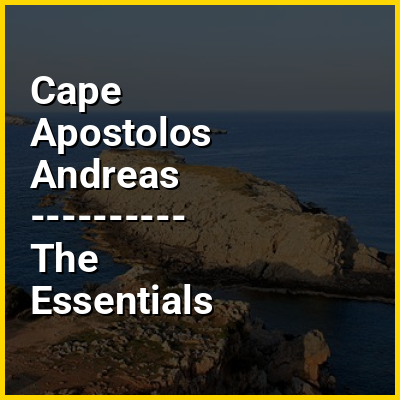
Cape Apostolos Andreas (Greek: Ακρωτήριο Αποστόλου Ανδρέα, "Cape Saint Andrew"; Turkish: Zafer Burnu, "Cape Victory") is the north-easternmost point (promontory) of the Mediterranean island of Cyprus (35°41.70′N 34°35.20′E / 35.69500°N 34.58667°E / 35.69500; 34.58667). It lies at the tip of the finger-like Karpass Peninsula.

The Apostolos Andreas Monastery is located 5 km southwest of the promontory itself.

↓ Menu

👉 Cape Apostolos Andreas in the context of Latakia

Latakia (/lætəˈkə/; Arabic: اللَّاذِقِيَّة, romanizedal-Lādhiqiyya; Syrian pronunciation: [el.laːdˈʔɪjje]), officially Lattakia, is the principal port city of Syria and capital city of the Latakia Governorate located on the Mediterranean coast. Historically, it has also been known as Laodicea in Syria or Laodicea ad Mare. In addition to serving as a port, the city is a significant manufacturing center for surrounding agricultural towns and villages. According to a 2023 estimate, the population of the city is 709,000, its population greatly increased as a result of the Syrian Revolution, which led to an influx of internally displaced persons from rebel held areas. It is the 5th-largest city in Syria after Aleppo, Damascus, Homs and Hama. Cape Apostolos Andreas, the north-eastern tip of Cyprus, is about 109 kilometres (68 mi) away.

Although the site of the city has been inhabited since the 2nd millennium BC, the city was founded as a Greek city in the 4th century BC under the rule of the Greek Seleucid Empire. Latakia was subsequently ruled by the Romans and Byzantines, followed by the Rashiduns, Umayyads and Abbasids during the 7th–10th centuries AD. Byzantine ruling groups frequently attacked the city, periodically recapturing it before losing it again to Arab powers, particularly the Fatimids. Afterward, Latakia was ruled successively by the Seljuk Turks, Crusaders, Ayyubids, Mamluks, and the Ottomans. Following World War I, Latakia was assigned to the French mandate of Syria, in which it served as the capital of the autonomous territory of the Alawites. This autonomous territory became the Alawite State in 1922, proclaiming its independence a number of times until reintegrating into Syria in 1944.

↓ Explore More Topics
In this Dossier

Cape Apostolos Andreas in the context of Northern Cyprus

Northern Cyprus, officially the Turkish Republic of Northern Cyprus (TRNC), is a de facto state comprising the northern third of the island of Cyprus. It is recognised only by Turkey, with the international community considering it territory of the Republic of Cyprus under Turkish military occupation. It extends from Cape Apostolos Andreas (the tip of the Karpass Peninsula) in the northeast to Morphou Bay in the northwest, with Cape Kormakitis at its westernmost point and the Kokkina exclave west of the mainland. A buffer zone controlled by the UN forms a barrier between both sides of the island and runs through Nicosia, the island's largest city and the capital of both sides.

After gaining independence from the United Kingdom in 1960, Cyprus was dominated by intercommunal violence between the island's Greek and Turkish populations. Greek Cypriots favoured enosis (union with Greece), while Turkish Cypriots favoured taksim (partition of the island). A coup d'état in 1974, performed as part of the Greek military junta's attempt to annex the island, prompted Turkey to invade Cyprus and capture the northern third of the island. This resulted in the eviction of much of the north's Greek Cypriot population and the flight of Turkish Cypriots from the south; the Turkish-occupied north unilaterally declared independence in 1983. UN Security Council Resolution 541 rejected the declaration as illegal and urged UN members not to recognise it. Attempts to resolve the Cyprus problem have been unsuccessful; Northern Cyprus and Turkey favour a two-state solution, while the Republic of Cyprus, the EU, and the UN favour a federalised Cyprus.

↑ Return to Menu

Cape Apostolos Andreas in the context of Karpass Peninsula

The Karpas Peninsula (Greek: Καρπασία, romanizedKarpasía; Turkish: Karpaz), also known as the Karpass, Karpaz or Karpasia, is a long, finger-like peninsula that is one of the most prominent geographical features of the island of Cyprus. Its farthest extent is Cape Apostolos Andreas, and its major population centre is the town of Rizokarpaso (Greek: Ριζοκάρπασο; Turkish: Dipkarpaz). It is currently under the de facto control of the internationally-unrecognised state of Northern Cyprus.

↑ Return to Menu

Cape Apostolos Andreas in the context of Cape Kormakitis

Cape Kormakitis (Greek: Ακρωτήριο Κορμακίτη, Akrotírio Kormakíti, Turkish: Koruçam Burnu), anciently known as Crommyon or Krommyon (Ancient Greek: Κρομμύων ἄκρα, romanizedKrommyon akra or Κρομμύου ἄκρα) and also Crommyacum or Krommyakon (Κρομμυακόν) is a promontory on the north-western coast of the Mediterranean island of Cyprus, located in the self-proclaimed republic of Northern Cyprus. Named after the nearby Maronite village of the same name, the cape marks the northernmost extent of Morphou Bay. The nearest coastal town to Cape Kormakitis is Kyrenia. Anciently, it was opposite to Anemurium in Cilicia on what is now the Turkish mainland.

The Beşparmak Trail, a 255 km long hiking trail, starts at Cape Kormakitis, and follows the Kyrenia Mountains all the way to Cape Apostolos Andreas, the north-easternmost point on Cyprus, at the tip of the Karpaz Peninsula.

↑ Return to Menu

Cape Apostolos Andreas in the context of Apostolos Andreas Monastery

Apostolos Andreas Monastery (Greek: Απόστολος Ανδρέας; Turkish: Apostolos Andreas Manastırı) is a monastery situated just south of Cape Apostolos Andreas, the north-easternmost point of the island of Cyprus, in Rizokarpaso in the Karpass Peninsula. The monastery is dedicated to Saint Andrew and is an important site for the Cypriot Orthodox Church. It was once known as "the Lourdes of Cyprus", served not by an organized community of monks but by a changing group of volunteer priests and laymen. Both Greek Cypriot and Turkish Cypriot communities consider the monastery a holy place. As such, it is visited by many people for votive prayers. The contents of the monastery are also noteworthy.

↑ Return to Menu