Insect morphology in the context of "Morphology of Diptera"

Play Trivia Questions online!

or

Skip to study material about Insect morphology in the context of "Morphology of Diptera"

Ad spacer

⭐ Core Definition: Insect morphology

Insect morphology is the study and description of the physical form of insects. The terminology used to describe insects is similar to that used for other arthropods due to their shared evolutionary history. Three physical features separate insects from other arthropods: they have a body divided into three regions (called tagmata) (head, thorax, and abdomen), three pairs of legs, and mouthparts located outside of the head capsule. This position of the mouthparts divides them from their closest relatives, the non-insect hexapods, which include Protura, Diplura, and Collembola.

There is enormous variation in body structure amongst insect species. Individuals can range from 0.3 mm (fairyflies) to 30 cm across (great owlet moth); have no eyes or many; well-developed wings or none; and legs modified for running, jumping, swimming, or even digging. These modifications allow insects to occupy almost every ecological niche except the deep ocean. This article describes the basic insect body and some variations of the different body parts; in the process, it defines many of the technical terms used to describe insect bodies.
↓ Menu

>>>PUT SHARE BUTTONS HERE<<<

👉 Insect morphology in the context of Morphology of Diptera

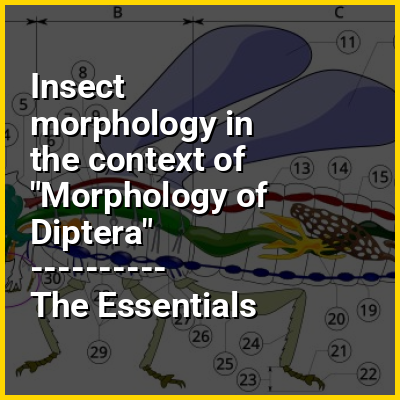
Dipteran morphology differs in some significant ways from the broader morphology of insects. The Diptera is a very large and diverse order of mostly small to medium-sized insects. They have prominent compound eyes on a mobile head, and (at most) one pair of functional, membraneous wings, which are attached to a complex mesothorax. The second pair of wings, on the metathorax, are reduced to halteres. The order's fundamental peculiarity is its remarkable specialization in terms of wing shape and the morpho-anatomical adaptation of the thorax – features which lend particular agility to its flying forms. The filiform, stylate or aristate antennae correlate with the Nematocera, Brachycera and Cyclorrhapha taxa respectively. It displays substantial morphological uniformity in lower taxa, especially at the level of genus or species. The configuration of integumental bristles is of fundamental importance in their taxonomy, as is wing venation. It displays a complete metamorphosis (egg, larva, pupa, adult), or holometabolous development. The larvae are legless, and have head capsules with mandibulate mouthparts in the Nematocera. The larvae of "higher flies" (Brachycera) are however headless and wormlike, and display only three instars. Pupae are obtect in the Nematocera, or coarcate in Brachycera.

↓ Explore More Topics
In this Dossier

Insect morphology in the context of Insect

Insects (from Latin insectum) are hexapod invertebrates of the class Insecta. They are the largest group within the arthropod phylum. Insects have a chitinous exoskeleton, a three-part body (head, thorax and abdomen), three pairs of jointed legs, compound eyes, and a pair of antennae. Insects are the most diverse group of animals, with more than a million described species; they represent more than half of all animal species.

The insect nervous system consists of a brain and a ventral nerve cord. Most insects reproduce by laying eggs. Insects breathe air through a system of paired openings along their sides, connected to small tubes that take air directly to the tissues. The blood therefore does not carry oxygen; it is only partly contained in vessels, and some circulates in an open hemocoel. Insect vision is mainly through their compound eyes, with additional small ocelli. Many insects can hear, using tympanal organs, which may be on the legs or other parts of the body. Their sense of smell is via receptors, usually on the antennae and the mouthparts.

↑ Return to Menu

Insect morphology in the context of Mayfly

Mayflies (also known as shadflies or fishflies in Canada and the upper Midwestern United States, as Canadian soldiers in the American Great Lakes region, and as up-winged flies in the United Kingdom) are aquatic insects belonging to the order Ephemeroptera. This order is part of an ancient group of insects termed the Palaeoptera, which also contains dragonflies and damselflies. Over 3,000 species of mayfly are known worldwide, grouped into over 400 genera in 42 families.

Mayflies have ancestral traits that were probably present in the first flying insects, such as long tails and wings that do not fold flat over the abdomen. Their immature stages are aquatic fresh water forms (called "naiads" or "nymphs"), whose presence indicates a clean, unpolluted and highly oxygenated aquatic environment. They are unique among insect orders in having a fully winged terrestrial preadult stage, the subimago, which moults into a sexually mature adult, the imago.

↑ Return to Menu