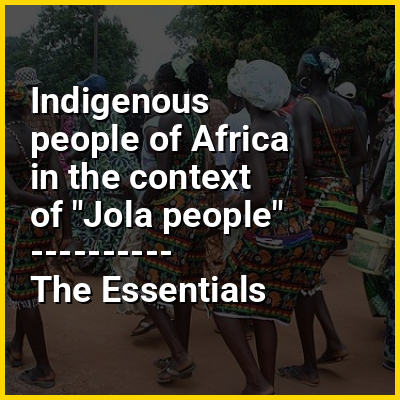
The indigenous people of Africa are groups of people native to a specific region; people who lived there before colonists or settlers arrived, defined new borders, and began to occupy the land. This definition applies to all indigenous groups, whether inside or outside of Africa. Although the vast majority of Native Africans can be considered to be "indigenous" in the sense that they originated from that continent and nowhere else (like all Homo sapiens), identity as an "indigenous people" is in the modern application more restrictive. Not every African ethnic group claims identification under these terms. Groups and communities who do claim this recognition are those who by a variety of historical and environmental circumstances have been placed outside of the dominant state systems. Their traditional practices and land claims have often come into conflict with the objectives and policies promulgated by governments, companies, and surrounding dominant societies.
Marginalization, along with the desire to recognize and protect their collective and human rights, and to maintain the continuity of their individual cultures, has led many to seek identification as indigenous peoples, in the contemporary global sense of the term. For example, in West Africa, the Dogon people of Mali and Burkina Faso, the Jola people of Guinea-Bissau, The Gambia, and Senegal, and the Serer people of Senegal, The Gambia, Guinea-Bissau, and Mauritania, and formally North Africa, have faced religious and ethnic persecution for centuries, and disenfranchisement or prejudice in modern times (see Persecution of Serers and Persecution of Dogons). These people, who are indigenous to their present habitat, are classified as indigenous peoples.