IBM in the context of Electronic business


IBM in the context of Electronic business

IBM Study page number 1 of 7

Play TriviaQuestions Online!

or

Skip to study material about IBM in the context of "Electronic business"


⭐ Core Definition: IBM

International Business Machines Corporation (using the trademark IBM), nicknamed Big Blue, is an American multinational technology company headquartered in Armonk, New York, and present in over 175 countries. It is a publicly traded company and one of the 30 companies in the Dow Jones Industrial Average. IBM is the largest industrial research organization in the world, with 19 research facilities across a dozen countries; for 29 consecutive years, from 1993 to 2021, it held the record for most annual U.S. patents generated by a business.

IBM was founded in 1911 as the Computing-Tabulating-Recording Company (CTR), a holding company of manufacturers of record-keeping and measuring systems. It was renamed "International Business Machines" in 1924 and soon became the leading manufacturer of punch-card tabulating systems. During the 1960s and 1970s, the IBM mainframe, exemplified by the System/360 and its successors, was the world's dominant computing platform, with the company producing 80 percent of computers in the U.S. and 70 percent of computers worldwide. Embracing both business and scientific computing, System/360 was the first family of computers designed to cover a complete range of applications from small to large.

↓ Menu
HINT:

In this Dossier

IBM in the context of Controlled natural language

Controlled natural languages (CNLs) are subsets of natural languages that are obtained by restricting the grammar and vocabulary in order to reduce or eliminate ambiguity and complexity. Traditionally, controlled languages fall into two major types: those that improve readability for human readers (e.g. non-native speakers),and those that enable reliable automatic semantic analysis of the language.

The first type of languages (often called "simplified" or "technical" languages), for example ASD Simplified Technical English, Caterpillar Technical English, IBM's Easy English, are used in the industry to increase the quality of technical documentation, and possibly simplify the semi-automatic translation of the documentation. These languages restrict the writer by general rules such as "Keep sentences short", "Avoid the use of pronouns", "Only use dictionary-approved words", and "Use only the active voice".

View the full Wikipedia page for Controlled natural language
↑ Return to Menu

IBM in the context of Economy of Israel

The economy of Israel is a highly developed free-market economy. The prosperity of Israel's advanced economy allows the country to have a sophisticated welfare state, a powerful modern military said to possess a nuclear-weapons capability with a full nuclear triad, modern infrastructure equivalent to developed countries, and a high-technology sector competitively on par with Silicon Valley. It has the second-largest number of startup companies in the world after the United States, and the third-largest number of NASDAQ-listed companies after the U.S. and China. American companies, such as Intel, Microsoft, and Apple, built their first overseas research and development facilities in Israel. More than 400 high-tech multi-national corporations, such as IBM, Google, Hewlett-Packard, Cisco Systems, Facebook and Motorola have opened R&D centers throughout the country. As of 2025, the IMF estimated Israel has the 25th largest economy in the world by nominal GDP, and one of the biggest economies in the Middle East.[1]

The country's major economic sectors are high-technology and industrial manufacturing. The Israeli diamond industry is one of the world's centers for diamond cutting and polishing, amounting to 21% of all exports in 2017. As the country is relatively poor in natural resources, it consequently depends on imports of petroleum, raw materials, wheat, motor vehicles, uncut diamonds and production inputs. Nonetheless, the country's nearly total reliance on energy imports may change in the future as recent discoveries of natural gas reserves off its coast and the Israeli solar energy industry have taken a leading role in Israel's energy sector.

View the full Wikipedia page for Economy of Israel
↑ Return to Menu

IBM in the context of Pointing device

A pointing device is a human interface device that allows a user to input spatial (i.e., continuous and multi-dimensional) data to a computer. Graphical user interfaces (GUI) and CAD systems allow the user to control and provide data to the computer using physical gestures by moving a hand-held mouse or similar device across the surface of the physical desktop and activating switches on the mouse. Movements of the pointing device are echoed on the screen by movements of the pointer (or cursor) and other visual changes. Common gestures are point and click and drag and drop.

While the most common pointing device by far is the mouse, many more devices have been developed. However, the term mouse is commonly used as a metaphor for devices that move a computer cursor.

View the full Wikipedia page for Pointing device
↑ Return to Menu

IBM in the context of Floppy disk

A floppy disk, diskette, or floppy diskette (casually known as a floppy or a disk) is a type of disk storage made from a thin, flexible disk coated with a magnetic storage medium. It is enclosed in a square or nearly square plastic shell lined with fabric to help remove dust from the spinning disk. Floppy disks store digital data, which can be read or written when inserted into a floppy disk drive (FDD) connected to or built into a computer or other device. The three most popular formats of floppy disks (and their drives) are the 8-inch, 5¼-inch, and 3½-inch versions.

The first floppy disks, invented and made by IBM in 1971, had a disk diameter of 8 inches (203.2 mm). Subsequently, the 5¼-inch (130 mm) and then the 3½-inch (90 mm) became a ubiquitous form of data storage and transfer into the first years of the 21st century. By the end of the 1980s, 5¼-inch disks had been superseded by 3½-inch disks. During this time, PCs frequently came equipped with drives of both sizes. By the mid-1990s, 5¼-inch drives had virtually disappeared, as the 3½-inch disk became the predominant floppy disk. The advantages of the 3½-inch disk were its higher capacity, its smaller physical size, and its rigid case which provided better protection from dirt and other environmental risks.

View the full Wikipedia page for Floppy disk
↑ Return to Menu

IBM in the context of Pentacene

Pentacene (C22H14) is a polycyclic aromatic hydrocarbon consisting of five linearly-fused benzene (C6H6) rings. This highly conjugated compound is an organic semiconductor. The compound generates excitons upon absorption of ultra-violet (UV) or visible light; this makes it very sensitive to oxidation. For this reason, this compound, which is a purple powder, slowly degrades upon exposure to air and light.

Structurally, pentacene is one of the linear acenes, the previous one being tetracene (four fused benzene rings) and the next one being hexacene (six fused benzene rings). In August 2009, a group of researchers from IBM published experimental results of imaging a single molecule of pentacene using an atomic force microscope. In July 2011, they used a modification of scanning tunneling microscopy to experimentally determine the shapes of the highest occupied and lowest unoccupied molecular orbitals.

View the full Wikipedia page for Pentacene
↑ Return to Menu

IBM in the context of Subsidiary

A subsidiary, subsidiary company, or daughter company is a company completely or partially owned or controlled by another company, called the parent company or holding company, which has legal and financial control over the subsidiary company. Unlike regional branches or divisions, subsidiaries are considered to be distinct entities from their parent companies; they are required to follow the laws of where they are incorporated, and they maintain their own executive leadership. Two or more subsidiaries primarily controlled by the same entity/group are considered to be sister companies of each other.

Subsidiaries are a common feature of modern business, and most multinational corporations organize their operations via the creation and purchase of subsidiary companies. Examples of holding companies are Berkshire Hathaway, Jefferies Financial Group, The Walt Disney Company, Warner Bros. Discovery, and Citigroup, which have subsidiaries involved in many different fields. More focused companies include IBM, Xerox, and Microsoft; they and their subsidiaries primarily operate within the tech sector. These, and others, organize their businesses into national and functional subsidiaries, often with multiple levels of subsidiaries.

View the full Wikipedia page for Subsidiary
↑ Return to Menu

IBM in the context of Merchandising

Merchandising is any practice which contributes to the sale of products ("merch" colloquially) to a retail consumer. At a retail in-store level, merchandising refers to displaying products that are for sale in a creative way that entices customers to purchase more items or products.

In retail commerce, visual display merchandising means merchandise sales using product design, selection, packaging, pricing, and display that stimulates consumers to spend more. This includes disciplines and discounting, physical presentation of products and displays, and the decisions about which products should be presented to which customers at what time. Often in a retail setting, creatively tying in related products or accessories is a great way to entice consumers to purchase more.

View the full Wikipedia page for Merchandising
↑ Return to Menu

IBM in the context of S/360

The IBM System/360 (S/360) is a family of computer systems announced by IBM on April 7, 1964, and delivered between 1965 and 1978. System/360 was the first family of computers designed to cover both commercial and scientific applications and a complete range of sizes from small, entry-level machines to large mainframes. The design distinguished between architecture and implementation, allowing IBM to release a suite of compatible designs at different prices. All but the only partially compatible Model 44 and the most expensive systems use microcode to implement the instruction set, which used 8-bit byte addressing with fixed-point binary, fixed-point decimal and hexadecimal floating-point calculations. The System/360 family introduced IBM's Solid Logic Technology (SLT), which packed more transistors onto a circuit card, allowing more powerful but smaller computers, but did not include integrated circuits, which IBM considered too immature.

System/360's chief architect was Gene Amdahl and the project was managed by Fred Brooks, responsible to Chairman Thomas J. Watson Jr. The commercial release was piloted by another of Watson's lieutenants, John R. Opel, who managed the launch of IBM's System/360 mainframe family in 1964. The slowest System/360 model announced in 1964, the Model 30, could perform up to 34,500 instructions per second, with memory from 8 to 64 KB. High-performance models came later. The 1967 IBM System/360 Model 91 could execute up to 16.6 million instructions per second. The larger 360 models could have up to 8 MB of main memory, though that much memory was unusual; a large installation might have as little as 256 KB of main storage, but 512 KB, 768 KB or 1024 KB was more common. Up to 8 megabytes of slower (8 microsecond) Large Capacity Storage (LCS) was also available for some models.

View the full Wikipedia page for S/360
↑ Return to Menu

IBM in the context of Southern Tier

The Southern Tier is a geographic subregion of the broader upstate region of New York State, geographically situated along or very near the state border with Pennsylvania. Definitions of the region vary widely, but generally encompass counties surrounding the Binghamton, Elmira-Corning, and Jamestown metropolitan areas, along with the land of the Seneca Nation. This region is adjacent to the Northern Tier of Pennsylvania, and both these regions together are known as the Twin Tiers.

Geographically, most of the Southern Tier resides in the Allegheny Plateau of the Appalachian Mountains, with the eastern areas of the region nestled in the western portion of the Catskill Mountains. A longtime home of the Iroquois Confederacy, European settlers moved to the region after the American Revolutionary War. The fertile yet hilly land, combined with sweeping river valleys, led the region to support a combination of manufacturing industries (including large companies such as IBM and Corning Inc.) and farming, but with less development compared to neighboring subregions of upstate. Since the 1950s, the area is often considered to be a part of the Rust Belt, as manufacturing jobs have left the region.

View the full Wikipedia page for Southern Tier
↑ Return to Menu

IBM in the context of Mandelbrot set

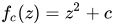
The Mandelbrot set (/ˈmændəlbrt, -brɒt/) is a two-dimensional set that is defined in the complex plane as the complex numbers for which the function does not diverge to infinity when iterated starting at , i.e., for which the sequence , , etc., remains bounded in absolute value.

This set was first defined and drawn by Robert W. Brooks and Peter Matelski in 1978, as part of a study of Kleinian groups. Afterwards, in 1980, Benoit Mandelbrot obtained high-quality visualizations of the set while working at IBM's Thomas J. Watson Research Center in Yorktown Heights, New York.

View the full Wikipedia page for Mandelbrot set
↑ Return to Menu

IBM in the context of Silicon Wadi

Silicon Wadi (Hebrew: סִילִיקוֹן וָאדִי, lit.'Silicon Valley') is a region in Israel that serves as one of the global centres for advanced technology. It spans the Israeli coastal plain, and is cited as among the reasons why the country has become known as the world's "start-up nation" (see science and technology in Israel). The highest concentrations of high-tech industry in the region can be found around Tel Aviv, including small clusters around the cities of Raʽanana, Petah Tikva, Herzliya, Netanya, Rehovot, and Ness Ziona. Additional clusters of high-tech industry can be found in Haifa and Caesarea. More recent high-tech establishments have been raised in cities such as Jerusalem and Beersheba, in towns such as Yokneam Illit, and in Airport City. Israel has the third highest number of startups by region, the highest rate of startups per capita in the world, with one in three cybersecurity unicorns in the world being an Israeli company.

View the full Wikipedia page for Silicon Wadi
↑ Return to Menu

IBM in the context of C++

C++ is a high-level, general-purpose programming language created by Danish computer scientist Bjarne Stroustrup. First released in 1985 as an extension of the C programming language, adding object-oriented (OOP) features, it has since expanded significantly over time adding more OOP and other features; as of 1997/C++98 standardization, C++ has added functional features, in addition to facilities for low-level memory manipulation for systems like microcomputers or to make operating systems like Linux or Windows, and even later came features like generic programming (through the use of templates). C++ is usually implemented as a compiled language, and many vendors provide C++ compilers, including the Free Software Foundation, LLVM, Microsoft, Intel, Embarcadero, Oracle, and IBM.

C++ was designed with systems programming and embedded, resource-constrained software and large systems in mind, with performance, efficiency, and flexibility of use as its design highlights. C++ has also been found useful in many other contexts, with key strengths being software infrastructure and resource-constrained applications, including desktop applications, video games, servers (e.g., e-commerce, web search, or databases), and performance-critical applications (e.g., telephone switches or space probes).

View the full Wikipedia page for C++
↑ Return to Menu

IBM in the context of 590 Madison Avenue

590 Madison Avenue, also known as the IBM Building, is a skyscraper at 57th Street and Madison Avenue in the Midtown Manhattan neighborhood of New York City. Designed by Edward Larrabee Barnes and Associates the 41-story, 603-foot (184 m)-tall tower was developed for the technology company IBM and built from 1978 to 1983.

The building is shaped like an irregular pentagon, with a chamfer cutting diagonally across what would typically be the southwest corner of a rectangular slab. The facade is made of gray-green glass and polished granite, which Barnes intended would give the building the appearance of a prism. The northeast corner of the tower is cantilevered over the main entrance, and there are no setbacks throughout the building's height. Adjacent to 590 Madison Avenue's southwest corner is a privately owned public space covered by a glass structure, which contains chairs, tables, and bamboo trees.

View the full Wikipedia page for 590 Madison Avenue
↑ Return to Menu

IBM in the context of Ross Perot

Henry Ross Perot (/pəˈr/ pə-ROH; June 27, 1930 – July 9, 2019) was an American businessman, politician, and philanthropist. He was the founder and chief executive officer of Electronic Data Systems and Perot Systems. He ran an independent campaign in the 1992 U.S. presidential election and a third-party campaign in the 1996 U.S. presidential election as the nominee of the Reform Party, which was formed by grassroots supporters of Perot's 1992 campaign. Although he failed to carry a single state in either election, both campaigns were among the stronger presidential showings by a third party or independent candidate in U.S. history.

Born and raised in Texarkana, Texas, Perot became a salesman for IBM after serving in the United States Navy. In 1962, he founded Electronic Data Systems, a data processing service company. In 1984, General Motors bought a controlling interest in the company for $2.4 billion ($6.1 billion in 2024). Perot established Perot Systems in 1988 and was an angel investor for NeXT, a computer company founded by Steve Jobs after he left Apple. Perot also became heavily involved in the Vietnam War POW/MIA issue, arguing that hundreds of American servicemen were left behind in Southeast Asia after the Vietnam War. During the presidency of George H. W. Bush, Perot became increasingly active in politics and strongly opposed both the Gulf War and the ratification of the North American Free Trade Agreement.

View the full Wikipedia page for Ross Perot
↑ Return to Menu

IBM in the context of Laser printer

Laser printing is an electrostatic digital printing process. It produces high-quality text and graphics (and moderate-quality photographs) by repeatedly passing a laser beam back and forth over a negatively charged cylinder called a "drum" to define a differentially charged image. The drum then selectively collects electrically charged powdered ink (toner), and transfers the image to paper, which is then heated to permanently fuse the text, imagery, or both to the paper. As with digital photocopiers, laser printers employ a xerographic printing process. Laser printing differs from traditional xerography as implemented in analog photocopiers in that in the latter, the image is formed by reflecting light off an existing document onto the photoconductor drum.

The laser printer was invented at Xerox PARC in the 1970s. Laser printers were introduced for the office and then home markets in subsequent years by IBM, Canon, Xerox, Apple, Hewlett-Packard and many others. Over the decades, quality and speed have increased as prices have decreased, and the once cutting-edge printing devices are now ubiquitous.

View the full Wikipedia page for Laser printer
↑ Return to Menu

IBM in the context of Workstation

A workstation is a special computer designed for technical or scientific applications. Intended primarily to be used by a single user, they are commonly connected to a local area network and run multi-user operating systems. The term workstation has been used loosely to refer to everything from a mainframe computer terminal to a PC connected to a network, but the most common form refers to the class of hardware offered by several current and defunct companies such as Sun Microsystems, Silicon Graphics, Apollo Computer, DEC, HP, NeXT, and IBM which powered the 3D computer graphics revolution of the late 1990s.

Workstations formerly offered higher performance specifications than mainstream personal computers, especially in terms of processing, graphics, memory, and multitasking. Workstations are optimized for the visualization and manipulation of different types of complex data such as 3D mechanical design, engineering simulations like computational fluid dynamics, animation, video editing, image editing, medical imaging, image rendering, computational science, generating mathematical plots, and software development. Typically, the form factor is that of a desktop computer, which consists of a high-resolution display, a keyboard, and a mouse at a minimum, but also offers multiple displays, graphics tablets, and 3D mice for manipulating objects and navigating scenes. Workstations were the first segment of the computer market to present advanced accessories, and collaboration tools like videoconferencing.

View the full Wikipedia page for Workstation
↑ Return to Menu

IBM in the context of Marcel Breuer

Marcel Lajos Breuer (/ˈbrɔɪər/ BROY-ur; 21 May 1902 – 1 July 1981) was a Hungarian-American modernist architect and furniture designer. He moved to the United States in 1937 and became a naturalized American citizen in 1944.

At the Bauhaus he designed the Wassily Chair and the Cesca Chair, which The New York Times have called some of the most important chairs of the 20th century. Breuer extended the sculpture vocabulary he had developed in the carpentry shop at the Bauhaus into a personal architecture that made him one of the world's most popular architects at the peak of 20th-century design. His work includes art museums, libraries, college buildings, office buildings, and residences. Many are in a Brutalist architecture style, including the former IBM Research and Development facility which was the birthplace of the first personal computer. He is regarded as one of the great innovators of modern furniture design and one of the most-influential exponents of the International Style.

View the full Wikipedia page for Marcel Breuer
↑ Return to Menu

IBM in the context of Lenovo

Lenovo Group Limited, trading as Lenovo (/ləˈnv/ lə-NOH-voh, Chinese: 联想; pinyin: Liánxiǎng), is a Hong Kong–based Chinese multinational corporation and technology company specializing in designing, manufacturing, and marketing consumer electronics, personal computers, software, servers, converged and hyperconverged infrastructure solutions, and related services. The smartphone brand is Motorola Mobility. Its global headquarters are in Beijing, China, and its North American headquarters is in Morrisville, North Carolina, United States; it has research centers at these locations, elsewhere in China, Hong Kong and Taiwan, in Stuttgart, Germany, and in Yamato, Kanagawa, Japan.

Lenovo originated as an offshoot of a state-owned research institute. Then known as Legend and distributing foreign IT products, co-founder Liu Chuanzhi incorporated Legend in Hong Kong in an attempt to raise capital and was successfully permitted to build computers in China, and were helped by the American AST Research. Legend listed on the Hong Kong Stock Exchange in 1994 and became the largest PC manufacturer in China and eventually in Asia; they were also domestic distributors for HP printers, Toshiba laptops, and others. After the company rebranded itself to Lenovo, it merged with IBM's PC business which produced its ThinkPad line in 2005, after which it rapidly expanded abroad. In 2013, Lenovo became the world's largest personal computer vendor by unit sales for the first time, a position it still holds as of 2024.

View the full Wikipedia page for Lenovo
↑ Return to Menu

IBM in the context of Pointing stick

A pointing stick (or trackpoint, also referred to generically as a nub, clit mouse, or nipple mouse) is a small analog stick used as a pointing device typically mounted centrally in a computer keyboard. Like other pointing devices such as mice, touchpads or trackballs, operating system software translates manipulation of the device into movements of the pointer on the computer screen. Unlike other pointing devices, it reacts to sustained force or strain rather than to gross movement, so it is called an "isometric" pointing device. IBM introduced it commercially in 1992 on the ThinkPad 700 series under the name "TrackPoint", and patented an improved version of it in 1997 (but the patent expired in 2017). It has been used for business laptops, such as Acer's TravelMate, Dell's Latitude, HP's EliteBook and Lenovo's ThinkPad.

The pointing stick senses applied force by using two pairs of resistive strain gauges. A pointing stick can be used by pushing with the fingers in the general direction the user wants the pointer to move. The velocity of the pointer depends on the applied force so increasing pressure causes faster movement. The relation between pressure and pointer speed can be adjusted, just as mouse speed is adjusted.

View the full Wikipedia page for Pointing stick
↑ Return to Menu