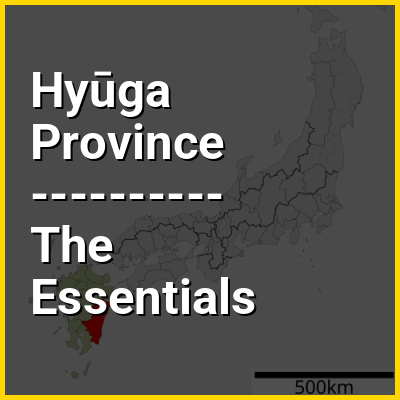
Hyūga Province (日向国, Hyūga no Kuni; Japanese pronunciation: [çɯꜜː.ɡa (no kɯ.ɲi), çɯꜜː.ŋa-]) was a province of Japan in the area of southeastern Kyushu, corresponding to modern Miyazaki Prefecture Hyūga bordered on Ōsumi to the south, Higo to the west, and Bungo to the north. Its abbreviated form name was Kōshū (向州), although it was also called Nisshū (日州). In terms of the Gokishichidō system, Hyūga was one of the provinces of the Saikaidō circuit. Under the Engishiki classification system, Hyūga was ranked as one of the "middle countries" (中国) in terms of importance, and one of the "far countries" (遠国) in terms of distance from the capital.
HINT:
👉 Hyūga Province in the context of Kinai
Kinai (畿内; Japanese pronunciation: [kʲiꜜ.nai]) is a Japanese term denoting an ancient division of the country. Kinai is a name for the ancient provinces around the capital Nara and Heian-kyō. The five provinces were called go-kinai after 1760.
The name is still used to describe part of the Kansai region, but the area of the Kinai corresponds only generally to the land of the old provinces.
In this Dossier
- ⭐ Core Definition: Hyūga Province
- 👉 Hyūga Province in the context of Kinai
- Hyūga Province in the context of Shimazu clan
- Hyūga Province in the context of Satsuma Domain
- Hyūga Province in the context of Saikaidō
- Hyūga Province in the context of Ōsumi Province
- Hyūga Province in the context of Emperor Jimmu
- Hyūga Province in the context of Bungo Province
- Hyūga Province in the context of Higo Province
Hyūga Province in the context of Shimazu clan
The Shimazu clan (島津氏, Shimazu-shi; Japanese pronunciation: [ɕiꜜ.ma.(d)zɯ, ɕi.ma.(d)zɯꜜ.ɕi]) were the daimyō of the Satsuma han, which spread over Satsuma, Ōsumi and Hyūga provinces in Japan.
The Shimazu were identified as one of the tozama or outsider daimyō families in contrast with the fudai or insider clans which were hereditary vassals or allies of the Tokugawa clan.
View the full Wikipedia page for Shimazu clanHyūga Province in the context of Satsuma Domain
The Satsuma Domain (薩摩藩, Satsuma-han Ryukyuan: Sachima-han), briefly known as the Kagoshima Domain (鹿児島藩, Kagoshima-han), was a domain (han) of the Tokugawa shogunate of Japan during the Edo period from 1600 to 1871.
The Satsuma Domain was based at Kagoshima Castle in Satsuma Province, the core of the modern city of Kagoshima, located in the south of the island of Kyushu. The Satsuma Domain was ruled for its existence by the Tozama daimyō of the Shimazu clan, who had ruled the Kagoshima area since the 1200s, and covered territory in the provinces of Satsuma, Ōsumi and Hyūga. The Satsuma Domain was assessed under the Kokudaka system and its value peaked at 770,000 koku, the second-highest domain in Japan after the Kaga Domain.
View the full Wikipedia page for Satsuma DomainHyūga Province in the context of Saikaidō
The Saikaidō (西海道; Japanese pronunciation: [sai.kaꜜi.doː], lit. 'Western Sea Circuit') is a Japanese geographical term. It means both an ancient division of the country and the main road running through it. Saikaido was one of the main circuits of the Gokishichidō system, which was originally established during the Asuka period.
This name identified the geographic region of Kyūshū and the islands of Tsushima and Iki. It consisted of nine ancient provinces and two islands. The provinces included Chikuzen, Chikugo, Buzen, Bungo, Hizen, Higo, Hyūga, Satsuma and Ōsumi.
View the full Wikipedia page for SaikaidōHyūga Province in the context of Ōsumi Province
Ōsumi Province (大隅国, Ōsumi no Kuni; Japanese pronunciation: [o(ꜜ)ː.sɯ.mʲi (no kɯ.ɲi)]) was a province of Japan in the area of southeastern Kyushu, corresponding to the eastern half of modern Kagoshima Prefecture, and including the Ōsumi Islands . Ōsumi bordered on Hyūga to the northeast, and Satsuma Province to the northwest. Its abbreviated form was Gūshū (隅州). In terms of the Gokishichidō system, Ōsumi was one of the provinces of the Saikaidō circuit. Under the Engishiki classification system, Ōsumi was ranked as one of the "middle countries" (中国) in terms of importance, and one of the "far countries" (遠国) in terms of distance from the capital.
The Ōsumi region has developed its own distinct local dialect. Although Ōsumi is part of Kagoshima Prefecture today, this dialect is different from that spoken in the city of Kagoshima. There is a notable cultural pride in traditional poetry written in Ōsumi and Kagoshima dialects.
View the full Wikipedia page for Ōsumi ProvinceHyūga Province in the context of Emperor Jimmu
Emperor Jimmu (神武天皇, Jinmu Tennō; Japanese pronunciation: [dʑiꜜm.mɯ (ten.noː), dʑim.mɯ ten.noꜜː]) was the legendary first emperor of Japan according to the Nihon Shoki and Kojiki. His ascension is traditionally dated as 660 BC. In Japanese mythology, he was a descendant of the sun goddess Amaterasu, through her grandson Ninigi, as well as a descendant of the storm god Susanoo. He launched a military expedition from Hyūga near the Seto Inland Sea, captured Yamato, and established this as his center of power. In modern Japan, Emperor Jimmu's legendary ascension is marked as National Foundation Day on February 11.
There is no evidence to suggest that Jimmu existed, and he is regarded by most modern scholars as a legendary figure.
View the full Wikipedia page for Emperor JimmuHyūga Province in the context of Bungo Province
Bungo Province (豊後国, Bungo no Kuni; Japanese pronunciation: [bɯꜜŋ.ɡo (no kɯ.ɲi), bɯꜜŋ.ŋo-]) was a province of Japan in the area of eastern Kyūshū, corresponding to most of modern Ōita Prefecture, except what is now the cities of Nakatsu and Usa. Bungo bordered on Hyūga to the south, Higo and Chikugo to the west, and Chikuzen and Buzen to the north. Its abbreviated form was Hōshū (豊州), although it was also called Nihō (二豊). In terms of the Gokishichidō system, Bungo was one of the provinces of the Saikaidō circuit. Under the Engishiki classification system, Bungo was ranked as one of the "superior countries" (上国) in terms of importance, and one of the "far countries" (遠国) in terms of distance from the capital.
View the full Wikipedia page for Bungo ProvinceHyūga Province in the context of Higo Province
Higo Province (肥後国, Higo no Kuni; Japanese pronunciation: [çiꜜ.ɡo (no kɯ.ɲi), çiꜜ.ŋo-, çi.ɡoꜜ-, çi.ŋoꜜ-]) was an old province of Japan in the area that is today Kumamoto Prefecture on the island of Kyūshū. It was sometimes called Hishū (肥州), with Hizen Province. Higo bordered on Chikugo, Bungo, Hyūga, Ōsumi, and Satsuma Provinces.
View the full Wikipedia page for Higo Province