In geometry, a hypotenuse is the side of a right triangle opposite to the right angle. It is the longest side of any such triangle; the two other shorter sides of such a triangle are called catheti or legs. Every rectangle can be divided into a pair of right triangles by cutting it along either diagonal; the diagonals are the hypotenuses of these triangles.
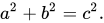
The length of the hypotenuse can be found using the Pythagorean theorem, which states that the square of the length of the hypotenuse equals the sum of the squares of the lengths of the two legs. As an algebraic formula, this can be written as , where is the length of one leg, is the length of the other leg, and is the length of the hypotenuse. For example, if the two legs of a right triangle have lengths 3 and 4, respectively, then the hypotenuse has length , because .