Hunminjeongeum Haerye in the context of "Hangul"

Play Trivia Questions online!

or

Skip to study material about Hunminjeongeum Haerye in the context of "Hangul"

Ad spacer

⭐ Core Definition: Hunminjeongeum Haerye

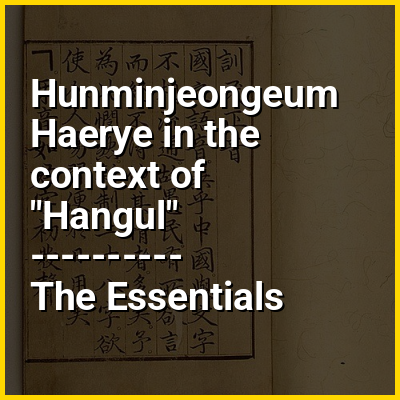
Hunminjeongeum Haerye (Korean: 훈민정음 해례; Hanja: 訓民正音解例), or simply Haerye, refers to either a commentary section on the text Hunminjeongeum or to copies of the Hunminjeongeum that contain the commentary section. The Hunminjeongeum and commentary were published together as a single text around October 1446 (Gregorian calendar). Together, they introduce the native Korean alphabet Hangul.

The Joseon king Sejong the Great (r. 1418–1450) authored the preface to the overall text as well as the basic introduction of the letters. The following members of the government agency Hall of Worthies coauthored the Haerye section: Chŏng Inji, Ch'oe Hang, Pak P'aengnyŏn, Sin Sukchu, Sŏng Sammun, Kang Hŭian, Yi Kae, and Yi Sŏllo [ko]. The text's postface was written by Chŏng Inji. The commentary and postface describe how the shapes of Hangul's letters were derived.
↓ Menu

>>>PUT SHARE BUTTONS HERE<<<

👉 Hunminjeongeum Haerye in the context of Hangul

The Korean alphabet is the modern writing system for the Korean language. It is known as Chosŏn'gŭl in North Korea, Hangul internationally, and Hangeul in South Korea. The script's original name was Hunminjeongeum.

Before Hangul's creation, Korea had been using Hanja (Chinese characters) since antiquity. As Hanja was poorly suited for representing the Korean language, and because its difficulty contributed to high illiteracy, Joseon king Sejong the Great (r. 1418–1450) moved to create Hangul. The script was announced around late 1443 to early 1444 and officially published in 1446 via the text Hunminjeongeum and its companion commentary Hunminjeongeum Haerye. While Hangul saw gradual adoption among both the elite and commoners, it was looked down upon by the elite for centuries. It only began to receive societal acceptance in the late 19th century. It is now the predominant script for Korean in both Koreas and among the Korean diaspora. It is also used to write the Jeju language, and to a limited degree, the Cia-Cia language of Indonesia.

↓ Explore More Topics
In this Dossier

Hunminjeongeum Haerye in the context of Hunminjeongeum

Hunminjeongeum (Korean: 훈민정음; Hanja: 訓民正音; lit. 'The Correct Sounds for the Instruction of the People') is a 1446 work that formally introduced the first native Korean alphabet. That alphabet was originally also called "Hunminjeongeum", although it is now widely called "Hangul" (international spelling; spelled in South Korea "Hangeul") or "Chosŏn'gŭl" (in North Korea).

The term Hunminjeongeum is used in a number of different ways, often due to the various editions and sections of the text. The term is sometimes used to refer to only the first two sections of the text: the preface and description of Hangul. That "base" Hunminjeongeum is sometimes referred to as the Yeui (예의; 例義). There is also a commentary section, the Hunminjeongeum Haerye, that was published alongside the base Hunminjeongeum. Sometimes, the base Hunminjeongeum and Haerye together are sometimes referred to only as Hunminjeongeum.

↑ Return to Menu