A horreum (plural: horrea) was a type of public warehouse used during the ancient Roman period. Although the Latin term is often used to refer to granaries. By the end of the imperial period, the city of Rome had nearly 300 horrea to supply its demands. The biggest were enormous, even by modern standards; the Horrea Galbae contained 140 rooms on the ground floor alone, covering an area of some 225,000 square feet (21,000 m). They provided storage fornot only the annona publica (public grain supply)but also a great variety of resources like olive oil and foodstuffs. The amount of storage space available in the public horrea can be judged by the fact that when the emperor Septimius Severus died in 211 AD, he is said to have left the city's horrea stocked with enough food to supply Rome's million-strong population for seven years. Smaller (though similar) horrea were a standard feature of Roman towns, cities and forts throughout the empire; well-preserved examples of military horrea have been excavated on Hadrian's Wall in England, notably at the forts of Housesteads, Corbridge and South Shields.
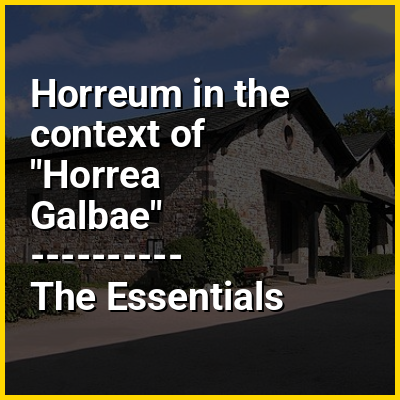
👉 Horreum in the context of Horrea Galbae
The Horrea Galbae were warehouses (horrea) in the southern part of ancient Rome, located between the southern end of the Aventine Hill and the waste dump of Monte Testaccio. They ran for a substantial distance, possibly extending as far as the Porta Ostiensis in the east and the Porticus Aemilia on the banks of the Tiber. The horrea were most likely built on the site of a suburban villa owned by the Sulpicii Galbae, a distinguished noble family of whom the 1st century AD Roman Emperor Galba was a member. (There are many alternative spellings of the name: Galbana, Galbiana, Galbes and so on.)
The tomb of Servius Sulpicius Galba (probably the consul of 108 BC, rather than his better-known father of the same name) stood in front of the warehouse complex. It is not clear when the horrea were founded, but presumably it was some time after the tomb was built. The complex was probably originally known as the Horrea Sulpicia, after the nomen of the gens Sulpicia, but acquired its later name during the time of the emperor Galba.
Horreum in the context of Portus
Portus was a large artificial harbour complex of Ancient Rome located at the mouth of the Tiber on the Tyrrhenian Sea. It was established by Claudius and enlarged by Trajan to supplement the nearby port of Ostia.. At its maximum extent the complex covered an area of about 350 hectares and included many horrea and an imperial palace.
Portus was the main port of ancient Rome for more than 500 years and provided a conduit for everything from glass, ceramics, marble and slaves to wild animals caught in Africa and shipped to Rome for spectacles in the Colosseum.
View the full Wikipedia page for Portus