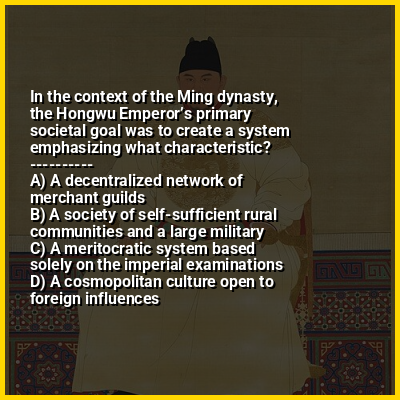
The Hongwu Emperor (21 October 1328 – 24 June 1398), personal name Zhu Yuanzhang, was the founding emperor of the Ming dynasty, reigning from 1368 to 1398.
In the mid-14th century, China was plagued by epidemics, famines, and peasant uprisings during the rule of the Mongol Yuan dynasty. Zhu Yuanzhang, orphaned during this time of chaos, joined a Buddhist monastery as a novice monk, where he occasionally begged for alms to sustain himself, gaining an understanding of the struggles faced by ordinary people, while harboring disdain for scholars who only gained knowledge from books. In 1352, he joined a rebel division, quickly distinguishing himself among the rebels and rising to lead his own army. In 1356, he conquered Nanjing and established it as his capital. He formed his own government, consisting of both generals and Confucian scholars, rejecting Mongol rule over China. He adopted the concept of country administration from them and implemented it in the territory he controlled, eventually expanding it to the entire country. He gradually defeated rival rebel leaders, with the decisive moment being his victory over Chen Youliang in the Battle of Lake Poyang in 1363. In 1364, he declared himself King of Wu. In 1367, however, he still acknowledged his formal subordination to the main Red Turban leader, Han Lin'er, who claimed to be the successor of the Song dynasty.