History painting in the context of "Bible stories"

Play Trivia Questions online!

or

Skip to study material about History painting in the context of "Bible stories"

Ad spacer

⭐ Core Definition: History painting

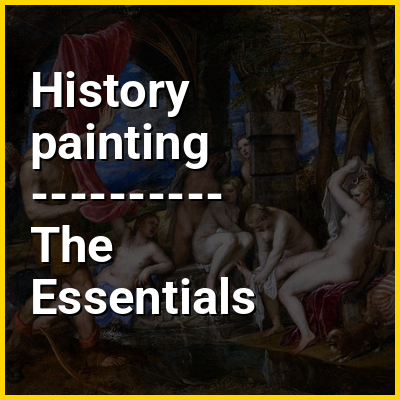
History paintings is a genre of Western art that focuses on the depiction of historical, mythological, biblical, or literary subjects, often with a moral or didactic purpose. Considered the most prestigious genre in the academic art hierarchy during the 17th to 19th centuries, history painting aimed to capture significant moments or narratives, emphasizing grandeur, heroism, and moral lessons.

History painting is a genre in painting defined by its subject matter rather than any artistic style or specific period. History paintings depict a moment in a narrative story, most often (but not exclusively) Greek and Roman mythology and Bible stories, opposed to a specific and static subject, as in portrait, still life, and landscape painting. The term is derived from the wider senses of the word historia in Latin and histoire in French, meaning "story" or "narrative", and essentially means "story painting". Most history paintings are not of scenes from history, especially paintings from before about 1850.
↓ Menu

>>>PUT SHARE BUTTONS HERE<<<
In this Dossier

History painting in the context of Fine art

In European academic traditions, fine art (or fine arts) is made primarily for aesthetics or creative expression, distinguishing it from popular art, decorative art or applied art, which also either serve some practical function (such as pottery or most metalwork) or is generally of limited artistic quality in order to appeal to the masses. In the aesthetic theories developed in the Italian Renaissance, the highest art was that which allowed the full expression and display of the artist's imagination, unrestricted by any of the practical considerations involved in, say, making and decorating a teapot. It was also considered important that making the artwork did not involve dividing the work between different individuals with specialized skills, as might be necessary with a piece of furniture, for example. Even within the fine arts, there was a hierarchy of genres based on the amount of creative imagination required, with history painting placed higher than still life.

Historically, the five main fine arts were painting, sculpture, architecture, music, and poetry. Other "minor or subsidiary arts" were also included, especially performing arts such as theatre and dance, which were counted as "among the most ancient and universal." In practice, outside education, the concept is typically only applied to the visual arts. The old master print and drawing were included as related forms to painting, just as prose forms of literature were to poetry. Today, the range of what would be considered fine arts (in so far as the term remains in use) commonly includes additional modern forms, such as film, photography, and video production/editing, as well as traditional forms made in a fine art setting, such as studio pottery and studio glass, with equivalents in other materials.

↑ Return to Menu

History painting in the context of Peter Paul Rubens

Sir Peter Paul Rubens (/ˈrbənz/ ROO-bənz; Dutch: [ˈpeːtər pʌul ˈrybəns]; 28 June 1577 – 30 May 1640) was a Flemish artist and diplomat. He is considered the most influential artist of the Flemish Baroque tradition. Rubens' highly charged compositions reference erudite aspects of classical and Christian history. His unique and immensely popular Baroque style emphasised movement, colour, and sensuality, which followed the immediate, dramatic artistic style promoted in the Counter-Reformation. Rubens was a painter producing altarpieces, portraits, landscapes, and history paintings of mythological and allegorical subjects. He was also a prolific designer of cartoons for the Flemish tapestry workshops and of frontispieces for the publishers in Antwerp.

Rubens was born and raised in the Holy Roman Empire (modern-day Germany) to parents who were refugees from Antwerp in the Duchy of Brabant in the Southern Netherlands (modern-day Belgium) and moved to Antwerp at about 12. In addition to running a large workshop in Antwerp that produced paintings popular with nobility and art collectors throughout Europe, Rubens was a classically educated humanist scholar and diplomat who was knighted by both Philip IV of Spain and Charles I of England. Rubens was a prolific artist. The catalogue of his works by Michael Jaffé lists 1,403 pieces, excluding numerous copies made in his workshop.

↑ Return to Menu

History painting in the context of Francesco Hayez

Francesco Hayez (Italian: [franˈtʃesko ˈaːjets]; 10 February 1791 – 12 February 1882) was an Italian painter. He is considered one of the leading artists of Romanticism in mid-19th-century Milan, and is renowned for his grand historical paintings, political allegories, and portraits.

↑ Return to Menu

History painting in the context of Hierarchy of genres

A hierarchy of genres is any formalization which ranks different genres in an art form in terms of their prestige and cultural value.

In literature, the epic was considered the highest form, for the reason expressed by Samuel Johnson in his Life of John Milton: "By the general consent of criticks, the first praise of genius is due to the writer of an epick poem, as it requires an assemblage of all the powers which are singly sufficient for other compositions." Below that came lyric poetry, and comic poetry, with a similar ranking for drama. The novel took a long time to establish a firm place in the hierarchy, doing so only as belief in any systematic hierarchy of forms expired in the 19th century.

↑ Return to Menu

History painting in the context of Jan Matejko

Jan Alojzy Matejko (Polish pronunciation: [ˈjan aˈlɔjzɨ maˈtɛjkɔ] ; also known as Jan Mateyko; 24 June 1838 – 1 November 1893) was a Polish painter, a leading 19th-century exponent of history painting, known for depicting nodal events from Polish history. His works include large scale oil paintings such as Stańczyk (1862), Rejtan (1866), Union of Lublin (1869), Astronomer Copernicus, or Conversations with God (1873), or Battle of Grunwald (1878). He was the author of numerous portraits, a gallery of Polish monarchs in book form, and murals in St. Mary's Basilica, Kraków. He is considered by many as the most celebrated Polish painter, and sometimes as the "national painter" of Poland.

Matejko spent most of his life in Kraków. He enrolled at the Kraków Academy of Fine Arts at age fourteen, where he studied under notable artists such as Wojciech Korneli Stattler and Władysław Łuszczkiewicz and completed his first major historical painting in 1853. His early exposure to revolutions in Kraków and the military service of his brothers influenced his artistic themes. After studying art in Munich and Vienna, he returned to Kraków and set up a studio. He gradually gained recognition, selling key paintings that settled his debts and created some of his most famous works, including Stańczyk and Skarga's Sermon. Matejko's art played a key role in promoting Polish history and national identity at a time when Poland was partitioned and lacked political autonomy.

↑ Return to Menu

History painting in the context of Walk to Canossa

The Road to Canossa or Humiliation of Canossa (Italian: L'umiliazione di Canossa), or, sometimes, the Walk to Canossa (German: Gang nach Canossa/Kanossa) was the journey of the Holy Roman Emperor Henry IV to Canossa Castle in 1077, and his subsequent ritual submission there to Pope Gregory VII. It took place during the Investiture controversy and involved the Emperor seeking absolution and the revocation of his excommunication by the Pope who had been staying at the castle as the guest of Margravine Matilda of Tuscany.

According to contemporary sources, he was forced to supplicate on his knees, waiting for three days and nights before the castle gate while a blizzard raged, "one of the most dramatic moments of the Middle Ages". The episode has spurred much debate among medieval chroniclers as well as modern historians, who dispute whether the walk was a humiliating defeat for the emperor or a "brilliant masterstroke".

↑ Return to Menu

History painting in the context of Jean-Pierre Saint-Ours

Jean-Pierre Saint-Ours (4 April 1752 – 6 April 1809) was a Swiss painter from Geneva.

As well as relatively informal portraits, he specialized in ambitious history paintings of subjects from ancient, especially classical, history. These are in a Neoclassical style, several with large groups of figures, inevitably drawing comparison with the works of his contemporary Jacques-Louis David, who was four years older. But many of Saint-Ours's works are far smaller, if only because he lacked the commissions to realize them at the full sizes he intended. His major compositions mostly exist as drawings with various degrees of finish, small painted versions and, if he received a commission, the full-size oil paintings, which can often be very large.

↑ Return to Menu

History painting in the context of Jacques-Louis David

Jacques-Louis David (French: [ʒaklwi david]; 30 August 1748 – 29 December 1825) was a French painter in the Neoclassical style, considered to be the preeminent painter of the era. In the 1780s, his cerebral brand of history painting marked a change in taste away from Rococo frivolity toward classical austerity, severity, and heightened feeling, which harmonized with the moral climate of the final years of the Ancien Régime.

David later became an active supporter of the French Revolution and friend of Maximilien Robespierre (1758–1794), and was effectively a dictator of the arts under the French Republic. Imprisoned after Robespierre's fall from power, he aligned himself with yet another political regime upon his release: that of Napoleon, the First Consul of France. At this time he developed his Empire style, notable for its use of warm Venetian colours. After Napoleon's fall from Imperial power and the Bourbon revival, David exiled himself to Brussels, then in the United Kingdom of the Netherlands, where he remained until his death. David had many pupils, making him the strongest influence in French art of the early 19th century, especially academic Salon painting.

↑ Return to Menu