
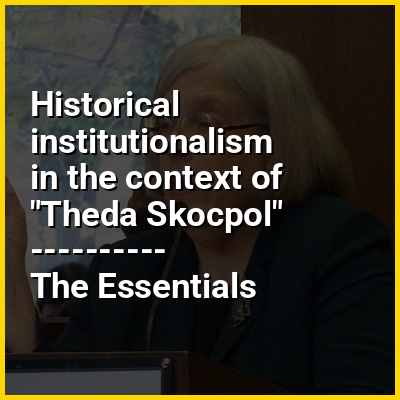
Theda Skocpol (née Barron; May 4, 1947) is an American sociologist and political scientist, who is currently the Victor S. Thomas Professor of Government and Sociology at Harvard University. She is best known as an advocate of the historical-institutional and comparative approaches, as well as her "state autonomy theory". She has written widely for both popular and academic audiences. She has been President of the American Political Science Association and the Social Science History Association.
In historical sociology, Skocpol's works and opinions have been associated with the structuralist school. As an example, she argues that social revolutions can best be explained given their relation with specific structures of agricultural societies and their respective states. Such an approach differs greatly from more "behaviorist" ones, which tend to emphasize the role of "revolutionary populations", "revolutionary psychology", and/or "revolutionary consciousness", as determinant factors of revolutionary processes.