High Gothic in the context of "Classic Gothic"

Play Trivia Questions online!

or

Skip to study material about High Gothic in the context of "Classic Gothic"


⭐ Core Definition: High Gothic

High Gothic was a period of Gothic architecture in the 13th century, from about 1200 to 1280, which saw the construction of a series of refined and richly decorated cathedrals of exceptional height and size. It appeared most prominently in France, largely thanks to support given by King Louis IX (r. 1226–1270), also known as Saint Louis. The goal of High Gothic architects was to bring the maximum possible light from the stained glass windows, and to awe the church goers with lavish decoration. High Gothic is often described as the high point of the Gothic style.

High Gothic was a period, rather than a specific style; during the High Gothic period, the Rayonnant style was predominant. Notable High Gothic cathedrals in the Rayonnant style included Reims Cathedral, Amiens Cathedral, Bourges Cathedral, Chartres Cathedral, and Beauvais Cathedral.
↓ Menu

👉 High Gothic in the context of Classic Gothic

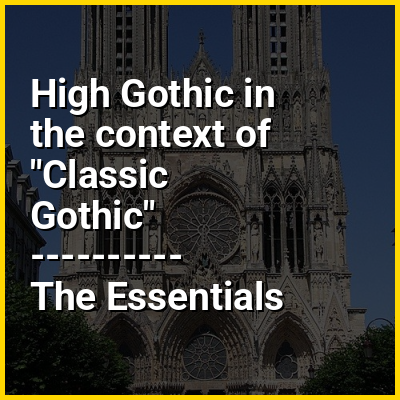
Classic Gothic (French: Gothique classique) is a French term for the second phase of Gothic architecture in France, as defined by French scholars. The common English term for the period is High Gothic. This is disputed by German scholars. The German definition of High Gothic requires bar tracery, which did not arrive in French cathedrals until the construction of Reims Cathedral, but the English definition does not.

The French definition of "Gothique Classique" calls for a long nave covered with quadripartite rib vaults and flanked by collateral aisles, a large transept, a choir, and a semi-circular disambulatory leading to a ring of small chapels. This model appeared at Chartres Cathedral and was copied at Reims Cathedral and other later structures.

↓ Explore More Topics
In this Dossier

High Gothic in the context of Rayonnant

Rayonnant was a very refined style of Gothic Architecture which appeared in France in the 13th century. It was the defining style of the High Gothic period, and is often described as the high point of French Gothic architecture. French architects turned their attention from building cathedrals of greater size and height towards bringing greater light into the cathedral interiors and adding more extensive decoration. The architects made the vertical columns and supports thinner, made extensive use of pinnacles and moldings. They combined the triforium gallery and the clerestory into single space and filled it with stained glass. They made extensive use of moldings and bar tracery to decorate the exteriors and interiors.

The most prominent features of the Rayonnant style were the enormous rose windows installed in the transepts and facades, made possible by the use of bar tracery. The design of the windows gave the name Rayonnant ("Radiant") to the style.

↑ Return to Menu

High Gothic in the context of Amiens Cathedral

The Cathedral of Our Lady of Amiens (French: Cathédrale Notre-Dame d'Amiens), or simply Amiens Cathedral, is a Catholic cathedral. The cathedral is the seat of the Bishop of Amiens. It is situated on a slight ridge overlooking the River Somme in Amiens, the administrative capital of the Picardy region of France, some 120 kilometres (75 miles) north of Paris.

The cathedral was built almost entirely between 1220 and c. 1270, a remarkably short period of time for a Gothic cathedral, giving it an unusual unity of style. Amiens is an early example of the High Gothic period, and the Rayonnant style of Gothic architecture. The Rayonnant appeared in the triforium and clerestory, which were begun in 1236, and in the enlarged high windows of the choir, added in the mid-1250s.

↑ Return to Menu

High Gothic in the context of Chartres Cathedral

Chartres Cathedral (French: Cathédrale Notre-Dame de Chartres, lit. Cathedral of Our Lady of Chartres) is a Catholic cathedral in Chartres, France, about 80 km (50 miles) southwest of Paris, and is the seat of the Bishop of Chartres. Dedicated in honour of the Virgin Mary ('Our Lady'), it was mostly constructed between 1194 and 1220. It stands on the site of at least five cathedrals that have occupied the site since the Diocese of Chartres was formed as an episcopal see in the 4th century. It is one of the best-known and most influential examples of High Gothic and Classic Gothic architecture. It was built above earlier Romanesque basements, while its north spire is more recent (1507–1513) and is built in the more ornate Flamboyant style.

"[O]ne of the most beautiful and historically significant cathedrals in all of Europe," it was designated a World Heritage Site by UNESCO in 1979, which called it "the high point of French Gothic art" and a "masterpiece".

↑ Return to Menu

High Gothic in the context of Porch

A porch (from Old French porche; from Latin porticus 'colonnade', from porta 'passage') is a room or gallery located in front of an entrance to a building. A porch is placed in front of the façade of a building it commands, and forms a low front. Alternatively, it may be a vestibule (a small room leading into a larger space) or a projecting building that houses the entrance door of a building.

Porches exist in both religious and secular architecture. There are various styles of porches, many of which depend on the architectural tradition of its location. Porches allow for sufficient space for a person to comfortably pause before entering or after exiting a building, or to relax on. Many porches are open on the outward side with balustrade supported by balusters that usually encircles the entire porch except where stairs are found.

↑ Return to Menu

High Gothic in the context of Cathedral of Reims

Notre-Dame de Reims (/ˌnɒtrə ˈdɑːm, ˌntrə ˈdm, ˌntrə ˈdɑːm/; French: [nɔtʁə dam ʁɛ̃s] ; meaning "Our Lady of Reims"), known in English as Reims Cathedral (also spelt Rheims Cathedral), is a Catholic cathedral in the French city of the same name, the seat of the Archdiocese of Reims. The cathedral was dedicated to the Virgin Mary and was the traditional location for the coronation of the kings of France. The cathedral is considered to be one of the most important works of Gothic architecture. A major tourist destination, it receives about a million visitors annually. It became a UNESCO World Heritage Site in 1991.

The cathedral is thought to have been founded by the bishop Nicasius in the early 5th century. Clovis was baptized a Christian here by Saint Remigius, the bishop of Reims, about a century later. He was the first Frankish king to receive this sacrament. Construction of the present cathedral began in the 13th century and concluded in the 14th century. A prominent example of High Gothic architecture, it was built to replace an earlier church destroyed by fire in 1210. Although little damaged during the French Revolution, the present cathedral saw extensive restoration in the 19th century. It was severely damaged during World War I and was again restored in the 20th century.

↑ Return to Menu