Hernando de Soto in the context of "Natchez people"

Play Trivia Questions online!

or

Skip to study material about Hernando de Soto in the context of "Natchez people"

Ad spacer

⭐ Core Definition: Hernando de Soto

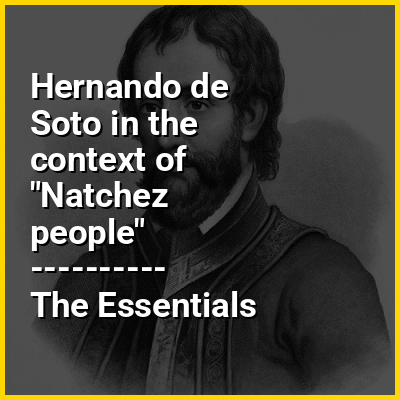
Hernando de Soto (/də ˈst/; Spanish: [eɾˈnando ðe ˈsoto]; c. 1497 – 21 May 1542) was a Spanish explorer and conquistador who was involved in expeditions in Nicaragua and the Yucatan Peninsula. He played an important role in Francisco Pizarro's conquest of the Inca Empire in Peru, but is best known for leading the first European expedition deep into the territory of the modern-day United States (through Florida, Georgia, Tennessee, Alabama, North Carolina, South Carolina, Mississippi, and most likely Arkansas). He is the first European documented as having crossed the Mississippi River.

De Soto's North American expedition was a vast undertaking. It ranged throughout what is now the southeastern United States, searching both for gold, which had been reported by various Native American tribes and earlier coastal explorers, and for a passage to China or the Pacific coast. De Soto died in 1542 on the banks of the Mississippi River; sources disagree on the exact location, whether it was what is now Lake Village, Arkansas, or Ferriday, Louisiana.
↓ Menu

>>>PUT SHARE BUTTONS HERE<<<

👉 Hernando de Soto in the context of Natchez people

The Natchez (/ˈnæɪz/ NATCH-iz, Natchez pronunciation: [naːʃt͡seh]) are a Native American people who originally lived in the Natchez Bluffs area in the Lower Mississippi Valley, near the present-day city of Natchez, Mississippi, in the United States. The DeSoto chronicle failed to record their presence when they came down the river in 1543. They speak a language with no known relatives, although it may be distantly related to the Muskogean languages of the Creek Confederacy. The somewhat unreliable archivist Pierre Margry (fr) recorded the identity the Natchez applied to themselves as "the Theloel". An early American geographer noted in his 1797 gazetteer that they were also known as the "Sun Set Indians".

The Natchez are noted for being the only Mississippian culture with complex chiefdom characteristics to have survived long into the period of European colonization. Other Mississippian societies in the southeast had generally experienced important transformations shortly after contact with the Spanish Empire or other settler colonists from across the ocean. The Natchez are also noted for having had an unusual social system of nobility classes and exogamous marriage practices. It was a strongly matrilineal kinship society, with descent reckoned along female lines. The paramount chief named the Great Sun was always the son of the Female Sun, whose daughter would be the mother of the next Great Sun. This ensured that the chiefdom stayed under the control of the single Sun lineage. Ethnologists have not reached consensus on how the Natchez social system originally functioned, and the topic is somewhat controversial.

↓ Explore More Topics
In this Dossier

Hernando de Soto in the context of Mississippian culture

The Mississippian culture was a collection of Native American societies that flourished in what is now the Midwestern, Eastern, and Southeastern United States from approximately 800 to 1600 CE, varying regionally. It was known for building large, earthen platform mounds, and often other shaped mounds as well. It was composed of a series of urban settlements and satellite villages linked together by loose trading networks. The largest city was Cahokia, believed to be a major religious center, located in what is present-day southern Illinois.

The Mississippian way of life began to develop in the Mississippi River Valley (for which it is named). Cultures in the tributary Tennessee River Valley may have also begun to develop Mississippian characteristics at this point. Almost all dated Mississippian sites predate 1539–1540 (when Hernando de Soto explored the area), with notable exceptions being Natchez communities. These maintained Mississippian cultural practices into the 18th century.

↑ Return to Menu

Hernando de Soto in the context of Upper Mississippian

The Upper Mississippian cultures were located in the Upper Mississippi basin and Great Lakes region of the American Midwest. They were in existence from approximately A.D. 1000 until the Protohistoric and early Historic periods (approximately A.D. 1700).

Archaeologists generally consider "Upper Mississippian" to be an attenuated version of "Middle Mississippian" cultures represented at Cahokia and other sites exhibiting more complex social and political structures, perhaps at a chiefdom level of development. The Middle Mississippians were capable of forming large cities and were thus heavily dependent on agriculture to support large populations. This civilization had its origins about A.D. 1000 or slightly earlier, and was at its peak in the 12th and 13th centuries A.D. when the population at Cahokia was estimated to be 40,000 and the city itself covered an area of 3,480 acres (in contrast, Upper Mississippian sites are usually well under 10 acres). Although the Middle Mississippian declined after its peak, there were still advanced chiefdom-level societies present at the time of the DeSoto expedition in the 1530s and 1540s.

↑ Return to Menu

Hernando de Soto in the context of Memphis, Tennessee

Memphis is a city in Shelby County, Tennessee, United States, and its county seat. Situated along the Mississippi River, it had a population of 633,104 at the 2020 census, making it the second-most populous city in Tennessee, the fifth-most populous in the Southeast, and the 28th-most populous in the US. Memphis is the largest city proper on the Mississippi River and anchors the Memphis area that includes parts of Arkansas and Mississippi, the 45th-most populous metropolitan area in the U.S. with 1.34 million residents.

European exploration of the area began with Spanish conquistador Hernando de Soto in 1541. Located on the high Chickasaw Bluffs, the site offered natural protection from Mississippi River flooding and became a contested location in the colonial era. Modern Memphis was founded in 1819 by John Overton, James Winchester, and Andrew Jackson. The city thrived due to its river traffic and cotton-based economy, becoming one of the largest cities in the Antebellum South. After the American Civil War, it remained a key hub for the cotton and hardwood industries. Memphis is also notable for its role in the American Civil Rights Movement; Dr. Martin Luther King Jr. was assassinated there in 1968, and the city is now home to the National Civil Rights Museum, a Smithsonian affiliate.

↑ Return to Menu