Head and neck cancer in the context of "Cisplatin"

Play Trivia Questions online!

or

Skip to study material about Head and neck cancer in the context of "Cisplatin"


⭐ Core Definition: Head and neck cancer

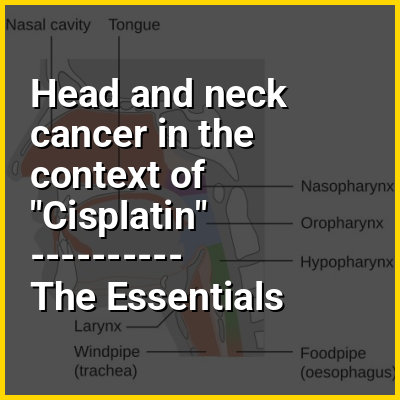
Head and neck cancer is a general term encompassing multiple cancers that can develop in the head and neck region. These include cancers of the mouth, tongue, gums and lips (oral cancer), voice box (laryngeal), throat (nasopharyngeal, oropharyngeal, hypopharyngeal), salivary glands, nose and sinuses.

Head and neck cancer can present a wide range of symptoms depending on where the cancer developed. These can include an ulcer in the mouth that does not heal, changes in the voice, difficulty swallowing, red or white patches in the mouth, and a neck lump.

↓ Menu

👉 Head and neck cancer in the context of Cisplatin

Cisplatin is a chemical compound with formula cis-[Pt(NH3)2Cl2]. It is a coordination complex of platinum that is used as a chemotherapy medication used to treat a number of cancers. These include testicular cancer, ovarian cancer, cervical cancer, bladder cancer, head and neck cancer, esophageal cancer, lung cancer, mesothelioma, brain tumors and neuroblastoma. It is given by injection into a vein.

Common side effects include bone marrow suppression, hearing problems including severe hearing loss, kidney damage, and vomiting. Other serious side effects include numbness, trouble walking, allergic reactions, electrolyte problems, and heart disease. Use during pregnancy can cause harm to the developing fetus. Cisplatin is in the platinum-based antineoplastic family of medications. It works in part by binding to DNA and inhibiting its replication.

↓ Explore More Topics
In this Dossier

Head and neck cancer in the context of Alcohol and cancer

Alcohol and cancer have a complex relationship. Alcohol causes cancers of the oesophagus, liver, breast, colon, oral cavity, rectum, pharynx, and larynx, and probably causes cancers of the pancreas. Cancer risk can occur even with light to moderate drinking. The more alcohol is consumed, the higher the cancer risk, and no amount can be considered completely safe.

Alcoholic beverages were classified as a Group 1 carcinogen by the International Agency for Research on Cancer (IARC) in 1988. An estimated 3.6% of all cancer cases and 3.5% of cancer deaths worldwide are attributable to consumption of alcohol (more specifically, acetaldehyde, a metabolic derivative of ethanol). 740,000 cases of cancer in 2020 or 4.1% of new cancer cases were attributed to alcohol.

↑ Return to Menu

Head and neck cancer in the context of Oral cancer

Oral cancer, also known as oral cavity cancer, tongue cancer or mouth cancer, is a cancer of the lining of the lips, mouth, or upper throat. In the mouth, it most commonly starts as a painless red or white patch, that thickens, gets ulcerated and continues to grow. When on the lips, it commonly looks like a persistent crusting ulcer that does not heal, and slowly grows. Other symptoms may include difficult or painful swallowing, new lumps or bumps in the neck, a swelling in the mouth, or a feeling of numbness in the mouth or lips.

Risk factors include tobacco and alcohol use. Those who use both alcohol and tobacco have a 15 times greater risk of oral cancer than those who use neither. Other risk factors include betel nut chewing and sun exposure on the lip. HPV infection may play a limited role in some oral cavity cancers. Oral cancer is a subgroup of head and neck cancers. Diagnosis is made by sampling (biopsy) of the lesion, followed by an imaging workup (called staging) which can include CT scan, MRI, PET scan to determine the local extension of the tumor, and if the disease has spread to distant parts of the body.

↑ Return to Menu

Head and neck cancer in the context of Nasopharyngeal carcinoma

Nasopharyngeal carcinoma (NPC), or nasopharynx cancer, is the most common cancer originating in the nasopharynx, most commonly in the postero-lateral nasopharynx or pharyngeal recess (fossa of Rosenmüller), accounting for 50% of cases. NPC occurs in children and adults. NPC differs significantly from other cancers of the head and neck in its occurrence, causes, clinical behavior, and treatment. It is vastly more common in certain regions of East Asia and Africa than elsewhere, with viral, dietary and genetic factors implicated in its causation. It is most common in males. It is a squamous cell carcinoma of an undifferentiated type. Squamous epithelial cells are a flat type of cell found in the skin and the membranes that line some body cavities. Undifferentiated cells are cells that do not have their mature features or functions.

↑ Return to Menu

Head and neck cancer in the context of Docetaxel

Docetaxel (DTX or DXL), sold under the brand name Taxotere among others, is a chemotherapy medication used to treat a number of types of cancer. This includes breast cancer, head and neck cancer, stomach cancer, prostate cancer and non-small-cell lung cancer. It may be used by itself or along with other chemotherapy medication. It is given by slow injection into a vein.

Common side effects include hair loss, cytopenia (low blood cell counts), numbness, shortness of breath, nausea, vomiting, and muscle pains. Other severe side effects include allergic reactions and future cancers. Docetaxel induced pneumotoxicity is also a well recognized adverse effect which has to be identified timely and treated after withholding the drug. Side effects are more common in people with liver problems. Use during pregnancy may harm the baby. Docetaxel is in the taxane family of medications. It works by disrupting the normal function of microtubules and thereby stopping cell division.

↑ Return to Menu

Head and neck cancer in the context of Gendicine

Gendicine is a gene therapy medication used to treat patients with head and neck squamous cell carcinoma linked to mutations in the TP53 gene. It consists of recombinant adenovirus engineered to code for p53 protein (rAd-p53) and is manufactured by Shenzhen SiBiono GeneTech.

Gendicine was the first gene therapy product to obtain regulatory approval for clinical use in humans after Chinese State Food and Drug Administration approved it in 2003. As of 2024, Gendicine has not been approved for use in the United States and the European Union.

↑ Return to Menu

Head and neck cancer in the context of Tumour heterogeneity

Tumour heterogeneity describes the observation that different tumour cells can show distinct morphological and phenotypic profiles, including cellular morphology, gene expression, metabolism, motility, proliferation, and metastatic potential. This phenomenon occurs both between tumours (inter-tumour heterogeneity) and within tumours (intra-tumour heterogeneity). A minimal level of intra-tumour heterogeneity is a simple consequence of the imperfection of DNA replication: whenever a cell (normal or cancerous) divides, a few mutations are acquired—leading to a diverse population of cancer cells. The heterogeneity of cancer cells introduces significant challenges in designing effective treatment strategies. However, research into understanding and characterizing heterogeneity can allow for a better understanding of the causes and progression of disease. In turn, this has the potential to guide the creation of more refined treatment strategies that incorporate knowledge of heterogeneity to yield higher efficacy.

Tumour heterogeneity has been observed in leukemias, breast, prostate, colon, brain, esophagus, head and neck, bladder and gynecological carcinomas, liposarcoma, and multiple myeloma.

↑ Return to Menu