Harthacnut in the context of "House of Knýtlinga"

Play Trivia Questions online!

or

Skip to study material about Harthacnut in the context of "House of Knýtlinga"

Ad spacer

⭐ Core Definition: Harthacnut

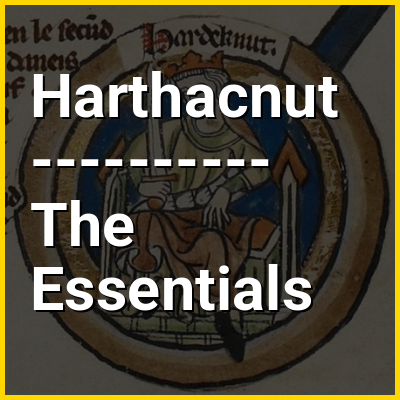
Harthacnut (c. 1018 – 8 June 1042) was King of Denmark from 1035, and King of England from 1040 until his death in 1042. He was the last monarch of the North Sea Empire, an empire consisting of England and Denmark, and was also the last monarch of the House of Knýtlinga.

Harthacnut was the son of King Cnut the Great, who ruled Denmark, Norway, and England, and Emma of Normandy. After Cnut's death in 1035, Harthacnut faced challenges in retaining his father's territories. Magnus I seized control of Norway, while Harthacnut succeeded as King of Denmark. In 1040, following the death of his half-brother Harold Harefoot, he became King of England. Harthacnut died suddenly in 1042 and was succeeded by Magnus in Denmark and Edward the Confessor in England. He was the last Dane to rule England.
↓ Menu

>>>PUT SHARE BUTTONS HERE<<<

👉 Harthacnut in the context of House of Knýtlinga

The Danish House of Knýtlinga (English: "House of Cnut's Descendants") was a ruling royal house in Middle Age Scandinavia and England. Its most famous king was Cnut the Great, who gave his name to this dynasty. Other notable members were Cnut's father Sweyn Forkbeard, grandfather Harald Bluetooth, and sons Harthacnut, Harold Harefoot, and Svein Knutsson. It has also been called the House of Canute, the House of Denmark, the House of Gorm, or the Jelling dynasty.

Under Harald Bluetooth's rule, he is said on a Jelling rune stone to have unified the territory that comprises modern-day Denmark under his rule, as well as Norway. The latter claim is more tenuous, as he most likely only had periodic and indirect power over parts of modern-day Norway. Under the House of Knýtlinga, early state formation in Denmark occurred.

↓ Explore More Topics
In this Dossier

Harthacnut in the context of Edward the Confessor

Edward the Confessor (c. 1003 – 5 January 1066) was King of the English from 1042 until his death in 1066. He was the last reigning monarch of the House of Wessex.

Edward was the son of Æthelred the Unready and Emma of Normandy. He succeeded Cnut the Great's son – and his own half-brother – Harthacnut. He restored the rule of the House of Wessex after the period of Danish rule since Cnut conquered England in 1016. When Edward died in 1066, he was succeeded by his brother-in-law Harold Godwinson, who was defeated and killed in the same year at the Battle of Hastings by the Normans under William the Conqueror. Edward's young great-nephew Edgar Ætheling of the House of Wessex was proclaimed king after the Battle of Hastings, but was never crowned and was peacefully deposed after about eight weeks.

↑ Return to Menu

Harthacnut in the context of Emma of Normandy

Emma of Normandy (referred to as Ælfgifu in royal documents; c. 984 – 6 March 1052) was a Norman-born noblewoman who became the English, Danish, and Norwegian Queen through her marriages to the Anglo-Saxon King Æthelred the Unready and the Danish King Cnut the Great. A daughter of the Norman ruler Richard the Fearless and Gunnor, she was Queen of England during her marriage to King Æthelred from 1002 to 1016, except during a brief interruption in 1013–14 when the Danish King Sweyn Forkbeard occupied the English throne. Æthelred died in 1016, and Emma married Sweyn's son Cnut. As Cnut's wife, she was Queen of England from their marriage in 1017, Queen of Denmark from 1018, and Queen of Norway from 1028 until Cnut died in 1035.

After Cnut's death, Emma continued to participate in politics during the reigns of her sons by each husband, Harthacnut and Edward the Confessor. In 1035 when her second husband Cnut died and was succeeded by their son Harthacnut, who was in Denmark at the time, Emma was designated to act as his regent until his return, which she did in rivalry with Harold Harefoot. Emma is the central figure within the Encomium Emmae Reginae, a critical source for the history of early-11th-century English politics. As Catherine Karkov notes, Emma is one of the most visually represented early medieval queens.

↑ Return to Menu

Harthacnut in the context of North Sea Empire

The North Sea Empire, also known as the Anglo-Scandinavian Empire, was the personal union of the kingdoms of England, Denmark and Norway for most of the period between 1013 and 1042 towards the end of the Viking Age. This ephemeral Norse-ruled empire was a thalassocracy, its components only connected by and dependent upon the sea.

The first king to unite all three kingdoms was Sweyn Forkbeard, king of Denmark since 986 and of Norway since 1000, when he conquered England in 1013. He died in the following year, and his realm was divided. His son Cnut the Great acquired England in 1016, Denmark in 1018 and Norway in 1028. He died in 1035 and his realm was again divided, but his successor in Denmark, Harthacnut, inherited England in 1040 and ruled it until his death in 1042. At the height of his power, when Cnut ruled all three kingdoms (1028–1035), he was the most powerful ruler in western Europe after the Holy Roman Emperor.

↑ Return to Menu

Harthacnut in the context of Harold Harefoot

Harold I (died 17 March 1040), commonly known as Harold Harefoot, was King of England from 1037 to 1040. His nickname "Harefoot" is first recorded as "Harefoh" or "Harefah" in the twelfth century in the history of Ely Abbey, and according to some late medieval chroniclers it meant that he was "fleet of foot".

The son of Cnut the Great and Ælfgifu of Northampton, Harold was elected regent of England following the death of his father in 1035. He initially ruled England in place of his brother Harthacnut, who was stuck in Denmark because of a rebellion in Norway that had ousted their brother Svein. Although Harold had wished to be crowned king since 1035, Æthelnoth, Archbishop of Canterbury, refused to do so. It was not until 1037 that Harold, supported by earl Leofric and many others, was officially proclaimed king. The same year, Harold's two step-brothers Edward and Alfred returned to England with a considerable military force. Alfred was captured by Earl Godwin, who had him seized and delivered to an escort of men loyal to Harefoot. While en route to Ely, he was blinded and soon after died of his wounds.

↑ Return to Menu

Harthacnut in the context of House of Godwin

The House of Godwin (Old English: Godƿine) was the house consisting of the Anglo-Saxon family who were one of the leading noble families in England during the last fifty years before the Norman Conquest. Its most famous member was Harold Godwinson, King of England for nine months in 1066.

The founder of the family's greatness, Earl Godwin, was raised from comparative obscurity by King Cnut and given the Earldom of Wessex c. 1018–1019. He retained his position during the reigns of Cnut's sons Harold Harefoot and Harthacnut, and consolidated it when King Edward the Confessor conferred earldoms on Sweyn and Harold, Godwin's two eldest sons by his Danish wife Gytha.

↑ Return to Menu