Harike Wetland in the context of "Indira Gandhi Canal"

Play Trivia Questions online!

or

Skip to study material about Harike Wetland in the context of "Indira Gandhi Canal"

Ad spacer

⭐ Core Definition: Harike Wetland

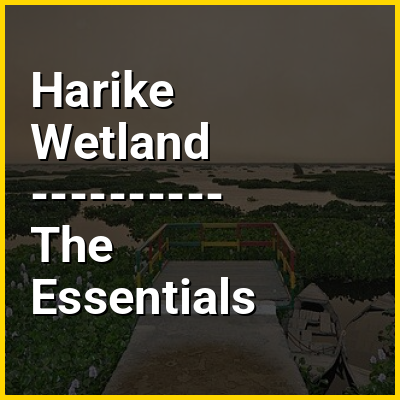
Harike Wetland, with the Harike Lake in the deeper part of it, east of the Harike village also known as "Hari-ke-Pattan" (Port of Harike), is a Ramsar site and the largest wetland in northern India on the border of Tarn Taran Sahib district and Ferozepur district of the Punjab state in India created by the manmade Harike Barrage headworks immediate downstream of the confluence of Beas and Sutlej rivers. Harike village is accessible by the NH-54 (Taran Taran 35 km north), NH-703A (Firozepur 45 km southwest and Kapurthala 60 km northeast), and NH-703B (Bhikhiwind 30 km northwest and Moga 50 km southeast).

Harike Barrage has created the manmade Harike Wetland. The Monsoon climate dominates the catchment draining into the wetland. The Harike headworks, which form the Harike lake and the enlarged wetland, was constructed for irrigation and drinking water supplies, through the Ferozepur, Indira Gandhi Canal and Makku feeder canals with total carrying capacity of 29,000 cubic feet per second (820 m/s), to supply to the command areas located in the states of Punjab and Rajasthan. The lake is triangular, with its apex in the west, bounded by a bund called the Dhussi Bund forming one side, a canal in the second and a major road on the third. The periphery of the lake is surrounded by agricultural land and the wetland is reported to be rich in ground water resources.
↓ Menu

>>>PUT SHARE BUTTONS HERE<<<

👉 Harike Wetland in the context of Indira Gandhi Canal

The Indira Gandhi Canal (also still known by the revered sacred name Saraswati Rupa Rajasthan Canal, also formerly officially called Rajasthan Canal) with total length of 837 kilometres (520 mi), is the longest canal in India which begins in Punjab state at the Harike Barrage (confluence of the Satluj and Beas rivers), flows a short distance through northwest part of Haryana state, and ends in the Thar Desert near Gadra Road in western Rajasthan. The course of Indira Gandhi Canal is subdivided into 4 sections, Rajasthan Feeder Canal (RF Canal) N-SW flowing 204 kilometres (127 mi) long course from Harike Barrage in Ferozepur district to Masitawali village in Hanumangarh, Indira Gandhi Main Canal (IGM Canal) N-SW flowing 445 kilometres (277 mi) long course from Masitawali to Mohangarh northeast of Jaisalmer, Sagarmal Gopa Branch Canal (SGB Canal) E-W flowing 96 kilometres (60 mi) long course from Mohangarh to Gunjangarh-Ramgarh northwest of Jaisalmer, Baba Ramdev Sub-branch Canal (BRSB Canal) N-S flowing 92 kilometres (57 mi) long course from Gunjangarh-Ramgarh toward Gadra Road town in Barmer district.

Indira Gandhi Canal follows Ghaggar paleochannel of the now-lost sacred Sarasvati River with natural incline, thus requiring no pumping station along the way, hence also the name Saraswati Rupa Rajasthan Canal. Indira Gandhi Canal forms the Rajasthan section of the revived ancient Saraswati River with numerous Indus-Sarasvati Valley Civilisation sites along its course, rest being in upstream Haryana-Punjab and downstream Gujarat.

↓ Explore More Topics
In this Dossier

Harike Wetland in the context of Ramsar site

A Ramsar site is a wetland site designated to be of international importance under the Ramsar Convention, also known as "The Convention on Wetlands", an international environmental treaty signed on 2 February 1971 in Ramsar, Iran, under the auspices of UNESCO. It came into force on 21 December 1975, when it was ratified by a sufficient number of nations. It provides for national action and international cooperation regarding the conservation of wetlands, and wise sustainable use of their resources. Ramsar treaty participants meet regularly to identify and agree to protect "Wetlands of International Importance", especially those providing waterfowl habitat.

As of August 2025, there are 2,544 Ramsar sites around the world, which protect 257,994,488 hectares (637,518,260 acres), and 172 national governments participate in the convention.

↑ Return to Menu