Hangzhou Bay in the context of "Yangshan Port"

Play Trivia Questions online!

or

Skip to study material about Hangzhou Bay in the context of "Yangshan Port"

Ad spacer

⭐ Core Definition: Hangzhou Bay

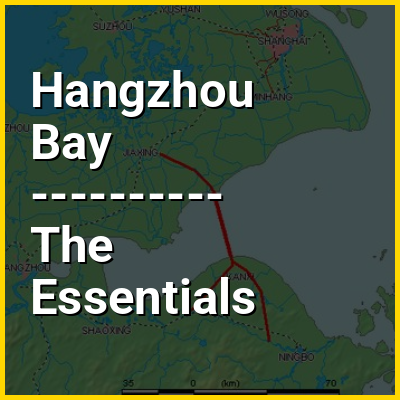
Hangzhou Bay is a funnel-shaped inlet of the East China Sea on the middle eastern coast of Mainland China, bordered by the province of Zhejiang to the west and south, and the municipality of Shanghai to north. The bay extends westwards to its head at the city of Hangzhou, the provincial capital of Zhejiang, from which its name is derived. The east and southeast margin of Hangzhou Bay are marked by numerous islands off the shores of Ningbo, collectively called the Zhoushan Islands, which are an urbanized archipelago that forms the prefecture-level city of Zhoushan.

At Hangzhou, the Qiantang River flows into the bay, providing fresh water from the west, while seawater comes in from the east. Thus, Hangzhou Bay, especially its western end, is sometimes called the Qiantang River Estuary in the scientific literature.

↓ Menu

>>>PUT SHARE BUTTONS HERE<<<

👉 Hangzhou Bay in the context of Yangshan Port

Yangshan Port (Chinese洋山, p Yángshān Gǎng, Wu Yan-se Kaon), formally the Yangshan Deep-Water Port (洋山, p Yángshān Shēnshuǐ Gǎng, Wu Yan-se Sen-sy Kaon), is an offshore deep-water port for containerization in Hangzhou Bay south of Shanghai, China, built on land reclamation joining the Lesser Yangshan Island with numerous other nearby islands of the northwestern Zhoushan archipelago. It is connected to Shanghai's Pudong New Area on the mainland by the 32.5 km-long (20.2 mi) Donghai Bridge, forming part of the Port of Shanghai, while the other islands of Yangshan archipelago (including the Greater Yangshan Island, where the civilian population of the archipelago live) are administered separately as part of Zhejiang's Shengsi County.

Yangshan Port is part of China's Maritime Silk Road, built to allow the Port of Shanghai to grow despite shallow waters near the shore. Prior to its construction, the Port of Shanghai was predominantly based around the mouth of the Huangpu River, which is too shallow to handle large container ships, forcing the port to often perform mid-stream operations within the Yangtze estuary, which often had to wait for the high tide hours, severely restricting the port's capacity. The construction of Yangshan Port allows berths with depths of up to 15 m (49 ft) to be built, and can handle today's largest container ships. In mid-2011, port officials said the port was on track to move 12.3 million twenty-foot equivalent units (TEUs) during the year, up from 10.1 million TEUs in 2010, overtaking Port of Singapore to become the world's busiest container port. In 2015, the port handled 36.54 million TEUs, and by 2019, its throughput had increased to 43.35 million TEU.
↓ Explore More Topics
In this Dossier

Hangzhou Bay in the context of Hangzhou

Hangzhou is the capital city of the Chinese province of Zhejiang. With a population of 13 million, the municipality comprises ten districts, two counties, and one county-level city in northwestern Zhejiang. It is situated at the head of Hangzhou Bay and the estuary of the Qiantang River.

Established as a county seat in 221 BC, Hangzhou later served as the capital of the Wuyue Kingdom (923–997) and the Southern Song dynasty (1138–1276). The city has three UNESCO World Heritage Sites, which are the West Lake Cultural Landscape, the Grand Canal, and the Archaeological Ruins of Liangzhu City.

↑ Return to Menu

Hangzhou Bay in the context of Port of Ningbo-Zhoushan

The Port of Ningbo-Zhoushan is the busiest port in the world in terms of cargo tonnage. It handled 888.96 million tons of cargo in 2015. The port is located in Ningbo and Zhoushan, on the coast of the East China Sea, in Zhejiang province on the southeast end of Hangzhou Bay, across which it faces the municipality of Shanghai.

The port is at the crossroads of the north–south inland and coastal shipping route, including canals to the important inland waterway to interior China, the Yangtze River, to the north. The port consists of several ports which are Beilun (seaport), Zhenhai (estuary port), and old Ningbo harbor (inland river port).

↑ Return to Menu

Hangzhou Bay in the context of Zhoushan

Zhoushan is an urbanized archipelago with the administrative status of a prefecture-level city in the eastern Chinese province of Zhejiang. It consists of an archipelago of islands at the southern mouth of Hangzhou Bay off the mainland city of Ningbo. The prefecture's city proper is Dinghai on Zhoushan Island, now administered as the prefecture's Dinghai District. During the 2020 census, Zhoushan Prefecture's population was 1,157,817, out of whom 882,932 lived in the builtup (or metro) area consisting of two urban districts of Dinghai and Putuo.

On July 8, 2011, the central government approved Zhoushan as Zhoushan Archipelago New Area, a state-level new area.

↑ Return to Menu

Hangzhou Bay in the context of Qiantang River

The Qiantang River, formerly known as the Hangchow River or Tsientang River, is a river in East China. An important commercial artery, it runs for 459 kilometers (285 mi) through Zhejiang, passing through the provincial capital Hangzhou before flowing into the East China Sea via Hangzhou Bay south of Shanghai. Its original name, the "Zhe River" or "Zhe Jiang", is the origin of the name of Zhejiang province. The river is also known, along with Hangzhou Bay, for having what is called by locals as the "Silver Dragon", the world's largest tidal bore, a phenomenon where the leading edge of the incoming tide forms a wave (or waves) that can rise to a height of 9 meters (30 ft) and travels up the river or narrow bay at top speeds of 40 km/h (25 mph; 11 m/s) against the direction of the river or bay's current, and can be seen from miles away.

↑ Return to Menu

Hangzhou Bay in the context of Ningbo

Ningbo is a sub-provincial city in northeastern Zhejiang province, People's Republic of China. It comprises six urban districts, two satellite county-level cities, and two rural counties, including several islands in Hangzhou Bay and the East China Sea. Ningbo is the southern economic center of the Yangtze Delta megalopolis, which includes Shanghai among other cities. The port of Ningbo–Zhoushan, spread across several locations, is the world's busiest port by cargo tonnage and the world's third-busiest container port since 2010.

Ningbo is the core city and center of the Ningbo Metropolitan Area. To the north, Hangzhou Bay separates Ningbo from Shanghai; to the east lies Zhoushan in the East China Sea; on the west and south, Ningbo borders Shaoxing and Taizhou respectively. As of the 2020 Chinese national census, the entire administrated area of Ningbo City had a population of 9.4 million (9,404,283).

↑ Return to Menu

Hangzhou Bay in the context of Beilun District

Beilun District (simplified Chinese: 北仑区; traditional Chinese: 北侖區; pinyin: Běilún Qū; Wu: Poh-len Chiu) is a district of Ningbo in Zhejiang province, China. It is dominated by Beilun port, an international port of the easternmost edge of the southern coast of Hangzhou Bay. It primarily services the regional city of Ningbo. Beilun district has 380,000 permanent residents and 850,000 residents. Beilun district has a land area of 615 square kilometers, a sea area of 258 square kilometers and a coastline of 150 kilometers. It is the largest sea area and the longest coastline area within the jurisdiction of Ningbo city.

↑ Return to Menu

Hangzhou Bay in the context of Taihu Wu

Taihu Wu (吳語太湖片) or Northern Wu (北部吳語) is a Wu Chinese language spoken in much of the southern part of the province of Jiangsu, including Suzhou, Wuxi, Changzhou, the southern part of Nantong, Jingjiang and Danyang; the municipality of Shanghai; and the northern part of Zhejiang province, including Hangzhou, Shaoxing, Ningbo, Huzhou, and Jiaxing. A notable exception is the dialect of the town of Jinxiang, which is a linguistic exclave of Taihu Wu in Zhenan Min-speaking Cangnan county of Wenzhou prefecture in Zhejiang province. Speakers in regions around Taihu Lake and Hangzhou Bay, are the largest population among all Wu speakers. Taihu Wu dialects such as Shanghainese, Shaoxing and Ningbo are mutually intelligible even for L2 Taihu speakers.

↑ Return to Menu

Hangzhou Bay in the context of Shaoxing

Shaoxing is a prefecture-level city on the southern shore of Hangzhou Bay in northeastern Zhejiang province, China. Located on the south bank of the Qiantang River estuary, it borders Ningbo to the east, Taizhou to the southeast, Jinhua to the southwest, and Hangzhou to the west. As of the 2020 census, its population was 5,270,977 inhabitants among which, 2,958,643 (Keqiao, Yuecheng and Shangyu urban districts) lived in the built-up (or metro) area of HangzhouShaoxing, with a total of 13,035,326 inhabitants.

Notable residents of Shaoxing include Wang Xizhi, the parents of Zhou Enlai, Lu Xun, and Cai Yuanpei. It is also noted for Shaoxing wine, meigan cai, and stinky tofu, and was featured on A Bite of China. Its local variety of Chinese opera sung in the local dialect and known as Yue opera is second in popularity only to Peking opera. In 2010, Shaoxing celebrated the 2,500th anniversary of the founding of the city.

↑ Return to Menu