Handicraft in the context of "Design"

Play Trivia Questions online!

or

Skip to study material about Handicraft in the context of "Design"

Ad spacer

⭐ Core Definition: Handicraft

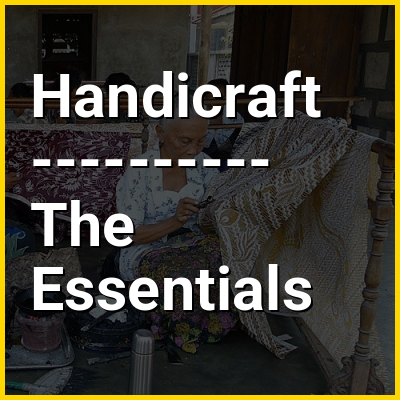
A handicraft is a traditional main sector of craft making and applies to a wide range of creative and design activities that are related to making things with one's hands and skill, including work with textiles, moldable and rigid materials, paper, plant fibers, clay, etc. One of the oldest handicraft is Dhokra; this is a sort of metal casting that has been used in India for over 5,000 years and is still used. In Iranian Baluchistan, women still make red ware hand-made pottery with dotted ornaments, much similar to the 4,000-year-old pottery tradition of Kalpurgan, an archaeological site near the village. Usually, the term is applied to traditional techniques of creating items (whether for personal use or as products) that are both practical and aesthetic. Handicraft industries are those that produce things with hands to meet the needs of the people in their locality without using machines.

Collective terms for handicrafts include artisanry, crafting, and handcrafting. The term arts and crafts is also applied, especially in the United States and mostly to hobbyists' and children's output rather than items crafted for daily use, but this distinction is not formal, and the term is easily confused with the Arts and Crafts design movement, which is in fact as practical as it is aesthetic.
↓ Menu

>>>PUT SHARE BUTTONS HERE<<<
In this Dossier

Handicraft in the context of Athena

Athena or Athene, often given the epithet Pallas, is an ancient Greek goddess associated with wisdom, warfare, and handicraft who was later syncretized with the Roman goddess Minerva. Athena was regarded as the patron and protectress of various cities across Greece, particularly the city of Athens, from which she most likely received her name. The Parthenon on the Acropolis of Athens is dedicated to her. Her major symbols include owls, olive trees, snakes, and the Gorgoneion. In art, she is generally depicted wearing a helmet and holding a spear.

From her origin as an Aegean palace goddess, Athena was closely associated with the city. She was known as Polias and Poliouchos (both derived from polis, meaning "city-state"), and her temples were usually located atop the fortified acropolis in the central part of the city. The Parthenon on the Athenian Acropolis is dedicated to her, along with numerous other temples and monuments. As the patron of craft and weaving, Athena was known as Ergane. She was also a warrior goddess, and was believed to lead soldiers into battle as Athena Promachos. Her main festival in Athens was the Panathenaia, which was celebrated during the month of Hekatombaion in midsummer and was the most important festival on the Athenian calendar.

↑ Return to Menu

Handicraft in the context of Manufacturing

Manufacturing is the creation or production of goods with the help of equipment, labor, machines, tools, and chemical or biological processing or formulation. It is the essence of the secondary sector of the economy. The term may refer to a range of human activity, from handicraft to high-tech, but it is most commonly applied to industrial design, in which raw materials from the primary sector are transformed into finished goods on a large scale. Such goods may be sold to other manufacturers for the production of other more complex products (such as aircraft, household appliances, furniture, sports equipment or automobiles), or distributed via the tertiary industry to end users and consumers (usually through wholesalers, who in turn sell to retailers, who then sell them to individual customers).

Manufacturing engineering is the field of engineering that designs and optimizes the manufacturing process, or the steps through which raw materials are transformed into a final product. The manufacturing process begins with product design, and materials specification. These materials are then modified through manufacturing to become the desired product.

↑ Return to Menu

Handicraft in the context of Secondary sector of the economy

In economics, the secondary sector is the economic sector which comprises manufacturing, encompassing industries that produce a finished, usable product or are involved in construction.

This sector generally takes the output of the primary sector (i.e. raw materials like metals, wood) and creates finished goods suitable for sale to domestic businesses or consumers and for export (via distribution through the tertiary sector). Many of these industries consume large quantities of energy, require factories and use machinery; they are often classified as light or heavy based on such quantities. This also produces waste materials and waste heat that may cause environmental problems or pollution (see negative externalities). Examples include textile production, car manufacturing, and handicraft.

↑ Return to Menu

Handicraft in the context of Craft production

Craft production is manufacturing by hand, with or without the aid of tools. The term "craft production" describes manufacturing techniques that are used in handicraft trades. These were the common methods of manufacture in the pre-industrialized world.

↑ Return to Menu

Handicraft in the context of Artisan

An artisan (from French: artisan, Italian: artigiano) is a skilled craft worker who makes or creates material objects partly or entirely by hand. These objects may be functional or strictly decorative, for example furniture, decorative art, sculpture, clothing, food items, household items, and tools and mechanisms such as the handmade clockwork movement of a watchmaker. Artisans practice a craft and may through experience and aptitude reach the expressive levels of an artist.

↑ Return to Menu

Handicraft in the context of Haiphong

Haiphong or Hai Phong (Vietnamese: Hải Phòng, pronounced [hǎːj fɔ̀ŋ͡m] ) is the third-largest city in Vietnam and is the principal port city of the Red River Delta. The municipality has an area of 1,526.52 km (589.39 sq mi). The city includes Bạch Long Vĩ and Cát Hải islands in the Gulf of Tonkin. It has a population of 2,130,898 in 2023. The city's economy has strength in manufacturing, as evidenced by large industrial parks and numerous smaller traditional handicraft villages. Historically, Haiphong was the first place in Vietnam and Mainland Southeast Asia to get electricity.

In the imperial era of Đại Việt, the Bạch Đằng River in Haiphong was a place of many legendary victories, led by now-legendary commanders Ngô Quyền and Trần Hưng Đạo. In the 16th century, Mạc dynasty promoted the coastal settlement as a secondary capital, growing to become an important port town of Đàng Ngoài. After the French conquest of Vietnam, in 1888, the president of the French Third Republic, Sadi Carnot, promulgated a decree to establish Haiphong as one of the principal cities of French Indochina. From 1954 to 1975, Haiphong served as the most important maritime city of North Vietnam. It was one of the directly controlled municipalities of a reunified Vietnam with Hanoi and Ho Chi Minh City in 1976.

↑ Return to Menu