HSL and HSV in the context of "RGB color model"

Play Trivia Questions online!

or

Skip to study material about HSL and HSV in the context of "RGB color model"

Ad spacer

⭐ Core Definition: HSL and HSV

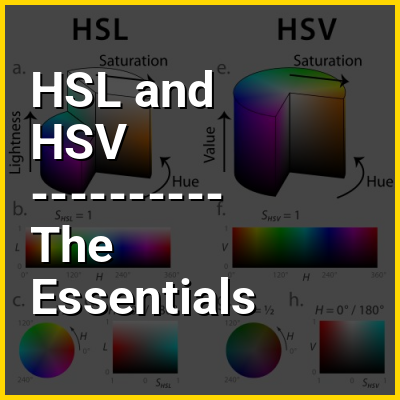
HSL and HSV are the two most common cylindrical-coordinate representations of points in an RGB color model. The two representations rearrange the geometry of RGB in an attempt to be more intuitive and perceptually relevant than the cartesian (cube) representation. Developed in the 1970s for computer graphics applications, HSL and HSV are used today in color pickers, in image editing software, and less commonly in image analysis and computer vision.

HSL stands for hue, saturation, and lightness, and is often also called HLS. HSV stands for hue, saturation, and value, and is also often called HSB (B for brightness). A third model, common in computer vision applications, is HSI, for hue, saturation, and intensity. However, while typically consistent, these definitions are not standardized, and any of these abbreviations might be used for any of these three or several other related cylindrical models. (For technical definitions of these terms, see below.)
↓ Menu

>>>PUT SHARE BUTTONS HERE<<<
In this Dossier

HSL and HSV in the context of Color

Color (or colour in Commonwealth English) is the visual perception produced by the activation of the different types of cone cells in the eye caused by light. Though color is not an inherent property of matter, color perception is related to an object's light absorption, emission, reflection and transmission. For most humans, visible wavelengths of light are the ones perceived in the visible light spectrum, with three types of cone cells (trichromacy). Other animals may have a different number of cone cell types or have eyes sensitive to different wavelengths, such as bees that can distinguish ultraviolet, and thus have a different color sensitivity range. Animal perception of color originates from different light wavelength or spectral sensitivity in cone cell types, which is then processed by the brain.

Colors have perceived properties such as hue, colorfulness, and lightness. Colors can also be additively mixed (mixing light) or subtractively mixed (mixing pigments). If one color is mixed in the right proportions, because of metamerism, they may look the same as another stimulus with a different reflection or emission spectrum. For convenience, colors can be organized in a color space, which when being abstracted as a mathematical color model can assign each region of color with a corresponding set of numbers. As such, color spaces are an essential tool for color reproduction in print, photography, computer monitors, and television. Some of the most well-known color models and color spaces are RGB, CMYK, HSL/HSV, CIE Lab, and YCbCr/YUV.

↑ Return to Menu

HSL and HSV in the context of Pastel (color)

Pastels or pastel colors belong to a pale family of colors, which, when described in the HSV color space, have high value and low or medium saturation. They are named after the artistic medium made from pigment and solid binding agents, similar to crayons. Pastel sticks historically had lower saturation than paints of the same pigment, hence the name of this color family.

The colors of this family are usually described as soothing, calming, and nostalgic. They tend to lean towards ideas of simplicity and help to contrast against the bolder and brighter colors that trend in our world. They are integrated into interior design in many places, such as healthcare to help soothe anxiety, or in classrooms to help the mind focus. Pastel colors work to oppose the brighter, bolder colors that tend to be common in many other places.

↑ Return to Menu