Gyrocompass in the context of "Elmer Ambrose Sperry"

Play Trivia Questions online!

or

Skip to study material about Gyrocompass in the context of "Elmer Ambrose Sperry"


⭐ Core Definition: Gyrocompass

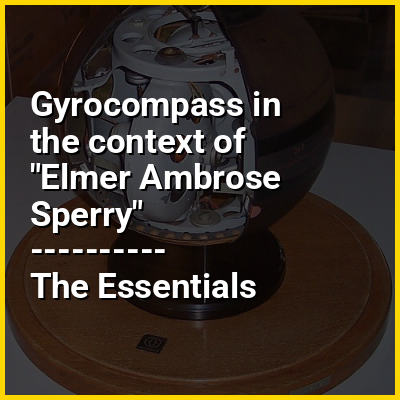
A gyrocompass is a type of non-magnetic compass which is based on a fast-spinning disc and the rotation of the Earth (or another planetary body if used elsewhere in the universe) to find geographical direction automatically. A gyrocompass makes use of one of the seven fundamental ways to determine the heading of a vehicle. A gyroscope is an essential component of a gyrocompass, but they are different devices; a gyrocompass is built to use the effect of gyroscopic precession, which is a distinctive aspect of the general gyroscopic effect. Gyrocompasses, such as the fibre optic gyrocompass are widely used to provide a heading for navigation on ships. This is because they have two significant advantages over magnetic compasses:

Aircraft commonly use gyroscopic instruments (but not a gyrocompass) for navigation and attitude monitoring; for details, see flight instruments (specifically the heading indicator) and gyroscopic autopilot.
↓ Menu

👉 Gyrocompass in the context of Elmer Ambrose Sperry

Elmer Ambrose Sperry Sr. (October 12, 1860 – June 16, 1930) was an American inventor and entrepreneur, most famous for construction, two years after Hermann Anschütz-Kaempfe, of the gyrocompass and as founder of the Sperry Gyroscope Company. He was known as the "father of modern navigation technology".

Sperry's compasses and stabilizers were adopted by the United States Navy and used in both world wars. He also worked closely with Japanese companies and the Japanese government and was honored after his death with a volume of reminiscences published in Japan.

↓ Explore More Topics
In this Dossier

Gyrocompass in the context of Hermann Anschütz-Kaempfe

Hermann Franz Joseph Hubertus Maria Anschütz-Kaempfe (3 October 1872 – 6 May 1931) was a German art historian and inventor. He was born in Zweibrücken and died in Munich.

In his quest to navigate to the North Pole by submarine, he became interested in the concept of the gyrocompass. In 1905 he founded, with Friedrich Treitschke, the company Anschütz & Co (today Anschütz GmbH) in Kiel, Germany. Anschütz was the first firm to manufacture gyroscopic navigation instruments, which Anschütz-Kaempfe designed. One of his staff was Maximilian Schuler, who made the fundamental discovery of Schuler tuning.

↑ Return to Menu

Gyrocompass in the context of Dynamic positioning

Dynamic positioning (DP) is a computer-controlled system to automatically maintain a vessel's position and heading by using its own propellers and thrusters. Position reference sensors, combined with wind sensors, motion sensors, and gyrocompasses, provide information to the computer pertaining to the vessel's position and the magnitude and direction of environmental forces affecting its position. Examples of vessel types that employ DP include ships and semi-submersible mobile offshore drilling units (MODU), oceanographic research vessels, cable layer ships, and cruise ships.

The computer program contains a mathematical model of the vessel that includes information pertaining to the wind and current drag of the vessel and the location of the thrusters. This knowledge, combined with the sensor information, allows the computer to calculate the required steering angle and thruster output for each thruster. This allows operations at sea where mooring or anchoring is not feasible due to deep water, congestion on the sea bottom (pipelines, templates), or other problems.

↑ Return to Menu