Gustaf V of Sweden in the context of Nils Edén


Gustaf V of Sweden in the context of Nils Edén

Gustaf V of Sweden Study page number 1 of 1

Play TriviaQuestions Online!

or

Skip to study material about Gustaf V of Sweden in the context of "Nils Edén"


⭐ Core Definition: Gustaf V of Sweden

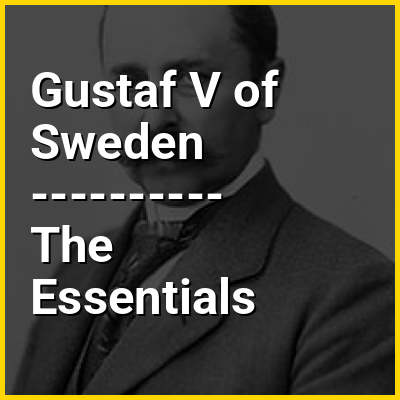
Gustaf V (Oscar Gustaf Adolf; 16 June 1858 – 29 October 1950) was King of Sweden from 8 December 1907 until his death in 1950. He was the eldest son of King Oscar II of Sweden and Sophia of Nassau, a half-sister of Adolphe, Grand Duke of Luxembourg. Reigning from the death of his father Oscar II in 1907 to his own death nearly 43 years later, he holds the record of being the oldest monarch of Sweden with the third-longest reign after Magnus IV (1319–1364) and his own great-grandson, Carl XVI Gustaf (1973–present). He was also the last Swedish monarch to exercise his royal prerogatives, which largely died with him, although they were formally abolished only with the remaking of the Swedish constitution in 1974. He was the first Swedish king since the High Middle Ages not to have a coronation and so never wore the king's crown, a practice that has continued ever since.

Gustaf's early reign saw the rise of parliamentary rule in Sweden although the leadup to World War I induced his dismissal of Liberal Prime Minister Karl Staaff in 1914, replacing him with his own figurehead, Hjalmar Hammarskjöld, the father of Dag Hammarskjöld, for most of the war. However, after the Liberals and Social Democrats secured a parliamentary majority under Staaff's successor, Nils Edén, he allowed Edén to form a new government which de facto stripped the monarchy of virtually all powers and enacted universal and equal suffrage, including for women, by 1919. Bowing to the principles of parliamentary democracy, he remained a popular figurehead for the remaining 31 years of his rule, although not completely without influence. Gustaf V had pro-German and anti-Communist stances which were outwardly expressed during World War I and the Russian Civil War. During World War II, he allegedly urged Per Albin Hansson's coalition government to accept requests from Nazi Germany for logistics support, arguing that refusing might provoke an invasion. His intervention remains controversial.
↓ Menu
HINT:

In this Dossier

Gustaf V of Sweden in the context of Constitutional monarchy

Constitutional monarchy, also known as limited monarchy, parliamentary monarchy or democratic monarchy, is a form of monarchy in which the monarch exercises their authority in accordance with a constitution and is not alone in making decisions. Constitutional monarchies differ from absolute monarchies (in which a monarch is the only decision-maker) in that they are bound to exercise powers and authorities within limits prescribed by an established legal framework. A constitutional monarch in a parliamentary democracy is a hereditary symbolic head of state (who may be an emperor, king or queen, prince or grand duke) who mainly performs representative and civic roles but does not exercise executive or policy-making power.

Constitutional monarchies range from countries such as Liechtenstein, Monaco, Morocco, Jordan, Kuwait, Bahrain and Bhutan, where the constitution grants substantial discretionary powers to the sovereign, to countries such as the United Kingdom and other Commonwealth realms, the Netherlands, Spain, Belgium, Denmark, Norway, Sweden, Lesotho, Malaysia, Thailand, Cambodia, and Japan, where the monarch retains significantly less, if any, personal discretion in the exercise of their authority. On the surface level, this distinction may be hard to establish, with numerous liberal democracies restraining monarchic power in practice rather than written law, e.g., the constitution of the United Kingdom, which affords the monarch substantial, if limited, legislative and executive powers.

View the full Wikipedia page for Constitutional monarchy
↑ Return to Menu

Gustaf V of Sweden in the context of Constitutional Monarchy

Constitutional monarchy, also known as limited monarchy, parliamentary monarchy or democratic monarchy, is a form of monarchy in which the monarch exercises their authority in accordance with a constitution and is not alone in making decisions. Constitutional monarchies differ from absolute monarchies (in which a monarch is the only decision-maker) in that they are bound to exercise powers and authorities within limits prescribed by an established legal framework. The monarch is frequently perceived as a visible symbol of national unity.

The powers of constitutional monarchs vary. In some countries, the monarch has virtually no executive or policy-making power and is primarily a hereditary symbolic head of state (who may be an emperor, king or queen, prince or grand duke), while in other countries, the monarch has meaningful formal powers (such as veto power, appointment power, and power to dissolve parliament). In countries such as Liechtenstein, Monaco, Morocco, Jordan, Kuwait, Bahrain and Bhutan, the constitution grants substantial discretionary powers to the sovereign, while in United Kingdom and other Commonwealth realms, the Netherlands, Spain, Belgium, Denmark, Norway, Sweden, Lesotho, Malaysia, Thailand, Cambodia, and Japan, the monarch retains significantly less power, if any, personal discretion in the exercise of their authority. While many constitutional monarchies are democratic, some are not.

View the full Wikipedia page for Constitutional Monarchy
↑ Return to Menu